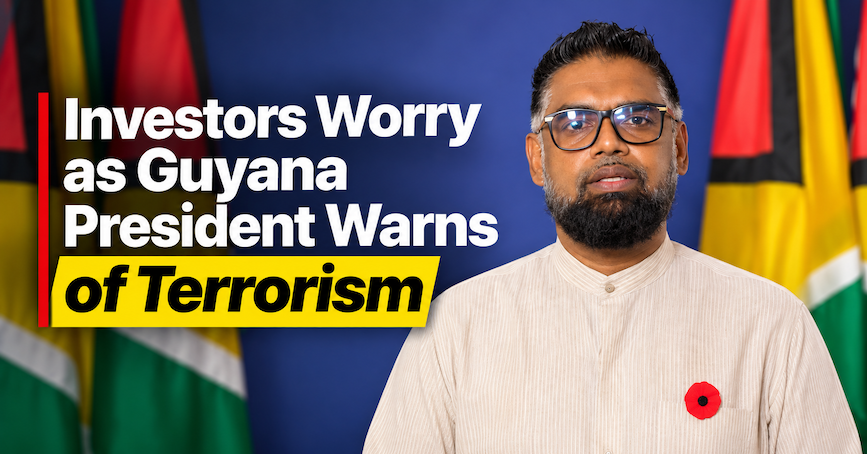
Guyana is a small country with small roads and very few alternate paths to the airports. Investors already nervous about civil strife have found themselves confronted with the very real threat of terrorism as described by Guyana’s President Irfaan Ali.
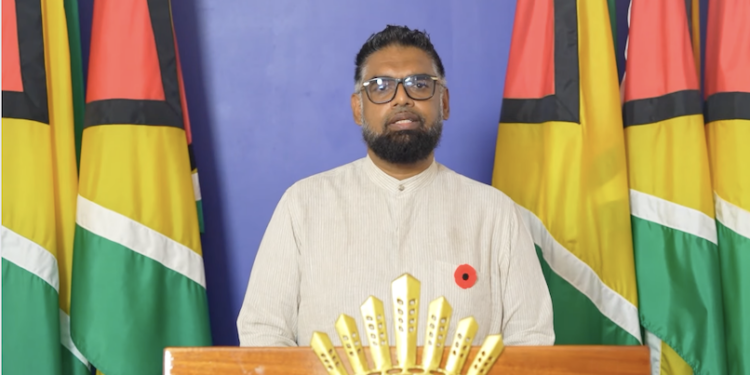
In a nationally televised address this week, Ali referenced a criminal organization called “Tren de Aragua”, which he described as a “terrorist-designated criminal organization operating out of Venezuela”, and warned of intelligence concerning the possible movement of its senior members. He also cited “incendiary statements” circulating on social media, alleged links between those statements and “planned criminal activities,” and what he called a “centrally coordinated conspiracy” intended to “harm or intimidate individuals, destroy or damage public and private property, disrupt essential services and economic activity, and create disorder.”
The President pointed to the November 10 alleged attack on a Guyana Power and Light substation at Good Hope, where two individuals were captured on CCTV throwing Molotov cocktails at the facility. No damage was reported. He said investigations are underway to establish whether the attack was planned or coordinated, and warned that perpetrators, including “intellectual authors”, would face the “fullness of the law,” with potential charges under Section 309A of the Criminal Law (Offences) Act, including terrorism-related provisions. Members of the public are skeptical about these claims by the government.
For investors, the timing is uncomfortable. Guyana’s economy has been transformed by offshore oil production, drawing international firms and capital at an unprecedented pace. But the country’s geography offers little margin for error: a handful of main roads connect the coast to the airports, and any disruption to transport, power, or public order could quickly ripple through supply chains and operations.
“The rhetoric alone is a risk factor,” said one Georgetown, based businessman, speaking on condition of anonymity. “When a head of state invokes terrorism and names organizations, investors start asking about insurance, evacuation plans, and whether their staff are safe. Perception matters as much as reality.”
Others questioned the substance behind the warnings. “No one believes a firebomb at an empty transformer is terrorism,” a Georgetown resident said. “This looks like an attempt to curtail dissent, not a genuine security emergency.” Critics have also pointed to the President’s own history of aggressive protest while in opposition, and to past incidents involving governing-party supporters, including the looting and burning of vehicles and a school bus.
The government insists the threat is credible and that security agencies, in collaboration with international partners, are taking coordinated action. “Every credible threat will be investigated,” Ali said, adding that Guyana “will not be allowed to become a haven for organized criminal networks.”
Still, the address has left investors weighing familiar questions in unfamiliar territory: whether the country’s institutions can separate security from politics, and whether the rule of law will be applied evenly. For now, the watchword among the business community is caution, and a quiet hope that the roads to the airports stay open.