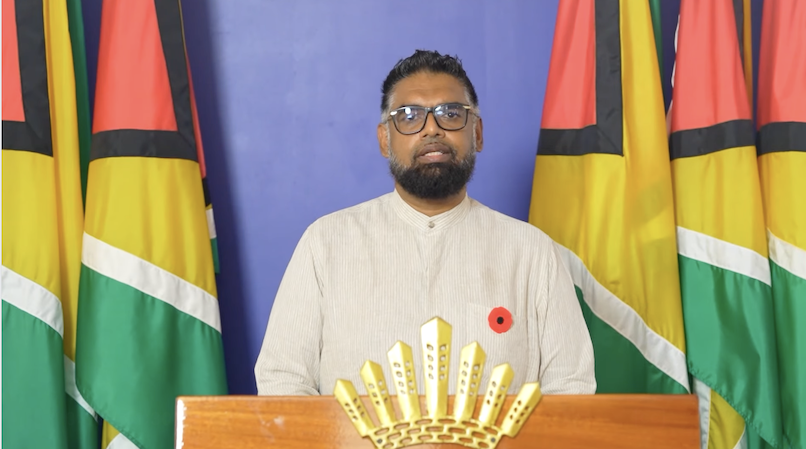
GEORGETOWN, Guyana — President Irfaan Ali on Wednesday delivered a nationally televised address warning of what he described as “serious national security developments,” citing incendiary social media statements, intelligence on possible organized criminal activity, and a deliberate attack on a Guyana Power and Light substation at Good Hope.
In the address, the President said law enforcement agencies “will act decisively to protect citizens, preserve public order, safeguard critical national infrastructure, and uphold the rule of law.” He warned that those who “plan, direct, finance, incite, assist, or execute criminal acts will be held accountable,” noting potential charges under Section 309A of the Criminal Law (Offences) Act, including terrorism-related provisions.
The President also referenced the November 10 attack on the Good Hope substation, in which two individuals were captured on CCTV throwing Molotov cocktails at the facility. No damage was reported. He said investigations are underway to determine whether the attack was coordinated and whether other facilities were targeted.
While acknowledging citizens’ constitutional right to “express their views and engage in lawful and peaceful” activity, the President said those rights “do not extend to violence, intimidation, destruction of property, or criminal incitement.”
Citizens Push Back
The address drew sharp criticism from citizens who viewed it as an attempt to curtail dissent. Speaking on condition of anonymity, several residents told this newspaper they reject the framing of recent events as terrorism and see the government’s posture as repressive.
“This is not about security, it’s about silencing people who disagree,” one Georgetown resident said. “No one believes a firebomb at an empty transformer is terrorism. They are using fear to justify control.”
Others pointed to the remand of the opposition leader, describing it as political repression rather than a matter of law. “The threats against democracy must not stand,” another citizen said. “What we are watching is a slide into authoritarianism, and Guyanese must not accept it.”
Critics have also noted what they call a double standard, pointing to the President’s own history of aggressive protest while in opposition, and to past incidents involving supporters of the governing party, including the looting and burning of vehicles and a school bus, and the shouting down of then-President David Granger.
The government has defended the address as a necessary response to credible threats, insisting that national security arrangements remain strong and that cooperation with international partners is at an “extraordinary level.” The President urged citizens to “remain responsible, vigilant, peaceful, patriotic, and nationalistic,” and to cooperate with law enforcement.
Opposition figures and civil society groups are expected to respond further in the coming days, with calls growing for clarity on the legal basis for the government’s warnings and for assurances that dissent will remain protected.