After months of unreliable electricity, prolonged blackouts and water disruptions, residents of Linden had to take to the streets before the government announced an intervention to protect the town’s water supply from the consequences of the failing electricity service.
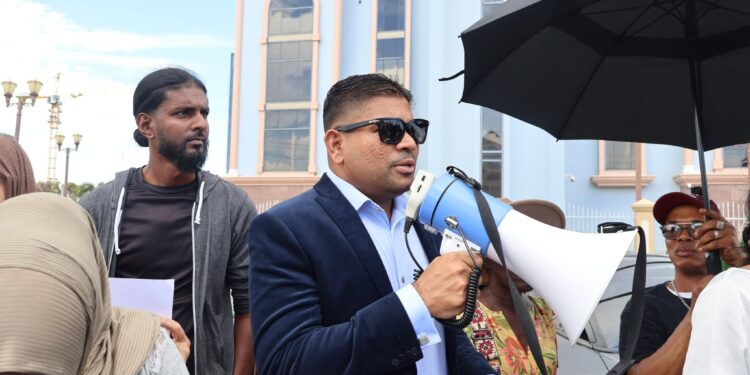
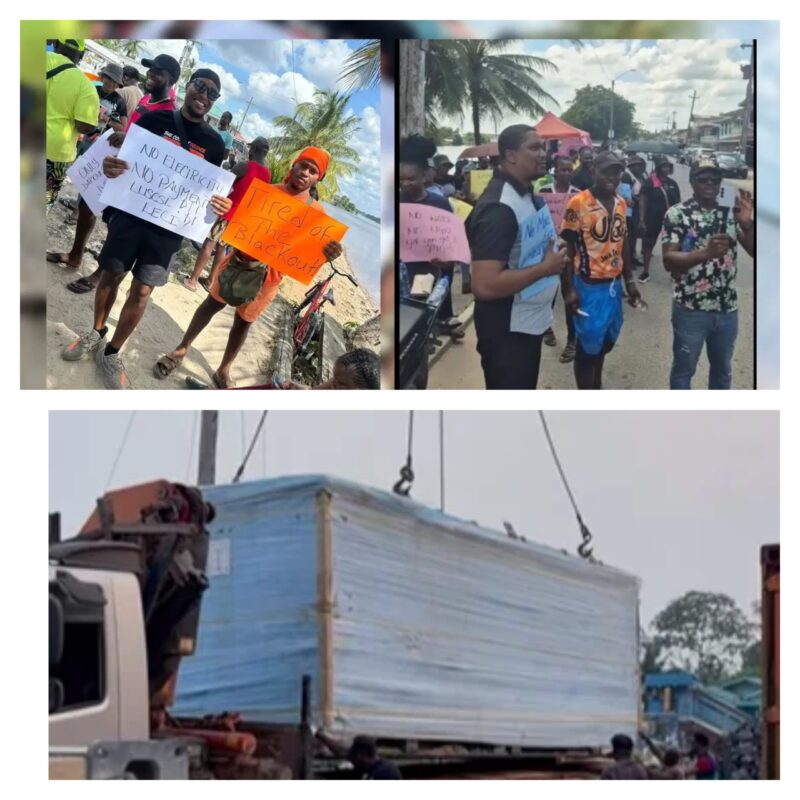
On Monday, November 2, residents staged a protest outside the Linden Utility Services Co-operative Society Limited (LUSCSL), demanding an end to the persistent power interruptions that have disrupted households, businesses, schools and access to potable water.
By Tuesday night, the Ministry of Public Utilities announced that a 750-kilovolt-ampere (kVA) backup generator had been installed at the West Watooka Water Treatment Plant, replacing the existing unit and strengthening the facility’s ability to continue operating during electricity outages.
The timing of the announcement was striking. Residents had been enduring the consequences of the electricity crisis for months, yet the generator intervention came only after public frustration spilled onto the streets.
The new generator may help prevent another interruption to water production at West Watooka, but it does not address the central grievance driving the protests: Lindeners cannot depend on a consistent electricity supply.
During Monday’s demonstration, protesters carried placards and chanted, “No water, no light, all-you will get it right.” Demerara Waves reported that residents in parts of the town had experienced more than 30 hours without electricity.
The consequences extended beyond household inconvenience. Residents reported damaged appliances, spoiled food and disruptions to small businesses. Some boat operators and route taxi services halted operations, while many parents kept their children home from school.
One protester, describing the daily uncertainty, said:
“This is sickening, every day is blackout and when the light go, the water going, no water, no light, by the time the light come on, it coming off, yuh can’t catch ya self and this heat is ordinary, we tired, we tired.”
The protest was not simply about the absence of electricity. It was about the failure of two essential services to function reliably and the burden being placed on residents to cope with repeated disruptions.
Government responds after public pressure
The Ministry said the decision to replace the West Watooka generator followed Tuesday’s engagement with regional officials and the electricity service providers operating in Linden.
Public Utilities Minister Deodat Indar reportedly instructed his Director-General, Alfonso De Armas, to oversee the deployment. GWI Executive Director of Projects Marlon Daniels and Director of Operations Jawaharlal Ramjug were also involved in coordinating the replacement and technical support.
The ministry further said that Indar had directed that all water treatment plants across Linden be equipped with backup power systems to reduce the impact of electricity interruptions on water production and distribution.
The meeting included Region Ten Regional Executive Officer Dr Gregory Harris, as well as representatives of the Linden Electricity Company Incorporated (LECI), which serves Mackenzie, and LUSCSL, which serves Wismar.
In a statement, the ministry said:
“The Ministry’s priority remained clear — to safeguard essential water services for Linden residents through coordinated interventions, while the respective electricity service providers addressed the ongoing power supply challenges.”
That commitment, however, leaves a larger question unanswered: when will the electricity providers and government deliver a permanent solution so that residents are not forced to depend on emergency arrangements to access basic services?
A crisis rooted in inadequate capacity and infrastructure
The latest protest is part of a wider dispute over whether Linden’s electricity generation and distribution systems can meet the town’s growing demand.
In August, LECI acknowledged that its maximum available generation capacity stood at approximately 14.5 megawatts, while peak demand had exceeded 15 megawatts. The company attributed the shortfall to increased electricity consumption, unusually high temperatures and expanding residential and commercial activity.
The growing number of sawmills operating in the area has also intensified questions about the pressure placed on the electricity network, particularly given Linden’s subsidised electricity rates.
During Monday’s protest, APNU parliamentarian and former Linden mayor Sharma Solomon argued that the problem extended beyond generating capacity to the ageing transmission and distribution infrastructure.
Solomon said the government needed to stop relying on short-term interventions and invest in a long-term energy solution.
He called for a 100-megawatt generation system, together with a comprehensive upgrade of the town’s electricity transmission and distribution network. He argued that the proposed capacity would accommodate housing expansion, infrastructure development and growing commercial and industrial activity.
Solomon also questioned the adequacy of the government’s broader energy planning, pointing to the need for generation capacity that reflects Linden’s present requirements and future development.
His proposal underscores the central issue confronting the town: additional electricity generation alone will not guarantee reliability if the network responsible for transmitting and distributing that power remains inadequate.
Relief is not the same as a solution
The 750-kVA generator at West Watooka is a necessary intervention, particularly for residents who have experienced water disruptions whenever electricity fails. The proposed backup systems at other treatment plants could provide further protection.
But the installation does not restore electricity to homes, businesses and schools, nor does it resolve the generation and distribution problems that have triggered repeated outages.
The government must now explain what concrete measures will be taken to stabilise electricity supply, how soon additional capacity will become available and whether the existing network can support Linden’s expanding residential and commercial needs.
For residents, the sequence of events is telling. They endured prolonged blackouts and water shortages, took to the streets to demand action, and only then saw a government announcement addressing one consequence of the crisis.
Lindeners should not have to protest to secure the reliable electricity and water services that are essential to their daily lives.