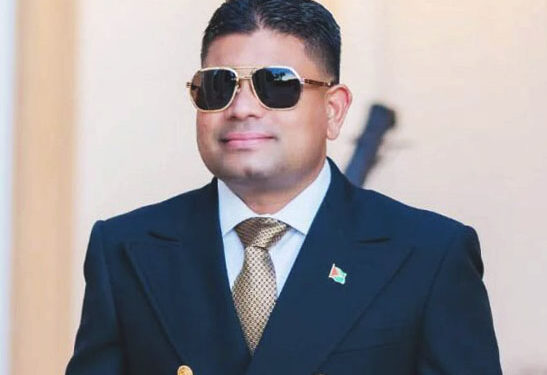
The remand of the Opposition Leader over leaked CCTV footage puts the state’s even-handedness on trial alongside the accused. On Friday 30 October, a magistrate at Sparendaam denied bail to Opposition Leader Azruddin Mohamed and Police Constable Ryan Greene, remanding both until November 24 on a charge under Section 9(2)(b) of the Cybercrime Act. Police allege that the constable took surveillance footage from the Command Centre, copied it to a flash drive and gave it to Mr. Mohamed.
They further allege that he was paid G$800,000. The recordings concern the October 12 gunfire outside the Kitty home of Special Branch head Prem Narine. The magistrate cited fears that the two men could commit another offence if released. Mohamed maintains that the footage shows an attempt on his life. None of the allegations has been proven in court.
Our concern is not whether the law may be enforced, but whether it is being enforced in proportion, and with equal zeal.
Consider first what the remand says to the rest of us. The footage was released to challenge the police version of a disputed shooting. When the person who airs such material is jailed, every journalist, whistle-blower and ordinary citizen takes note. Reporters Without Borders warned, while this very law was being drafted, that it could have a “serious chilling effect on press freedom in Guyana” if turned against reporting built on confidential sources. That warning is eight years old, yet it reads as current.
According to CIVICUS Monitor, which cited the RSF index (RSF: Stands for Reporters Sans Frontières (Reporters Without Borders), our press freedom ranking fell 17 places in 2024. Earlier this year, the Region Three Chamber of Commerce reminded the government that it had publicly assured the nation that cybercrime reforms were “not intended to suppress freedom of the press and freedom of expression.” Those assurances are now being tested.
Then there is the pattern. This was at least the fourth arrest of Mohamed since early September. In the same period, two vehicles assigned to his office were impounded for more than two weeks, only days after the Attorney General cautioned police against such action over minor offences.
None of this proves a design. But when the leader of a party that won nearly a quarter of parliamentary seats in its first election is repeatedly detained, and then held without bail, citizens are entitled to ask whether the machinery of state is being turned on a rival. A voter who backed that party has a stake in the answer.
Proportion matters as much as pattern. Attorney General Anil Nandlall has declared that “those whom the law calls upon to account will be held to account.” That promise must be universal. Transparency International has observed that, while Guyana has anti-corruption laws and institutions, enforcement remains weak and attacks on dissenting voices are growing.
Stories published by Village Voice News noted that Auditor General reports repeatedly flag irregularities, yet prosecutions are rare. The ordinary taxpayer may fairly wonder why a footage case can produce a prison remand within days, while questions about public money can wait years for an answer.
The government rejects this reading. President Irfaan Ali has insisted that the rule of law must apply equally to everyone, and has denied that his administration targets the Mohameds. Officials also point out that the High Court dismissed an earlier claim by the Mohameds that the government was biased. The courts will now test the evidence, and the defence is already seeking bail in the High Court. Our judiciary deserves the space to do that work without a rush to verdict from either camp.
What our nation needs now is plain. The prosecution should be transparent and the charge justified in open court. Bail should be decided on law rather than on political temperature. Above all, the state must show the same urgency in pursuing corruption allegations, wherever they point, as it has shown here. A democracy is not measured by whom it is able to jail, but by whether it applies the same standard to the powerful and the powerless, to government and opposition alike.