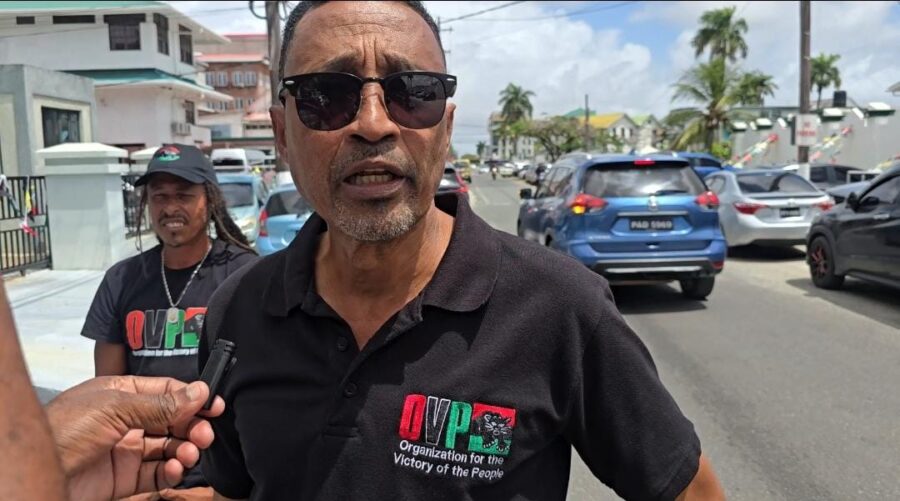
The Organisation for the Victory of the People (OVP) has condemned Guyana’s decision to abstain from a United Nations resolution calling for an end to the United States’ economic blockade against Cuba, describing the move as a betrayal of a longstanding ally and a departure from Guyana’s anti-imperialist legacy.
Speaking on behalf of the organisation, Gerald A. Perreira, in an October 29 statement, described Guyana’s abstention during the October 28 vote as an act of “cowardice”, particularly given Cuba’s decades of assistance to Guyana.
He also condemned Trinidad and Tobago’s vote against the resolution, arguing that both positions undermined the effort to end the blockade. Perreira criticised Prime Ministers Kamla Persad-Bissessar of Trinidad and Tobago, Andrew Holness of Jamaica and Haiti’s Alix Didier Fils-Aimé, as well as representatives of Antigua and Barbuda, Dominica and Saint Lucia, who left the General Assembly Hall during the vote.
“Both actions – abstention or a vote against – were of course the same in terms of outcome.”
The OVP said Guyana’s position was especially troubling given the legacy of the People’s Progressive Party’s founder, Dr Cheddi Jagan, whom Perreira described as an internationally recognised anti-imperialist and freedom fighter.
He recalled Cuba’s longstanding assistance to Guyana, including support extended to Jagan during his tenure as Premier between 1961 and 1964, years before Cuban medical brigades arrived in 1978.
“The PPP government betrayed Cuba, a country that stood by us for decades, providing so much in terms of medical and other forms of assistance.”
The organisation said the abstention represented a break with the founding principles of both the PPP and the Caribbean Community (CARICOM). Perreira maintained that the Ali administration and other Caribbean governments had aligned themselves with US policy at the expense of regional sovereignty.
He described the so-called “Donroe Doctrine” as an attempt to treat the Caribbean as Washington’s “backyard” and reduce regional countries to proxies and vassal states.
Rejecting the argument that Guyana’s proximity to the United States leaves it with no choice but to accommodate Washington, Perreira said the OVP would not accept what he characterised as the inevitability of regional subordination.
“Like our great ancestors, Kofi (Cuffy), Atta, and Accabre, and all those who fought alongside them, Organization for the Victory of the People (OVP) will never accept this fate. We do not agree with those who say that our enslavement is inevitable.”
The statement also highlighted the humanitarian impact of the blockade, pointing to shortages of electricity, fuel, food, water and medical supplies in Cuba. Perreira said hospitals were struggling to maintain essential services, while critical treatments, including dialysis and chemotherapy, were being affected by shortages.
He argued that the hardships endured by Cuban families were the consequence of more than six decades of US pressure since the 1959 Cuban Revolution.
Perreira also recalled the October 6, 1976 bombing of Cubana de Aviación Flight 455, which was travelling from Guyana to Cuba via Barbados. All 73 people aboard, including 11 Guyanese, were killed. He cited the bombing as an example of the violence Cuba has endured, arguing that its refusal to submit to US influence was at the heart of its continued persecution.
The OVP said Guyana’s abstention had compromised the country’s historical commitment to sovereignty and solidarity with nations resisting foreign domination.
“October 28th was a sad and embarrassing day for the peoples of Guyana and the seven Caribbean nations who broke ranks with Caricom, turning on their own and capitulating to Trumpism. History will not absolve them.”
The UN General Assembly has repeatedly adopted resolutions calling for an end to the US embargo against Cuba. While not legally binding, the votes have consistently reflected broad international opposition to the decades-old policy.
The OVP’s statement places renewed focus on divisions within CARICOM over the Cuba question and the implications of Guyana’s decision to abstain.