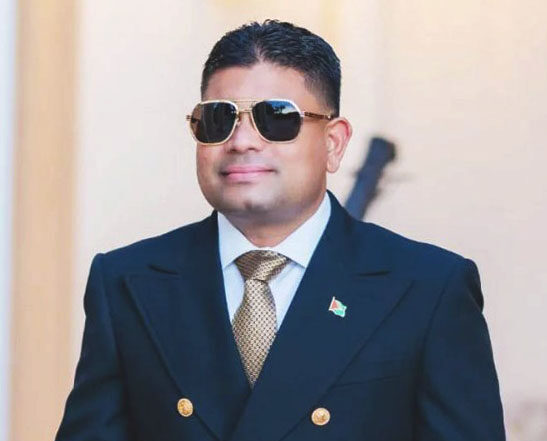
Guyana must confront the dangerous precedent being established when its elected Opposition Leader is arrested and detained under circumstances that raise serious questions about constitutional rights, state power and the protection of democracy.
This is not simply a personal feud between President Irfaan Ali and Opposition Leader Azruddin Mohamed. It is about whether the office of the Leader of the Opposition will be respected as a vital institution of parliamentary democracy or treated as an inconvenience by those in government.
The deafening silence from sections of society is particularly troubling. Some may see this as a clash between two powerful personalities. Others may have little sympathy for Mohamed or disagree with his politics. But personal feelings must not obscure the fundamental issue: an individual’s rights do not disappear because he is politically unpopular, and the constitutional significance of the office he occupies cannot be dismissed because of who holds it.
Democracy cannot function on the basis of selective outrage. Constitutional rights are not privileges reserved for those who enjoy public approval or political favour.
Mohamed is not merely a private citizen. He is the elected Leader of the Opposition, an office central to Guyana’s parliamentary system. He has a responsibility to scrutinise government, challenge executive decisions and represent citizens who did not vote for the governing party.
His ability to travel throughout Guyana, meet citizens, engage supporters and discharge his parliamentary responsibilities must not be treated as a favour granted by the President or the police. Freedom of movement and political participation are fundamental rights, subject only to lawful restrictions.
The state must not create the impression that the Opposition Leader’s movements or political activities can be curtailed at the convenience of those in power.
If there are allegations against Mohamed, let the police investigate. If evidence exists, let the prosecution proceed through the courts. Nobody is above the law, including the Opposition Leader. But neither is he beneath it. Allegations must be tested, evidence produced and due process respected.
Arrest is not conviction, and detention must never become a substitute for justice or an instrument of political intimidation.
The issue is not whether Mohamed should be held accountable if he has broken the law. He should. The question is whether state power is being exercised consistently with constitutional safeguards, equal treatment and the rule of law.
A government exercising authority over state institutions has a heightened responsibility to demonstrate restraint. Its conduct must not undermine public confidence in the independence and impartiality of law enforcement.
The consequences extend beyond one individual. When an Opposition Leader is detained under circumstances that raise concerns about political interference, the entire opposition is affected. So are the citizens who depend on that office for representation. The parliamentary system is weakened when the person elected to hold government accountable cannot freely discharge that responsibility.
There is also a dangerous precedent in normalising the idea that political disagreements can be managed through police action rather than democratic engagement. Guyana has a history of contested relationships between political power, state institutions and citizens. The country should be vigilant against anything that revives fears of political intimidation and institutional abuse.
Where are the voices of civil society, religious leaders, trade unions, professional organisations and other influential institutions? Their responsibility is not to defend Mohamed personally or endorse his politics. It is to defend the principles that protect every Guyanese, regardless of political affiliation.
Those dismissing this as a feud between Ali and Mohamed must consider the consequences of remaining silent. If the state can treat the office of the Opposition Leader in a manner that raises serious democratic concerns today, what protection will remain for the next person who occupies it?
The test of democracy is not how government treats its supporters. It is how it treats those who challenge its authority. An opposition leader must be able to criticise, organise, mobilise and travel without fear that exercising those democratic functions will invite retaliation.
President Ali must understand that he is not the owner of Guyana, and the Opposition Leader is not a subject whose movements require presidential approval. Both occupy public offices with distinct responsibilities. Neither should be reduced to a personal contest between its occupant and the other.
Guyanese must recognise that silence is a dangerous bargain. Today it may be Mohamed. Tomorrow it could be another opposition figure, a trade unionist, journalist, activist or ordinary citizen challenging those in authority.
Democracy is not destroyed only through coups or suspended elections. It can be eroded gradually through intimidation, weakened institutions, excessive state power and a public willing to look away.
This is bigger than Azruddin Mohamed. It is bigger than Irfaan Ali. It is about whether Guyana will remain a country where political power is restrained by law, constitutional rights are protected and elected representatives can perform their duties without intimidation.
The office of the Leader of the Opposition belongs to Guyana’s democratic system, not merely to the individual occupying it. An attack on its ability to function is an attack on the democratic rights of every Guyanese.
The country must find its voice before silence becomes complicity.