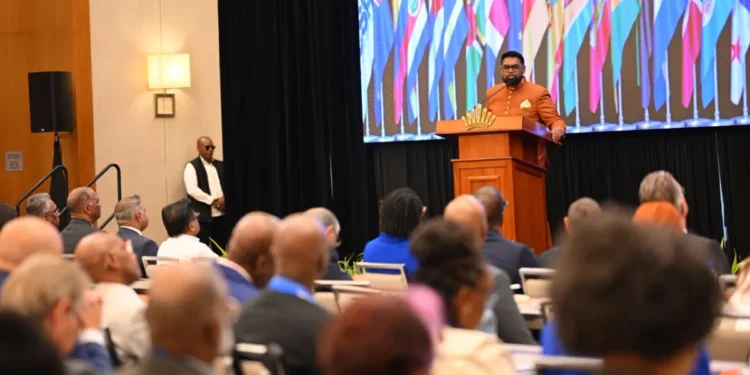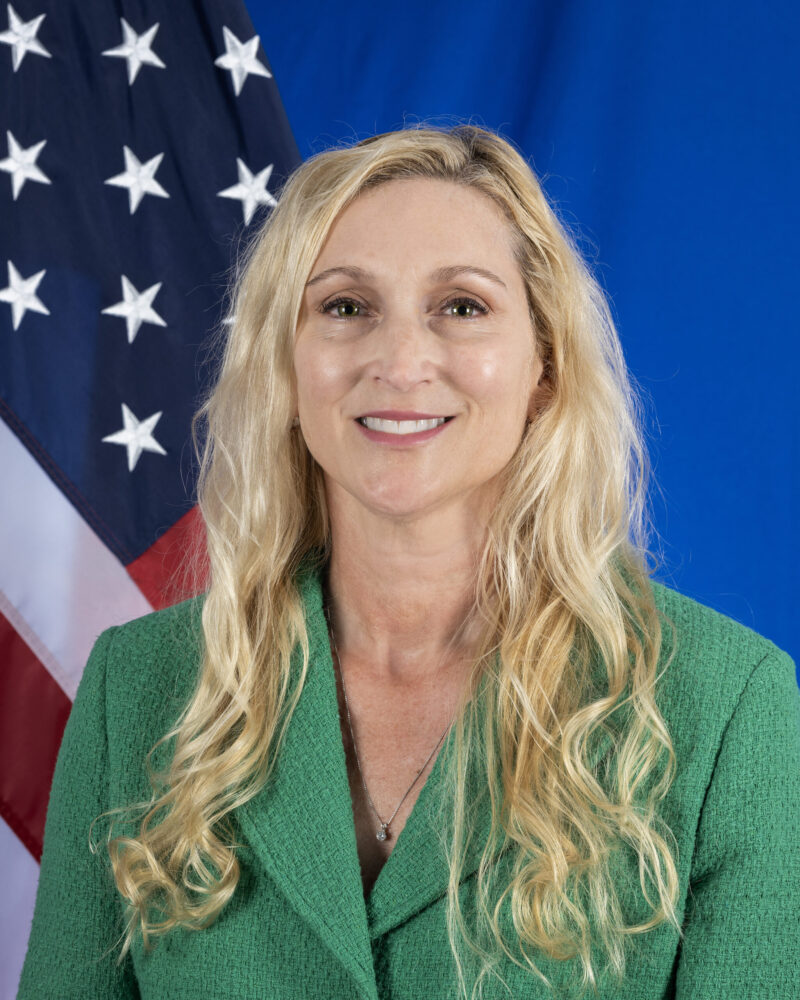
United States Ambassador to Guyana Nicole Theriot has insisted that Washington’s relationship with Georgetown is an equal partnership, but her assertion of a “50/50” dynamic raises a fundamental question: can two countries with vastly unequal military, economic and geopolitical power genuinely negotiate as equals?
Theriot dismissed suggestions that the United States dominates Guyana’s relationship with Washington, following the signing last week of a Joint Declaration for an Enhanced Defence Partnership designed to strengthen military cooperation and Guyana’s defence capabilities.
“It is a partnership – 50/50 absolutely. There is no dominance. It is very, very much a partnership,” Theriot told reporters.
“We feel like we benefit from our relationship with Guyana, hopefully, as much as they benefit from us. It’s a true partnership in every sense of the word,” she added.
However, declarations of mutual respect do not, by themselves, establish equality. The balance of power between the two countries tells a more complicated story, particularly when military security, strategic interests and regional influence are involved.
The United States is a global superpower with enormous military capabilities, economic influence and the capacity to shape international security arrangements.
Guyana, despite its rapidly expanding oil economy and growing strategic importance, remains a small developing state whose defence capabilities are substantially more limited.
That imbalance matters because a partnership is not measured only by what both parties say they gain. It must also be assessed by who sets the agenda, who determines the terms of cooperation, whose strategic interests take priority and whether both sides possess the practical ability to refuse proposals without facing significant consequences.
Security cooperation or strategic dependence?
The declaration provides for sustained US defence expertise, multi-domain training and joint military exercises with the Guyana Defence Force (GDF), alongside efforts to modernise Guyana’s defence infrastructure.
Theriot, who said she assisted in drafting the agreement- an agreement the Guyanese people are yet to see-described security cooperation as a critical component of bilateral relations.
Such cooperation could strengthen the GDF’s operational capabilities, improve training and support Guyana’s efforts to protect its territorial integrity, particularly amid regional security concerns. But those potential benefits do not eliminate questions about the long-term implications of deeper military alignment with a superpower.
The central issue is whether Guyana is strengthening its independent capacity to make security decisions or becoming increasingly dependent on Washington’s expertise, resources and strategic priorities.
Military training and joint exercises can improve national defence, but they can also deepen institutional relationships and create expectations of strategic alignment. Where one partner possesses overwhelmingly greater resources, the smaller state may find that its room for manoeuvre narrows, even without an explicit demand to comply.
Who holds the leverage?
The language of equal partnership becomes especially difficult to sustain when one country has considerably greater capacity to influence the international environment in which the other operates.
Guyana may have valuable oil resources, geographic importance and strategic assets, but these do not automatically translate into equivalent diplomatic or military leverage. Nor does economic growth necessarily insulate a small state from pressure exerted by a dominant international power.
The concern is not that cooperation with the United States is inherently undesirable. Rather, it is whether Georgetown can consistently defend its own interests when they diverge from Washington’s priorities.
A credible test of equality is whether Guyana can disagree, reject a proposal or pursue an independent diplomatic position without fearing political, economic or security repercussions.
The government must therefore explain what safeguards exist to protect Guyana’s decision-making authority under the enhanced defence arrangement, including the limits of US involvement, the obligations assumed by Georgetown and the mechanisms for resolving disagreements.
The public also deserves clarity on whether the declaration creates commitments beyond training and cooperation, and how those commitments will be governed.
Ultimately, Theriot’s “50/50” description is a diplomatic assertion, not proof of equal power.
For Guyana, the challenge is to benefit from cooperation with a superpower without surrendering the independence that sovereignty is supposed to guarantee. A partnership can offer substantial advantages while remaining unequal in practice.
The question is whether Guyana is negotiating with Washington from a position of meaningful strategic choice—or whether the language of partnership risks obscuring a relationship in which the stronger power possesses considerably more influence over the outcome.