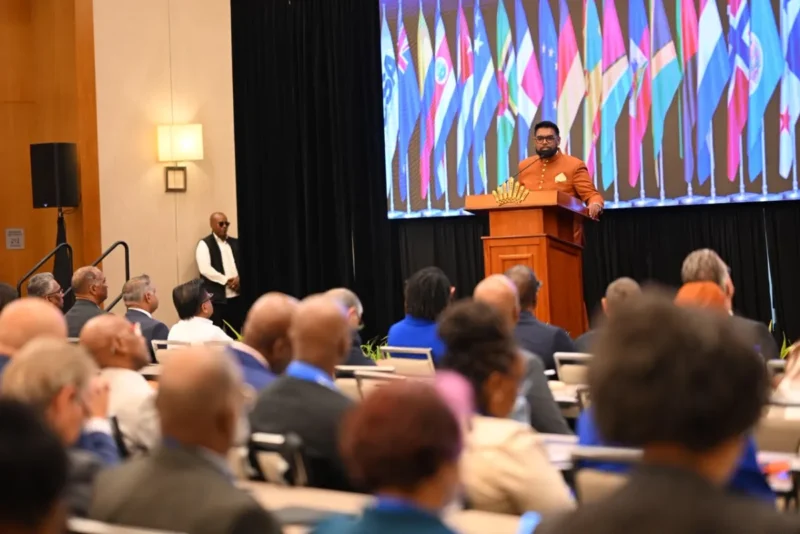
President Irfaan Ali has called for an urgent regional investment plan to modernise Caribbean ports, but his appeal comes as Guyana continues to confront shipping costs, port congestion and infrastructure limitations that businesses say are feeding into the price of imported goods.
Addressing the opening of the Caribbean Shipping Association’s 56th Annual General Meeting, Conference and Exhibition at the Guyana Marriott Hotel on Monday, Ali urged the shipping industry to develop a policy document backed by the Caribbean Development Bank, the Inter-American Development Bank (IDB) and IDB Invest.
The plan, he said, should identify fiscal incentives, banking support and public-private partnership models capable of attracting capital into port infrastructure.
“We need to come up with a plan that allows private capital to merge with a public good,” Ali said.
However, Guyana’s own shipping difficulties underline the urgency of turning such proposals into measurable improvements rather than another regional policy exercise.
In April, the Shipping Association of Guyana reported that congestion at major Caribbean transshipment hubs had disrupted container movements to Guyana, delaying cargo and extending vessel turnaround times. Industry stakeholders have also raised concerns about port congestion, demurrage charges, document-processing delays and rising freight rates.
The consequences reach beyond shipping companies. Importers face additional costs when cargo is delayed, while businesses must manage uncertainty over delivery schedules and inventory. Those costs can ultimately be passed on to consumers.
Ali acknowledged the wider regional problem, citing a May 2026 International Monetary Fund working paper which found that Caribbean countries generally pay above-average shipping costs.
“Ultimately, high shipping costs become a cost-of-living problem for our people and a competitiveness problem for our businesses,” he said.
Ports lag behind economic demands
Ali said a 2018 IDB study found that most Caribbean ports were at least 50 years old, arguing that investment had failed to keep pace with the demands of modern trade.
“If we look at budgets across the region, you will see that this is not a priority at the moment,” he said.
The issue is particularly significant for Guyana, where expanding oil production and economic activity are increasing demands on transport and logistics infrastructure.
In June, Public Utilities and Aviation Minister Deodat Indar said vessel traffic had increased by 42 per cent since 2020, while containerised imports had risen from about 42,000 twenty-foot equivalent units annually to nearly 150,000. He warned that shipping costs were placing pressure on importers, businesses and households.
The government has promoted private investment in shore bases and port facilities along the Demerara River, which Ali said amounted to close to or more than US$1 billion over four to five years. He also cited plans for a deepwater port, with discussions involving Bechtel and potential financing partners.
Yet major projects remain subject to financing, feasibility and implementation hurdles. Recent reporting indicates that Chevron declined to continue funding preliminary engineering and design work for the proposed Berbice deepwater port after acquiring Hess, leaving further development dependent on other arrangements.
Ali urged the industry to take a more aggressive approach to attracting partners and opening markets, while questioning whether development financiers had been adequately involved in the conference.
“Are we speaking to ourselves or are we speaking to a system that can help each other?” he asked.
The four-day conference, held under the theme “Building a More Connected, Resilient, and Competitive Caribbean”, runs until October 28.
The central test for Guyana and the wider region will be whether the proposed investment framework delivers more reliable shipping, modern port facilities and lower logistics costs—or whether businesses and consumers continue paying for infrastructure gaps that policymakers have long acknowledged.