As paddy prices recover, questions emerge over conflicting production figures, billions in government support and the search for export markets that can sustain Guyana’s growing rice industry.
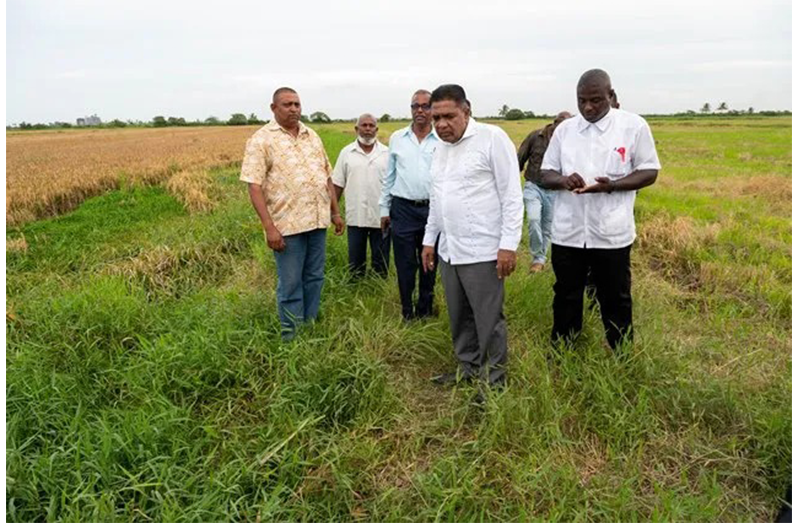
GEORGETOWN, GUYANA, October 26, 2026 — Agriculture Minister Zulfikar Mustapha brought encouraging news to rice farmers at Big Biaboo, Region Five, on Sunday, announcing that paddy prices had increased to G$3,500 per bag and expressing optimism that prices could climb further.
For farmers who have spent much of the past two years struggling with low prices, increasing production expenses and uncertainty over overseas buyers, the announcement offers some relief. But a closer examination of Guyana’s rice industry raises questions about how much farmers are actually earning, whether growing production is being matched by reliable markets, and how long the sector can depend on government assistance.
The minister attributed the price improvement to international market conditions and announced that Guyana was pursuing additional export opportunities, including a possible return to the Venezuelan market and agricultural trade discussions involving Kenya.
There was, however, no announcement of a signed agreement, guaranteed purchase volumes or a timetable for shipments to either country.
And while G$3,500 represents an improvement over some of the lower prices reported during the past year, it is worth remembering that in March 2025, the government announced that negotiations with millers had secured a minimum price of G$4,000 per 143-pound bag of paddy.
That arrangement did not prevent subsequent difficulties. In September 2025, Stabroek News reported that farmers in Region Two were being offered as little as G$2,300 per bag, while some complained about lengthy waits to deliver their harvests to mills.
The prices relate to different crop periods and may reflect differences in quality and purchasing arrangements, but they illustrate the volatility confronting farmers.
The latest announcement did not establish whether G$3,500 is a national average, a price offered by particular mills, or the amount farmers can expect after grading and quality deductions.
That distinction is important because what a miller offers and what a farmer eventually receives can be different amounts.
Production is growing, but the figures need clarification
Guyana’s rice industry has expanded considerably in recent years, supported by improved seed varieties, agricultural infrastructure and government assistance.
Mustapha told farmers that national rice production had already exceeded 830,000 tonnes in 2026, compared with what he described as just under 500,000 tonnes in 2020.
However, the historical comparison requires clarification.
Earlier Guyana Rice Development Board figures, reproduced in the Ministry of Agriculture’s investment prospectus, put rice production in 2020 at approximately 687,539 tonnes. Government figures place production in 2025 at 810,299 tonnes.
Meanwhile, the government’s 2026 Mid-Year Report recorded production of 414,088 tonnes of rice equivalent during the first half of this year and projected full-year output of 827,838 tonnes.
The minister’s October announcement may reflect more recent production results, but the updated figures have not been accompanied by a publicly available breakdown explaining the revision.
These distinctions matter. Guyana’s industry has made measurable progress, but accurate production comparisons are essential for evaluating that progress and determining how much additional rice must be sold overseas.
The Food and Agriculture Organization (FAO), in its August 2026 country assessment, forecast Guyana’s rice exports at approximately 420,000 tonnes for the 2026 marketing year. The organisation also identified rising fuel and fertiliser costs, flooding and unusually hot, dry conditions as risks to production.
Billions in public support
Another important part of the rice story is the amount of public money being used to support the industry.
In July, the Ministry of Agriculture disclosed that G$2.76 billion had been distributed to 5,106 farmers under its First Crop 2026 Support Programme.
Farmers cultivating 50 acres or less received G$15,000 per acre, while larger producers received G$10,000 per acre. The government has also provided assistance through fertiliser programmes, drainage and irrigation works, seed development and other interventions.
These measures have helped farmers manage difficult market conditions and maintain production. They also underline the importance of developing a market in which producers can earn sustainable returns without requiring repeated emergency assistance.
A central question is whether the current G$3,500 paddy price, combined with existing support, is enough to cover production costs and leave farmers with a reasonable profit.
The answer will vary depending on yields, acreage, financing costs, transport expenses and the quality of paddy delivered to mills.
Without updated information on average production costs and the prices actually paid by millers, an increase in the headline price cannot establish how much better off farmers are.
The Venezuela opportunity comes with a warning
The proposed revival of the Venezuelan rice market is particularly significant because of the country’s history with Guyana’s agricultural sector.
Under the PetroCaribe arrangement established in 2009, Guyana supplied rice and paddy to Venezuela as part of an agreement involving payments for Venezuelan oil.
For several years, the arrangement provided Guyanese exporters with unusually favourable prices.
According to a 2016 study by the Inter-American Development Bank, the prices paid under the agreement averaged approximately 20 percent above prevailing world market levels.
Venezuela accounted for 37.5 percent of Guyana’s rice exports in 2014, according to the Ministry of Agriculture.
When the arrangement ended in 2015, farmers and millers were forced to adjust to lower international prices and search for alternative buyers.
The IDB study warned that Guyana’s relatively high production costs placed it at a disadvantage against major international rice exporters. It recommended lowering production costs, diversifying markets and expanding value-added processing.
That analysis was published a decade ago, and an updated assessment would be needed to determine how much Guyana’s competitiveness has improved.
Nevertheless, the experience demonstrates the danger of building an industry around one highly profitable but politically vulnerable export arrangement.
A renewed Venezuelan agreement could benefit Guyanese farmers. But its value would depend on the quantities Venezuela commits to purchasing, the prices offered, the reliability of payment arrangements and the duration of the contract.
None of those details was announced on Sunday.
Has Guyana exchanged one dependency for another?
A review of more recent international trade data reveals another concern.
According to the World Bank’s World Integrated Trade Solution database, Guyana exported approximately US$171.4 million in semi-milled and wholly milled rice during 2025.
Of that amount, approximately US$111.35 million went to Cuba, representing roughly 65 percent of the export value within that category.
Jamaica and Portugal were among the other important buyers, purchasing approximately US$24.1 million and US$23.3 million respectively.
These figures do not represent every category of rice exported by Guyana. Paddy, brown rice and broken rice are recorded separately. Nevertheless, the concentration in the principal milled-rice category raises questions about how widely Guyana’s export risks are being spread.
The lesson from Venezuela is relevant. Large buyers are valuable, particularly when they offer favourable prices, but reliance on a small number of markets leaves exporters exposed if purchasing arrangements change.
Guyana’s expanding rice industry therefore needs dependable access to multiple markets, preferably with different economic and political characteristics.
Can Kenya become a serious buyer?
Mustapha also disclosed that he had met with Kenya’s ambassador to discuss agricultural trade opportunities.
The possibility of expanding into African markets deserves consideration, but the announcement remains preliminary. No rice purchase agreement, quantity, price or shipping arrangement was disclosed.
The economics of such trade will matter.
Guyana would have to compete with established international suppliers, and any proposed shipment would need to be commercially viable after accounting for freight, insurance, handling, quality requirements and other associated expenses.
The same considerations apply to expanding Caribbean exports. New buyers are useful only when agreements lead to dependable deliveries and prices that allow Guyanese producers and exporters to remain competitive.
There are also important domestic questions.
Can Guyana’s milling and storage systems handle the increased harvests efficiently? Are farmers able to deliver their paddy without excessive delays? Are grading procedures applied consistently? And can smaller farmers obtain fair prices when only a limited number of mills are purchasing in their area?
In September, the government announced plans for a 10,000-tonne climate-controlled rice storage facility in Region Two. The project could help protect harvested grain from deterioration and reduce some of the pressure associated with storage constraints, although its benefits will depend on completion, operating arrangements and farmer access.
The next test is what farmers actually earn
Guyana has good reason to invest in its rice industry. Unlike emerging sectors requiring entirely new production systems, rice cultivation already supports established farming communities, processing businesses and export relationships.
The gains in production are meaningful, and government efforts to support farmers during depressed international market conditions have provided financial relief.
But the industry needs to demonstrate that higher production can consistently translate into profitable farming and sustainable export earnings.
The government and Guyana Rice Development Board could improve public understanding by publishing regular information on production volumes, export destinations, average export prices, paddy prices paid by region and grade, and the amount of government support provided.
Such reporting would allow farmers to assess their position, help prospective investors understand the market and give the public a clearer picture of the industry’s financial performance.
The rise to G$3,500 is welcome news for farmers receiving that price. Whether it marks the beginning of lasting improvement will depend on what follows.
For Guyana’s rice farmers, the most important figure is ultimately the money remaining after the crop has been planted, harvested, transported and sold.
A growing rice industry is encouraging. A rice industry in which farmers can consistently earn a decent living, with dependable customers and less need for emergency assistance, would be a far stronger achievement.