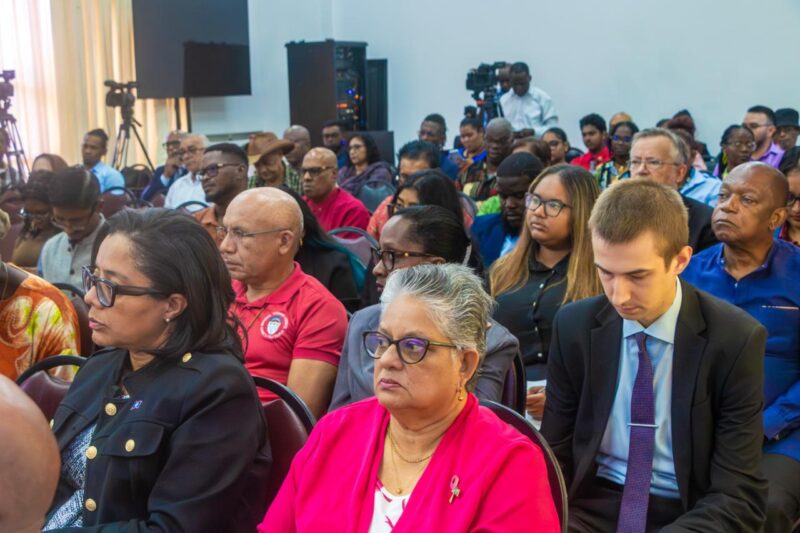
The Ethnic Relations Commission (ERC) convened its Constituency Consultation on Constitutional Reform on Tuesday, October 13, 2026, at the Arthur Chung Conference Centre (ACCC), Liliendaal, Greater Georgetown. The consultation brought together representatives of the ten ERC constituencies, civil society, the Diplomatic Corps, sister constitutional commissions, members of the public and other stakeholders to discuss constitutional matters relevant to the Commission’s mandate.
The engagement provided an opportunity to consider how Guyana’s constitutional framework could be strengthened to promote equality of opportunity, eliminate discrimination, foster ethnic security, encourage meaningful participation in national life and support harmonious relations among all ethnic groups.
In his opening remarks, ERC Chairman Shaikh Moeenul Hack underscored the importance of ensuring that constitutional reform reflects the experiences, concerns and aspirations of Guyanese across the country. He acknowledged the Government of Guyana for initiating the national exercise and the National Assembly for enacting the legislation establishing the Constitutional Reform Commission (CRC).
The Chairman described the Constitution as a living document that must continue to reflect the aspirations of the people and earn their confidence. He encouraged broad-based participation, noting that contributions from every community and constituency strengthen the legitimacy of the reform process and contribute to democratic development.
Reaffirming the ERC’s constitutional mandate, he highlighted the importance of equality of opportunity, protection against discrimination, ethnic security, participation in national life and the peaceful resolution of disputes. He also encouraged participants to engage openly and constructively, listen respectfully to differing perspectives and propose practical recommendations.
The Chairman further identified the ERC’s investigative powers as an area warranting consideration in the constitutional reform process. He noted that the absence of a general mechanism to compel attendance in certain circumstances can present challenges and potentially delay investigations. He called for consideration of whether the existing legal framework provides the powers and safeguards necessary for the Commission to discharge its responsibilities effectively.
1
Mr. Ralph Ramkarran, SC, former Chairman of the Constitution Reform Commission, delivered a presentation on Guyana’s constitutional development, the objectives of the current reform process and the importance of public participation.
Tracing the country’s constitutional evolution from Independence through the adoption of the 1980 Constitution and subsequent reform initiatives, Mr. Ramkarran discussed questions surrounding public participation and the legitimacy of constitutional arrangements.
Following the presentations, participants engaged in structured, plenary-style discussions facilitated by Mr. Ramkarran and the ERC’s Legal Officer Ms. Seeta Bishundial. The discussions were held in the main hall, enabling participants to consider the issues collectively, exchange views and propose recommendations relevant to the ERC’s mandate and the wider reform process.
The ERC will review, analyse and consolidate the contributions and recommendations from the consultation into a report for submission to the CRC before the December 31, 2026, deadline. The report will also include recommendations arising from the Commission’s institutional experience and assessment of matters relevant to its constitutional mandate.
The consultation also featured the latest draft of the ERC Glossary of Ethnically Sensitive Terms, a public education resource intended to promote awareness of how language, context and terminology can influence relations among Guyana’s diverse communities.
ERC Commissioner and Chairman of the Media/PR Subcommittee, Mr. Neaz Subhan, explained that words and expressions may be interpreted differently depending on context and individual experience. Expressions considered acceptable by some may be perceived as offensive by others, including persons from the same ethnic background.
Participants offered varied perspectives on the draft, including suggestions on how particular expressions should be treated and the importance of considering context. Mr. Subhan noted that the draft had benefited from input from experts at the University of Guyana and emphasised that its circulation was intended to encourage further discussion and obtain public feedback before finalisation and publication.
The consultation forms part of the ERC’s continuing commitment to public education, stakeholder engagement and the promotion of harmonious relations among all ethnic groups in Guyana.
The Commission will also publish the CRC feedback form on its social media platforms, allowing persons who were unable to attend the consultation in person to access and complete the form online. Members of the public are encouraged to use this opportunity to share their views and contribute to the national constitutional reform process.
The ERC thanks all participants, presenters, constituency representatives and stakeholders for their contributions to the consultation and the wider discussion on building a more inclusive, peaceful and harmonious Guyana.