By Mark DaCosta-On the afternoon of Wednesday, 6 October 1976, a Douglas DC-8 lifted off the runway at Seawell Airport in Barbados and climbed into the sky above the Caribbean Sea. Within minutes, two bombs had torn through it. All 73 people aboard died when Cubana de Aviación Flight CU-455 plunged into the Atlantic. Eleven of them were Guyanese, and most were young people on their way to build futures that were never allowed to begin.
This month marks half a century since that day. For many families in our country, the passing of fifty years has not softened it.
The flight had begun its journey at Timehri, as the airport now named for Cheddi Jagan was then known. Its route took it through Trinidad and Barbados, onward to Jamaica, and finally to Havana. Aboard were 48 passengers and a crew of 25: 57 Cubans, 11 Guyanese and five North Koreans. Among the Cubans were members of the national fencing team, young athletes returning home from a regional championship.
The Guyanese passengers were Raymond Persaud, Rawle Thomas, Jacqueline Williams, Rita Thomas, Eric Norton, Gordon Sobha, Ann Nelson, Margaret Bradshaw, Violet Thomas, Sabrina Harripaul and Seshnarine Kumar. Official accounts record that several were scholarship students bound for Cuba to study medicine, engineering and other disciplines. Rawle Thomas was just 19. In an independent Guyana that was still defining itself, these were exactly the young people a young nation hoped would return home to serve it.

Their deaths came at a moment of regional courage. Only four years earlier, in 1972, Guyana, Barbados, Jamaica and Trinidad and Tobago had jointly established diplomatic relations with Cuba, an independent step taken despite considerable pressure. The scholarships that sent our students to Havana were fruits of that new friendship. The bombing of Flight 455 was therefore not only a catastrophe for the families on board. It was an assault on the idea that small Caribbean states could choose their own partners.
The investigation that followed pointed to two Venezuelans, Hernán Ricardo Lozano and Freddy Lugo. They boarded in Trinidad and Tobago, left the aircraft in Barbados, and were later arrested. Reports say they implicated Luis Posada Carriles and Orlando Bosch, Cuban exiles with long histories of anti-Castro militancy, as the organisers of the plot. The decades that followed brought no conviction of either man for the bombing, and both died in the United States. For the families, that absence of accountability has been a second grief.
Although diminished with time, it is a grief our state has refused to let pass quietly. At the 2015 commemoration, then President David Granger reminded the nation that “Guyana, a small state, was one of the earliest victims of international terrorism.” He added that justice for the victims remained outstanding. Rawle Thomas’s brother, Jeffrey, laid the wreath on behalf of the bereaved families that year, a reminder that behind the statistics are siblings, parents and friends who still count the years.
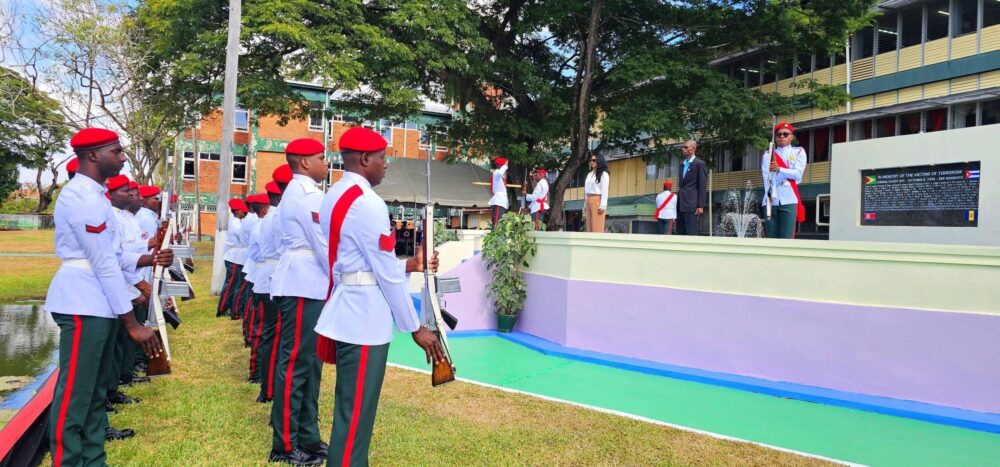
Each October, Guyana gathers at the Cubana Air Monument on the University of Guyana’s Turkeyen campus. Presidents, ministers, diplomats and relatives have stood there in recent years to lay wreaths and observe silence. In Barbados, a companion monument at Paynes Bay, St James, draws regional leaders on the same date. Cuba observes 6 October as its Day of Victims of State Terrorism, and Caribbean voices have urged a wider international day of remembrance so that the 73 are not forgotten.
Perhaps the most telling feature of this remembrance is how little it has changed. Governments come and go, yet the ceremony continues, the names are read, and the solemn promise is repeated that our region will not allow such an act to be forgotten or repeated.
Fifty years is long enough for a generation to grow up knowing the tragedy only from a monument and a date. That is exactly why it matters to tell it plainly. Eleven Guyanese set out on a journey of promise, carrying their families’ hopes and our country’s. They deserve to be remembered by name, as the young people they were, and not merely as figures in the history of a crime.