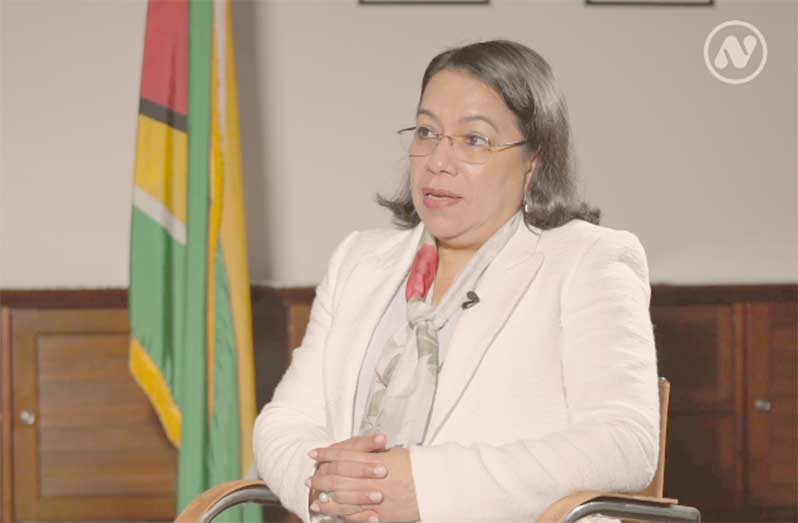
Guyana’s candidate for United Nations Secretary-General, Ambassador Carolyn Rodrigues-Birkett, is campaigning on a message of peace, inclusion and a more effective international system, but her call for the world to pursue “peace outcomes” has also brought renewed attention to the unresolved political, civil and economic tensions within Guyana.
In an interview with The Exchange, Rodrigues-Birkett warned that the world is experiencing its highest number of conflicts since the Second World War and argued that the United Nations must become more effective in preventing conflict and delivering tangible results.
“I would start by saying that we need a UN that learns from the past, that is fit for today, and that is ready for the future,” Rodrigues-Birkett said.
She acknowledged widespread criticism of the UN over its inability to prevent or end major conflicts.
“What I’ve seen during these last years is lots of criticism being directed to the UN, particularly because we have not been able to end and prevent conflicts.”
Rodrigues-Birkett said the UN must remain focused on its founding mandate and insisted that peace must be measured by actual outcomes.
“So, to be effective, we have to work to have peace outcomes,” she said.
But while Rodrigues-Birkett speaks of resolving conflicts abroad, Guyana continues to experience its own disputes over political representation, economic opportunity, state accountability, freedom of expression and the treatment of dissent.
Opposition parties, civil society organisations and other voices argue that some of these tensions are not simply inherited divisions but are being intensified by government policies and actions, particularly where citizens and political groups feel excluded from decisions affecting them.
The Carter Center, following its 2025 election assessment, has raised concerns about obstacles affecting opposition participation and has called for reforms to strengthen inclusive political representation. In August, it specifically urged Guyanese officials to resolve the impasse over the composition of the Guyana Elections Commission and amend legislation to ensure broader party representation.
The controversy has extended beyond elections. In July, the parliamentary Opposition objected to the composition of the Commission of Inquiry into the MV Barima disaster, arguing that there had been insufficient consultation with political and national stakeholders.
A coalition of 165 civil society organisations subsequently rejected the Commission’s composition, calling for a process involving survivors, bereaved families, Indigenous leaders, civil society and opposition representatives. The groups accused the authorities of exclusion and weak accountability. Those are the organisations’ allegations, not established findings.
The debate has also reached the broader question of dissent. Freedom House’s 2026 assessment also cited concerns about intimidation of journalists, political obstacles affecting opposition competition and discrimination against certain groups.
The government rejects such criticism and maintains that Guyana has a free and pluralistic media environment and that it remains committed to democratic governance and freedom of expression. Government officials have also defended the “One Guyana” concept as an effort to promote national unity rather than exclusion.
The disagreement, however, is over what national unity should mean.
For opposition parties, civil society organisations and others calling for greater inclusion, unity cannot mean conformity or the expectation that Guyanese must accept a single political narrative.
Rodrigues-Birkett has acknowledged that peace requires movement even during periods of profound disagreement.
“I am well aware of the geopolitical times in which we live, but I believe that even in great distress geopolitically, we can make movements.”
She also said that the UN survived the Cold War and other periods of intense division because progress remained possible.
“This organisation has gone through the Cold War. It has gone through very difficult times, and even then, you had successes.”
That principle arguably applies to Guyana as well. Political disagreement is not necessarily a threat to national unity; suppressing or marginalising legitimate disagreement can deepen divisions.
Rodrigues-Birkett says that, if appointed Secretary-General, she would wake up each day looking for opportunities to advance peace.
“I would wake up every day looking to how we could find peace outcomes through different means, using the tools, but also the Security Council, working very closely with the Security Council.”
The question now confronting Guyana is whether that philosophy can also be applied domestically by forging genuine civil, political and economic inclusion, respecting the country’s diversity and recognising that “One Guyana” cannot mean conformity to a single political worldview.
If peace is the objective internationally, then the pursuit of peace, inclusion and respect for differences must also begin at home.