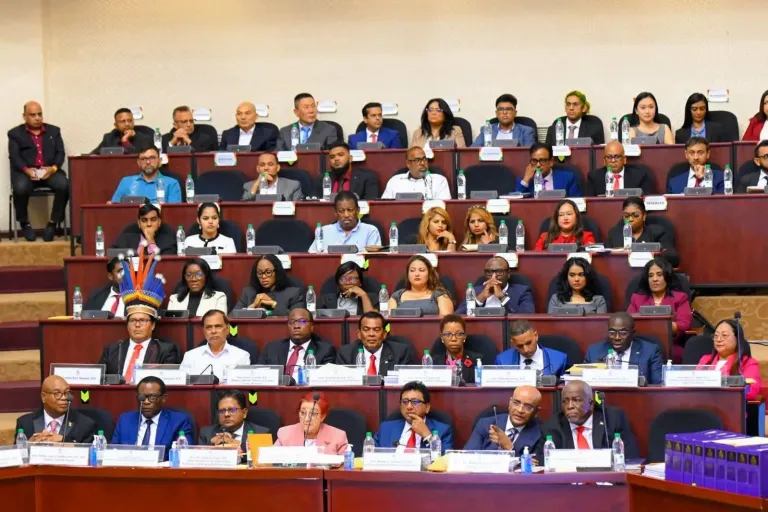
By Mark DaCosta-Guyana’s ruling People’s Progressive Party (PPP) majority has used its numbers to scrap the monetary ceilings on the state-funded benefits of former presidents, reviving a 2009 framework while many citizens struggle with rising prices and thin pay packets. The Former Presidents (Benefits and Other Facilities) Bill 2026 passed its second reading during Monday’s 23 November sitting —concluding shortly after midnight— by 35 votes to 22, and went through its third reading without a single amendment. The government calls this the restoration of dignity. The opposition calls it an open-ended commitment of public money, made without a published cost estimate, at a time when the people who fund it are stretched.
The Bill, tabled in June as Bill No. 10 of 2026, repeals the 2015 law and revives the earlier regime. That regime covers residential utilities, household and support staff, medical treatment, security, transport and vacation allowances. It also lifts the 2015 restrictions on former presidents who go into private business, trade or paid work. These benefits are separate from the presidential pension, which means they come on top of it. Four former presidents are alive today: Samuel Hinds, Bharrat Jagdeo, Donald Ramotar and David Granger.
The history explains why the issue never goes away. Before 2009, many of these facilities existed through administrative arrangements rather than statute. The then PPP/C administration placed them on a legal footing that year. Critics of the day, including the parties that later formed the APNU+AFC coalition, branded the package extravagant for a poor country, especially with Jagdeo expected to leave office while still relatively young. The coalition acted soon after taking office in 2015. Its amending law capped several entitlements, including $25,000 monthly for each of water, electricity and telephone services, limited medical spending, and attached forfeiture conditions to private business and paid employment.
The 2015 reform was weakened by a legal reality. Rights granted under the 2009 law were constitutionally protected as vested entitlements for the three presidents who had already left office, meaning the caps bit chiefly on future retirees. Granger, who left office in 2020, was the first affected. Ministers now say this created two classes of former president, and that the present administration has already extended support to Granger beyond the 2015 limits. That admission is damning. By the government’s own account, it has been providing benefits in excess of the statutory caps set in 2015, and has now rewritten the law to match its practice.
Government speakers argued from principle. Minister of Parliamentary Affairs and Governance Gail Teixeira, drawing on three decades of working alongside successive presidents, described the 2015 limits as an injustice. She questioned why a former head of state should face a modest utilities ceiling when ministers enjoy more generous allowances, and warned that a serious illness could swiftly exhaust the statutory medical limit. She also rejected the notion that a former president should be barred from consultancy work.
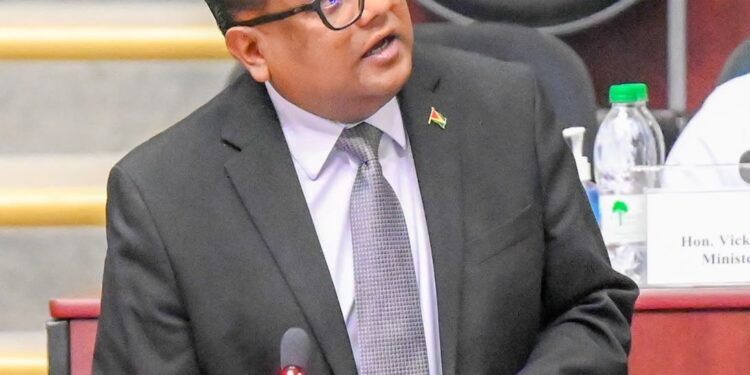
Minister of Public Works Juan Edghill said the state must not be left to negotiate gratitude at a change of government, and suggested that work restrictions could deter younger Guyanese from seeking the presidency. Attorney General Anil Nandlall rooted his defence in history, noting that the benefits predate the 2009 statute. Senior Minister Dr Ashni Singh, who closed the debate, insisted that the absence of dollar ceilings does not mean unlimited entitlement, since spending will still pass through parliamentary appropriation and the Committee of Supply.
That assurance is cold comfort to taxpayers. A ceiling is a promise written into law. A reliance on the budgetary process is a promise that the majority will police itself, and that majority has just declined every opportunity to write safeguards into the Bill.
The opposition’s questions went largely unanswered. Tabitha Sarabo-Halley asked how officials would separate the cost of maintaining a former president’s home from the cost of running a private commercial venture, warning of an unfair advantage and a public subsidy for private enterprise. She set the generous package against the burdens of ordinary households: housing, electricity bills, food and transport.
Dr Terrence Campbell demanded annual cost projections compared with the 2015 law, along with estimates for 15 to 20 years hence, and asked whether any actuarial assessment had been commissioned. He contrasted the treatment of former presidents with that of teachers and other retirees who struggle to access pensions after decades of service. Ganesh Mahipaul asked how a government can concede that it exceeded the 2015 law and still expect citizens to obey the country’s statutes, and pointed out that former presidents already draw a substantial pension. And another member of Parliament spoke of vulnerable citizens and families affected by recent tragedies.
Outside Parliament, public hostility has been plain since June. The Working People’s Alliance and others organised a protest in July, and trade union and community voices have framed the measure as insensitive to the cost-of-living burdens borne by working people, even as oil revenues swell the national purse.
The question was never whether former presidents deserve support. It is why that support should carry no ceiling, no published cost and no clear boundary between public duty and private gain, while teachers, pensioners and low-paid workers are told to wait. Government says existing controls suffice. Our nation will now find out, and the public should watch every appropriation closely.