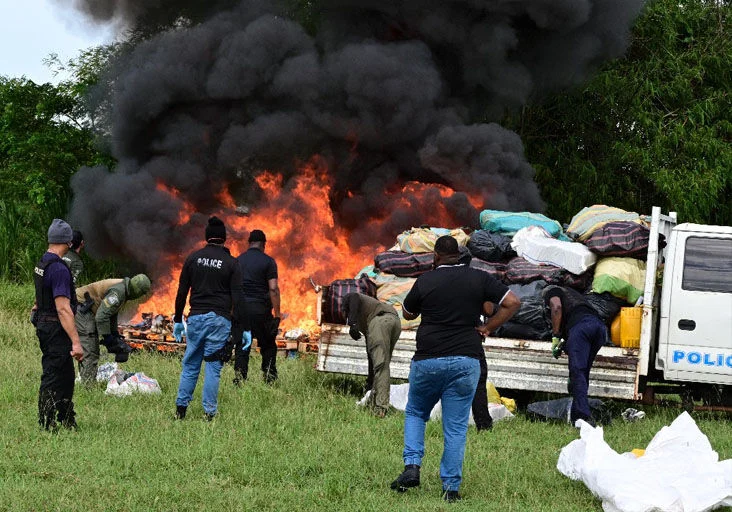
More than 8.3 tonnes of illegal narcotics—including cocaine, marijuana and heroin with an estimated street value of over $1.6 billion— were destroyed by the Trinidad and Tobago Police Service (TTPS) at the Caroni Cremation Site yesterday.
Prime Minister Kamla Persad-Bissessar acknowledged the burning of the illegal drugs, saying in a social media post, “This value of drugs seized from the local drug mafia amounts to approximately 1% of our annual GDP. Thanks to the efforts of our brave men and women of our protective services, these drugs did not make it onto our streets to poison our children and destroy families.”

She said the United National Congress (UNC) Government and the protective services “will continue our fight against the local drug mafia who were allowed to run rampant for ten years under the PNM. The local drug mafia that got so much under the PNM’s time in office is over”.
The Prime Minister said the authorities were going after their physical shipments of drugs.
“We are also displacing their accomplices in our financial institutions, distribution networks, and public sector with the help of international law enforcement,” she added.
Around 8 a.m. yesterday, a convoy of TTPS vehicles arrived at the cremation site carrying two truckloads of narcotics.
The narcotics destroyed included seized cocaine, marijuana, heroin and other synthetic drugs.
The seizures took place at several points across Trinidad, including Piarco International Airport and several policing divisions, including Eastern, North-Eastern and Southern, from as far back as 2005 to as recently as last year.
The drugs, packed in different bags, were unloaded as officers prepared for the destruction exercise.
Pallets were placed on the ground, and about two dozen police officers began cutting open the bags to display their contents.
Police Commissioner Allister Guevarro noted that when the fire was lit, the narcotics seized by officers of the Southern Division had not yet arrived at the site.
He later commended the officers for what he described as their hard work and proper work ethic throughout the process, from arrests to seizure of the drugs and their eventual destruction.
During the entire process, the TTPS had a drone hovering overhead and several armed officers standing guard around the perimeter of the cremation site.
Alexander: It’s war
Speaking at the cremation site yesterday, Minister of Homeland Security Roger Alexander urged parents to join the fight against narcotics entering their homes and communities. He said narcotics were destroying communities.
“So what we did in return? We are destroying the narcotics. So, it’s war,” he told journalists.
He continued: “So, we are asking parents now to take that same initiative and if they find it home, destroy it the same way,” he said, adding: “Destroy it from coming into your homes. Destroy it from coming into your communities and destroying your people.”
Alexander also noted that drugs would be a “problem to any father, mother, brother, sister, aunt, cousin, teacher. So, when you see this happening here, it would have saved how much millions of lives of young people.”
Asked what was different in T&T’s current counter-narcotics fight, Alexander said the difference in the current approach was the “new level of support” being provided by T&T’s international allies.
Asked if there were any difficulties in getting the cremation site to dispose of the narcotics, Alexander replied that all ministries were on board with immediate effect.
Cocaine from
Monos Island bust
Guevarro noted that some of the drugs being burnt were from 2005 when nine men were initially detained over cocaine found at a house on Monos Island.
Seven men were eventually charged. They included two nationals, one Antiguan and four Venezuelans.
Using the Monos Island case as an example, Guevarro said seized narcotics could remain in police custody for years while the related legal proceedings ran their course.
In another example, he explained that last year, about 1,500 kilogrammes of “creepy” marijuana were found at the Caroni Swamp, and that also went up in flames.
According to Guevarro, that was because no one was charged in that case.
Guevarro said what he was aiming to achieve in the destruction of the drugs was a sense of transparency and accountability.
“You know the old narrative, oh, they’re regurgitating it. Well, it can’t regurgitate. It has been set on fire and we are destroying it for the entire world to see,” Guevarro said.
He also used the public destruction of the narcotics to address long-standing concerns about the handling of seized drugs, including a past incident in which authorities had said missing narcotics were eaten by rats.
“The mere fact that we are here today and you are seeing the destruction of it means that rats didn’t eat these,” he said.
Furthermore, Guevarro said, based on his experience in the TTPS, narcotics could deteriorate while being held as exhibits, with cocaine breaking down from a solid substance into powder and marijuana eventually turning to dust.
He said yesterday’s exercise was intended to remove any doubt about the fate of the seized drugs.
Guevarro also pointed to an increase in cocaine seizures as evidence that police operations were becoming more effective.
Citing data published by the Crime and Problem Analysis Branch (CAPA), which showed a significant increase in cocaine seized between 2024 and 2025, while marijuana seizures remained relatively consistent, Guevarro said the figures should be viewed from another perspective.
“We have more being seized. That means that the operations that the police are carrying out are more successful in removing it from the streets,” he said.
Guevarro also pointed to a recent successful drug interdiction by the Coast Guard and said a large quantity of cocaine seized several weeks ago could soon be destroyed.
“When those numbers go up, it gives me pleasure as the head of the TTPS to realise that operations are working,” he said.
caribbeannationalweekly.com