For a good part of the first two hours, India’s call to bowl first in the baking heat of Trivandrum felt like a curious choice. Nitish Reddy offered a whole lot of hit-me’s in a 17-run opening over. Gurnoor Brar and Prasidh Krishna brought bounce, but Justin Greaves, an ODI first-timer in India, smoothly sized them up, seizing the Powerplay with his back-foot game. Greaves and John Campbell hit 13 fours in the first ten, rallying together, to borrow a word or two from their team anthem.
Reddy did not return until the 28th over. Debutant Naman Dhir, identifying as an all-rounder lately, sent down five overs, causing no harm. Ravindra Jadeja had another wicketless outing, his sixth in his last seven ODIs.
Some of India’s ODI regulars are currently chasing Gold in Japan, leaving behind gaps and backups. But against a tenth-ranked West Indies, it was still supposed to be a soft landing at home for India’s second line of bowlers. By the first drinks break, Greaves and Campbell had put together West Indies’ first 100+ opening stand in India in 24 years.
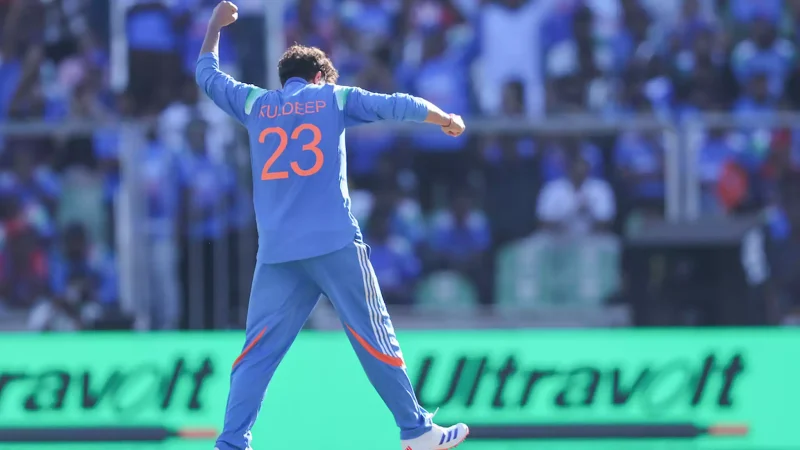
Shubman Gill hadn’t looked towards Kuldeep Yadav until then. For a lineup missing Jasprit Bumrah, Kuldeep assumes the attacking role in this team. The idea was probably to let the ball get older, scruffier, prone to more turn. India had to break the predictability of West Indies’ run-scoring.
When Kuldeep first took the ball in the 16th over, West Indies’ boundary-hitting spree had already eased up. Between overs 10 to 15, they had exacted just one four.
Kuldeep began rather too full to let the pitch cast doubts in minds. Off just his second ball, Campbell pushed an already limping Greaves for a quick single. They wouldn’t have wanted him to settle down in a comfortable rhythm.
His next over, Campbell ploughed a six over deep mid-wicket, sending the same message to Kuldeep. The switch-out from full deliveries had to be a swift act. The next ball darted in quicker, but not fuller. From there on, Kuldeep’s mixology began.
He first deprived Campbell of sweeping lengths, leaving him with no scope to pre-meditate that shot. He wanted to either toss and turn it away, or dart it in on length. When he finally sucked him into a sweep, it was a wrong’ un Campbell did not read. The top edge gave India a long-awaited breakthrough.
Slowly but firmly, through Kuldeep’s calculated lengths, the control started to show in India’s bowling. Newly entered Keacy Carty had no breathing room to match the scoring rates thus far. Greaves couldn’t rush around for quick singles, and Kuldeep had cut off their supply of boundaries Between overs 20 to 30, West Indies collected 40 runs, looking to see Kuldeep through.
Even in his attacking role, it’s this control that Kuldeep can bring to India’s bowling that is hard to substitute. It’s been a hard year for him: the Trivandrum ODI was his second white-ball game for India in seven months. In the New Zealand ODIs earlier this year, he was the most expensive among everyone who took more than a wicket that series. At the T20 World Cup that followed, he played just one game.
More recently, Kuldeep did not get a game in the ODI tour of England, with spin all-rounders Axar Patel and Washington Sundar preferred instead.
After the game, Kuldeep admitted that spells like these can bring back the confidence lost by constant in-and-outs. “It always feels nice when you enjoy your bowling, that’s where you achieve your best,” Kuldeep later said, “You are a bit relaxed as well, then your performance comes at peak.
“To get that confidence back, you have to have a bowling spell like this”.
As a wrist-spinner, Kuldeep can fare better on pitches that offer only marginal help. In Trivandrum, finger-spinners didn’t really offer much: Jadeja and Dhir were both wicketless. Later, West Indies – without wrist-spinner Vitel Lawes – were carted around by Indian batters on a pitch that had eased up even more under lights. After the first 25 overs, West Indies managed to draw only six false shots. In his first spell of six overs, Kuldeep had drawn five himself.
He briefly left the field, but when he returned, Gill was so eager to use him away that the umpires had to remind him of the cooling-off period. It only delayed West Indies’ imminent crash-out.
The second spell had to be tighter lines, with no fielder in the deep on the off-side, allowing no cushion for strays. By that time, Kuldeep had settled into the rhythm he later spoke about. Strangled by line, and teased by length, Shai Hope was forced to dance down, giving Kuldeep his second. Later, Greaves’ grievous sweeping plan was undone by a wrong ‘un.
And the very next ball, teenager Jewel Andrew, playing his first ball in India, got the hard deal, bamboozled by a ball that turned and kicked off length, taking the outside edge along. That double-wicket maiden flipped the innings around.
“I was very calm in my rhythm and just trying to bowl whatever I felt like bowling,” Kuldeep said later, “just varying the pace, variations were superb, just reading the batters, where they’re going to hit me, and yeah, I found very good rhythm.”
Kuldeep couldn’t claim a fifth, resting himself at the boundary after his quota finished, and India’s erratic death bowling resumed. Later, Amir Jangoo admitted that they probably should have gone after Kuldeep a little harder: “One thing all of us have to do is put him (Kuldeep) under pressure as well. We cannot allow him to get into his spell, given the kind of start we had. We have to put him under some more pressure and face him slightly differently”.
It’s amazing what an on-song Kuldeep can do, yet it’s hard to be him and look at the bigger picture. After the West Indies ODIs, it isn’t certain if he will get game time in New Zealand, a place he last bowled in 2020. There’s the not-so-distant World Cup, where pitches like Paarl and Gqeberha would be conducive to spin. Kuldeep offers the benefits of wrist-spin, but a question mark has always stayed around him. For now, he just wants to stay in a good space.
“I personally feel there’s still a chance to improve, and I’m going to stick with the same rhythm: that’s the most important thing,” he said, before venturing into lighter topics, such as his favourite football club Barcelona’s continued run at the top of the Spanish League, La Liga.
Perhaps, if Kuldeep listens to Spanish popstars too, the popular lyrics would fit him right: “All I need, is the rhythm divine”.