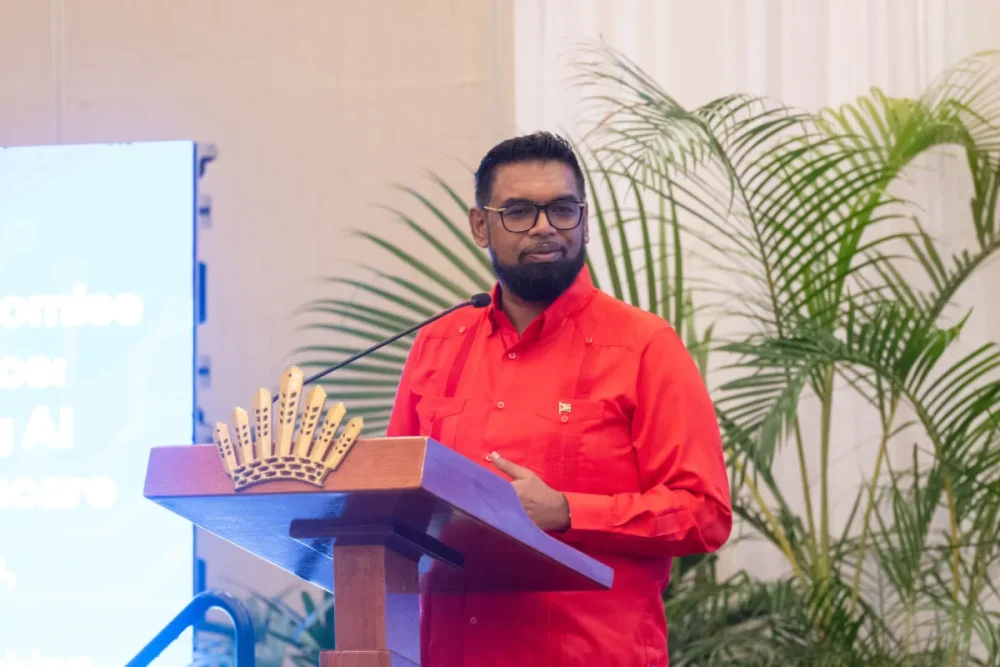
President Irfaan Ali used his 25-minute address to the United Nations on Thursday to call for greater transparency, accountability, stronger institutions, respect for international law, inclusion and a revitalised multilateral system—principles that also expose difficult questions about Guyana’s own democratic and institutional record.
Ali told the 81st UN General Assembly that the United Nations must become “more transparent, accountable, and responsive” and urged stronger institutions capable of restoring public confidence.
“To make the United Nations fit for purpose we must make it more transparent, accountable and responsive.”
He also argued that international rules must be applied consistently.
“There can be no just international order where rules are applied selectively.”
That principle raises a question at home: are the same standards being applied consistently within Guyana?
International observers of Guyana’s 2025 general elections identified several weaknesses that remain relevant to that question. The European Union Election Observation Mission concluded that the elections were peaceful and well-run, but found that the ruling party benefited from an “undue advantage of incumbency,” including the misuse of state resources. It also identified weaknesses in campaign-finance regulation and enforcement, concerns about GECOM’s politicised structure and a strongly politicised media environment.
The Commonwealth Observer Group similarly described the elections as largely peaceful and professionally managed, while identifying uneven access to campaign resources, media bias favouring the governing party, weak campaign-finance regulation and continuing partisan divisions as factors affecting public confidence and equity.
Ali’s own Government rejected the EU’s characterisation of an “uneven playing field” and “undue advantage of incumbency,” with the President describing those findings as unsupported by facts and based largely on complaints from political participants and affiliates.
The contrast between the international prescription and domestic record is nevertheless difficult to overlook.
Ali called for UN institutions to defend international law “without fear or favour” and said leadership must be capable of building bridges where division has become habitual.
“The United Nations needs leadership that can build bridges where division has become habitual; leadership that can defend the principles of the Charter without fear or favour.”
Guyana’s own political environment remains deeply contested, with disagreements over electoral administration, institutional independence, campaign practices and the relationship between government and opposition continuing well beyond the 2025 elections.
Ali also declared that development must improve societies rather than merely increase economic output.
“Development must not merely make our economies richer; it must make our societies better.”
He cited universal healthcare, free education, infrastructure, affordable housing, employment opportunities, financing for small and medium-sized enterprises and digital services as evidence of Guyana’s progress.
Yet the speech offered little discussion of the harder domestic questions surrounding inequality, poverty, public-service delivery and the distribution of the benefits generated by Guyana’s rapidly expanding oil economy.
His appeal for consistent adherence to international law was also prominent. Ali defended Guyana’s decision to pursue the Venezuela border controversy before the International Court of Justice and pledged that Guyana would respect the court’s forthcoming ruling.
That position is consistent with Georgetown’s longstanding approach to the controversy. But the principle Ali articulated—that rules should not be selectively applied—extends beyond the international arena.
The address ultimately created an uncomfortable comparison.
Ali called for transparency while international observers identified transparency and campaign-finance weaknesses in Guyana. He called for accountability while observers highlighted weak enforcement of campaign-finance rules. He called for independent institutions while GECOM’s politicised structure was identified as affecting public confidence. And he called for bridge-building while Guyana remains politically polarised.
None of this erases the positive assessments of the 2025 elections. Both the EU and Commonwealth found the voting and administration generally peaceful and professionally managed, while also identifying reforms they said were necessary to strengthen Guyana’s democratic system.
The real test, therefore, is not whether the principles Ali articulated at the UN are sound. It is whether the same standards of transparency, accountability, institutional independence and consistent application of rules can withstand scrutiny inside Guyana.
Ali concluded:
“We must not abandon multilateralism because it is imperfect; we must renew it because humanity still needs it.”
The same logic applies to democratic governance. Institutions are strengthened not by speeches alone, but by how power is exercised, challenged and held accountable.
Ali asked the world to renew its commitment to those principles from the UN podium. The harder measure will be how convincingly those principles are reflected in Guyana’s own institutions and political practice.