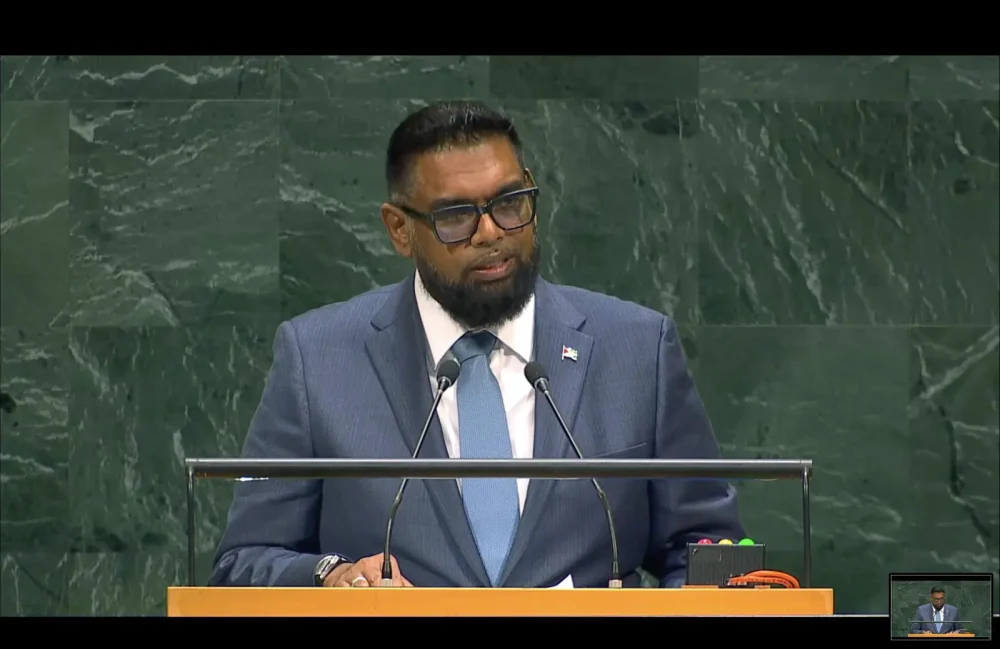
For a Head of Government and Head of State standing before the United Nations, President Irfaan Ali’s address Thursday was conspicuously short on conviction. Over roughly 25 minutes, he offered an expansive catalogue of global challenges and sweeping appeals for reform, but the presentation often lacked the authority, urgency and force expected from a national leader addressing the international community.
Speaking at the 81st United Nations General Assembly, Ali moved through war, climate change, food insecurity, biodiversity loss, debt, inequality, geopolitical tensions and what he described as the weakening of multilateralism.
His delivery added to the impression of a speech that was more declarative than commanding. At various points, Ali rocked from side to side, tugged at his jacket and stumbled over words and transitions.
On multilateralism, he declared:
“The crisis confronting multilateralism can become the catalyst for its renewal.”
Ali called for a reformed UN Security Council that reflects 21st-century geopolitical realities, including permanent representation for Africa and Latin America and the Caribbean.
He also urged greater transparency and accountability, a stronger General Assembly and improved coordination among UN agencies. But beyond those broad principles, the speech offered limited detail on how the reforms he advocated should be pursued.
Ali subsequently addressed the Middle East, Ukraine, Sudan and Haiti, reaffirmed Guyana’s support for a two-state solution and urged Venezuela to respect the forthcoming International Court of Justice ruling on the Guyana-Venezuela border controversy.
A Different Ali for Rodrigues-Birkett
The most pronounced shift came when Ali turned to Guyana’s candidate for UN Secretary-General, Ambassador Carolyn Rodrigues-Birkett.
His delivery became noticeably more animated as he appealed for international support.
“This is an individual of extreme quality. Not because she’s a Guyanese. Not because she comes from Guyana. But because I know her personally…”
He added:
“I know that this world will be a better place with Carolyn Rodrigues as the Secretary-General of the United Nations.”
Ali then appealed directly to member states:
“Look beyond the small country that nominated her.”
Rodrigues-Birkett and the Guyana delegation were repeatedly shown by the cameras. At several points, Rodrigues-Birkett appeared to be looking down toward her lap. When Ali turned specifically to her candidacy, she looked up and smiled before returning to her earlier posture.
The contrast was striking. The President’s most animated and emphatic moments came not during his discussion of war, poverty, climate change or the future of multilateralism, but when he made the case for Guyana’s candidate.
Ali argued that the next Secretary-General must restore confidence in the United Nations, defend the UN Charter and bridge divisions between developed and developing countries.
“The reform of the United Nations, the restoration of trust, and the need to manage transformation is therefore inseparable from the question of leadership,”
he said.
The address ultimately left a wide gap between its sweeping language and its practical substance. For a leader speaking on the world stage, the speech presented plenty of problems, principles and aspirations, but far less in the way of a forceful roadmap for addressing them.