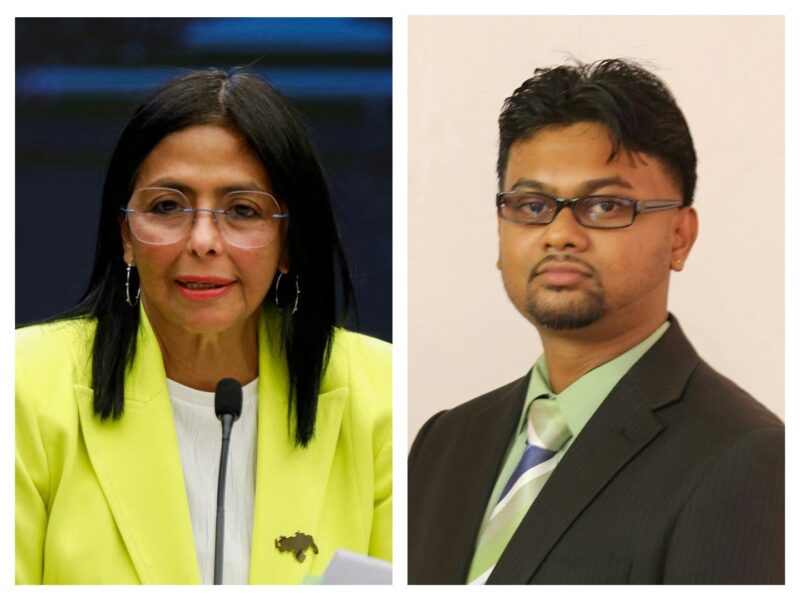
Former Georgetown Mayor and political figure Ubraj Narine is urging the Guyana Government to respond promptly and diplomatically if Venezuela’s interim President Delcy Rodríguez uses her appearance at the United Nations to reinforce Caracas’ claim to Guyana’s Essequibo region.
Narine issued the call as Rodríguez arrived in New York for the 81st United Nations General Assembly, where she is expected to meet United States President Donald Trump on Tuesday. The meeting would mark the first encounter between the two leaders and comes amid expanding U.S.-Venezuelan engagement, including cooperation involving Venezuela’s energy sector.
In his statement, Narine said the timing of Rodríguez’s visit and the planned Trump meeting created particular sensitivity for Guyana and the wider Caribbean.
“There is therefore legitimate concern in Guyana about whether the longstanding Venezuelan claim to Guyana’s Essequibo region will be raised during these engagements.”
Narine pointed to Rodríguez’s previous use of a pin depicting a map that included Essequibo as Venezuelan territory. The display triggered a formal complaint from President Irfaan Ali, while Rodríguez defended the imagery as representing Venezuela’s historical position. The incident also drew attention within CARICOM, which reaffirmed support for Guyana’s territorial integrity.
Narine said Guyana should respond officially if similar symbolism or representations are used at the United Nations.
“If Rodríguez again uses a map, symbol, statement or other official representation at the United Nations that depicts Guyana’s Essequibo as Venezuelan territory, the Government of Guyana should respond promptly and officially.”
He called for any response to remain measured and grounded in international law, arguing that repeated symbolic representations should not be allowed to create the impression that the territorial dispute has already been settled in Venezuela’s favour.
The dispute is currently before the International Court of Justice. The Court ruled in 2020 that it had jurisdiction to determine the validity of the 1899 Arbitral Award and the related question of the definitive settlement of the land boundary between Guyana and Venezuela.
The case has since advanced through the merits stage. Oral hearings concluded at the ICJ in May 2026, with Guyana arguing that the 1899 Award is legally valid and binding, while Venezuela challenged the Award and advanced arguments concerning the 1966 Geneva Agreement. The Court is now deliberating its final judgment.
Narine said the pending judicial process makes it important to distinguish between Venezuela’s right to present its legal position and any attempt to portray the territorial question as already resolved.
“The issue is not about Venezuela having the right to speak. It is about ensuring that Guyana’s sovereignty, territorial integrity and the ongoing judicial process are respected.”
He also called attention to Washington’s role, saying Guyana could seek clarification of the U.S. position if Venezuela uses the UN platform to symbolically incorporate Essequibo into Venezuelan territory.
Narine acknowledged, however, that the Trump administration’s expanding engagement with Rodríguez means Washington’s response cannot be assumed in advance.
With the ICJ’s final judgment still pending, Narine said Guyana should continue relying on international law and diplomacy while ensuring that Venezuela’s territorial claim is not allowed to acquire legitimacy through repeated diplomatic symbolism.
“Guyana must speak. Guyana must object when necessary. And Guyana must ensure that the world continues to understand the distinction between a territorial claim and established international legal processes.”