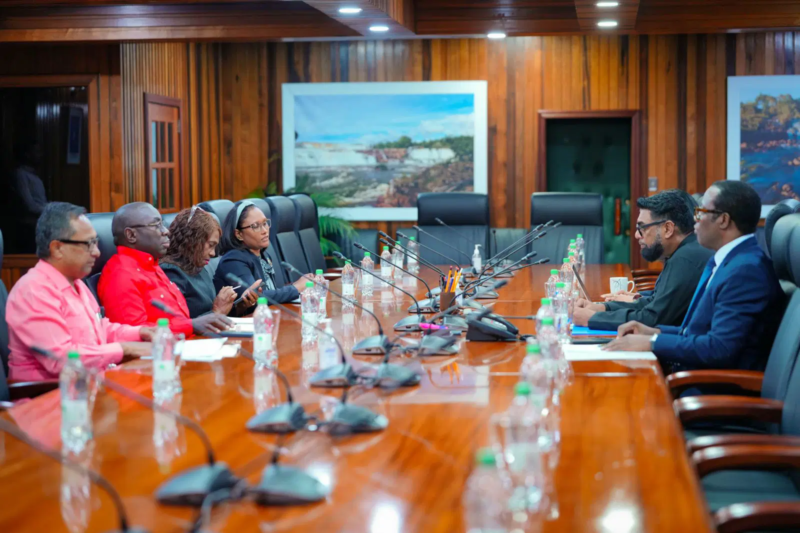
President Irfaan Ali on Tuesday proceeded with a meeting of Parliament’s Foreign Relations Sub-Committee without the participation of opposition members, after WIN and APNU rejected the proposed engagement, citing the absence of a clear agenda and other concerns over how the meeting was being convened.
The meeting at the Office of the President was intended to address some of Guyana’s most sensitive national issues, including the International Court of Justice (ICJ) proceedings concerning Venezuela’s claim to Essequibo and the Third Country National Agreement between Guyana and the United States.
Yet, rather than producing a broad parliamentary discussion, the meeting went ahead without the very opposition representatives whose participation would have provided an alternative political perspective on those issues.
The Office of the President said all members of the committee had been invited through Speaker of the National Assembly Manzoor Nadir.
It said that, up to the time of the meeting, opposition members had neither accepted nor declined the invitation.
That explanation, however, leaves out the substantive reasons for their non-participation.
WIN and APNU had raised objections to the manner in which the Government was seeking to engage them.
APNU Parliamentary Leader Dr Terrence Campbell said APNU would not attend without an agenda and supporting documents.
“In the absence of an agenda, we will not attend,” Campbell said.
Campbell indicated that the Government was aware of the Opposition’s position before Tuesday’s meeting.
WIN’s objection was broader.
Opposition Chief Whip Tabitha Sarabo-Halley said the lack of an agenda was only one of the concerns raised by WIN.
“No, we are not…. It’s absence of agenda, one, but other issues we want to highlight as well,” Sarabo-Halley said.
WIN subsequently declined the invitation, arguing that President Ali was seeking to engage parliamentary committees while bypassing the constitutional office of Leader of the Opposition Azruddin Mohamed.
The dispute is therefore not simply about whether opposition MPs received an invitation. It is about whether the form of engagement offered by the Executive was capable of producing meaningful parliamentary scrutiny.
Ali says consultation is the objective
The President’s Office described the meeting as part of efforts to align the work of the Government with Parliament.
According to the release, those present welcomed the engagement and expressed a desire for continued discussions in support of Guyana’s foreign-policy agenda.
Ali also said his Government intends to work with all parliamentary committees in an “open, transparent and accountable manner.”
But that claim is being tested by the circumstances surrounding Tuesday’s meeting.
Ali had said on Monday that the discussions would be broad rather than structured.
“It’s going to be broad, a broad agenda. Not it’s not going to be a structured agenda,” Ali said.
For an Opposition being asked to discuss the ICJ proceedings, relations with Venezuela and a controversial agreement with Washington, the absence of a defined agenda and supporting documentation presents an obvious difficulty.
The Third Country National Agreement has already attracted political scrutiny following the arrival in Guyana of six people transferred from the United States—four Cubans and two Afghans.
Ali has maintained that Guyana retains the final authority over who enters the country under the arrangement and that Washington must provide information necessary for Guyanese authorities to assess those proposed for transfer.
The Opposition has questioned the transparency of the arrangement and the extent of parliamentary oversight.
A changing Parliament
The disagreement comes against the backdrop of a substantially changed parliamentary landscape following the 2025 general elections.
WIN emerged as the largest opposition grouping with 16 seats, while APNU holds 12 and the Forward Guyana Movement one. The PPP/C controls 36 of the National Assembly’s 65 seats.
WIN’s emergence as the largest opposition bloc has also created a new dynamic in the relationship between the President and Parliament, particularly over the constitutional role of the Opposition Leader.
The Government says it wants wider engagement with Parliament. The Opposition says such engagement must respect parliamentary independence and provide the information necessary for legislators to properly scrutinise executive policy.
Consultation—or convenience?
Tuesday’s meeting ultimately produced an uncomfortable picture.
President Ali was able to say that he had engaged a parliamentary committee on matters of national importance, while WIN and APNU were left outside the room because of objections they had raised beforehand.
If the Government genuinely wants meaningful consultation on issues involving sovereignty, national security and foreign policy, an agenda, supporting documents and an agreed framework for engagement should be basic requirements—not obstacles.
Instead, the President’s approach risks creating a roadblock where there should be a bridge.
The Government cannot credibly champion “open, transparent and accountable” consultation while treating the Opposition’s legitimate questions about process as an inconvenience.
Parliamentary consultation must be more than an invitation issued on the Government’s terms. If President Ali wants genuine engagement, he must stop building the roadblock himself—and start building the bridge.