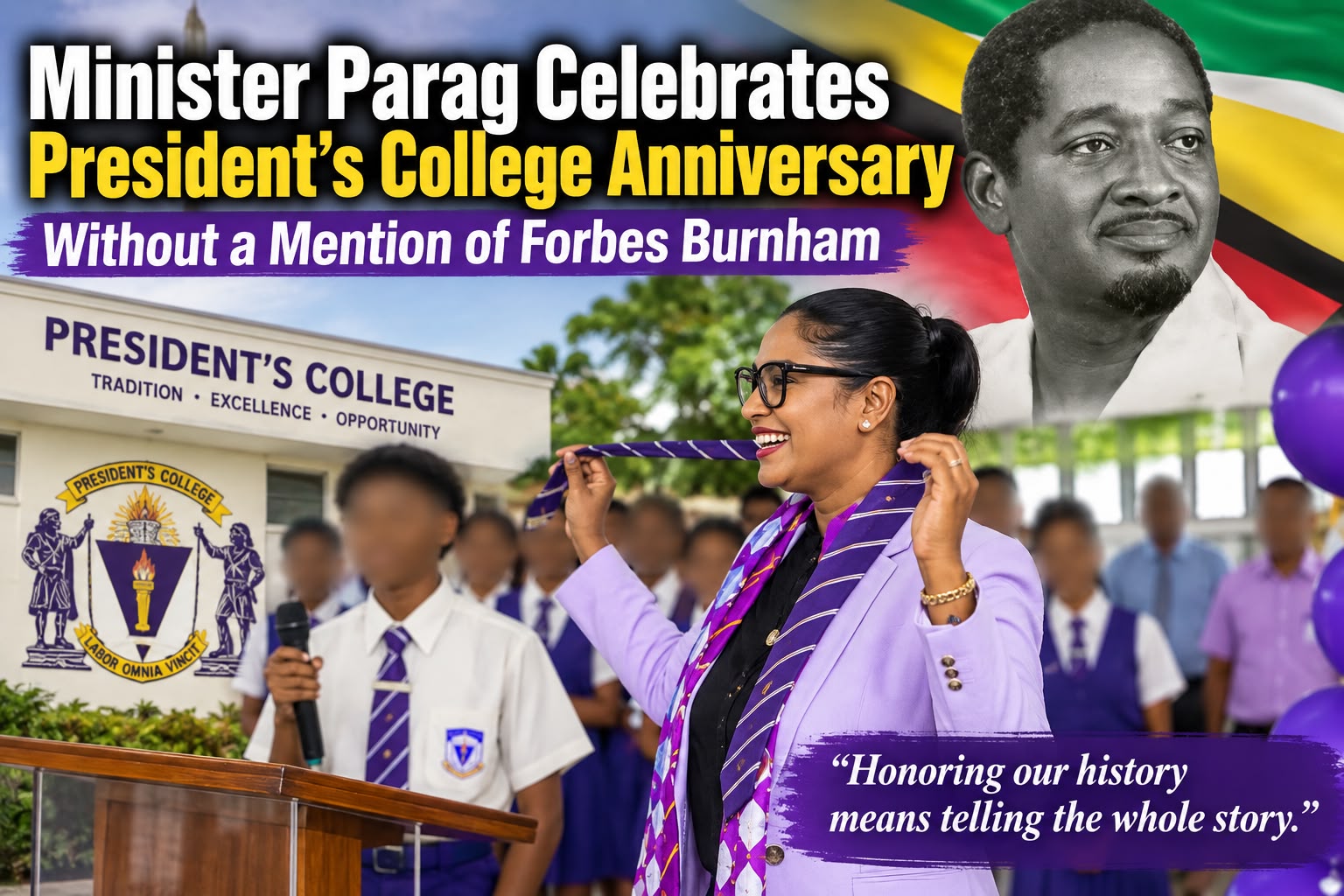
Georgetown, Guyana – President’s College marked its 41st anniversary on September 11 with an assembly that has sparked discussion about how the institution’s history is being remembered and taught.
Education Minister Sonia Parag, a past student of the college, served as chief guest at the event. In a post on her official social media page, Parag described the return to her alma mater as “a deeply moving experience,” adding that she “loved sharing words of motivation with the current student body.”
However, the celebration has drawn criticism from some quarters, with observers noting that the minister’s remarks did not reference the school’s founding connection to Guyana’s first Executive President, Linden Forbes Burnham. President’s College was established in 1985 as a boarding institution envisioned by Burnham as a “school of excellence” for the nation’s top academic performers. The school officially opened on September 11, 1985, the date now commemorated as its anniversary, after Burnham’s death earlier that year.
One student, who spoke on condition of anonymity, said the assembly felt more like a personal tribute than a historical commemoration. “She made it all about herself,” the student said.
The alleged omission, if intentional, raises questions about how educational institutions document and transmit their origins. Critics argue that failing to acknowledge Burnham’s role, however controversial one believes his legacy may be, constitutes a form of historical revisionism that deprives students of a complete understanding of their school’s place in Guyana’s post-independence development.
The President’s College Act of 1990 formally established the institution as a government school under a Board of Governors, but its origins remain rooted in Burnham’s vision of a meritocratic, leadership-oriented boarding school. For decades, admission was restricted to the top two percent of performers on the Secondary School Entrance Examination.
Neither the Ministry of Education nor Minister Parag has issued a public response to the criticism. The assembly itself included steelpan performances and speeches, which Parag described as “a day filled with pure nostalgia and gratitude.”
As President’s College enters its fifth decade, the question of whose history is told, and whose is omitted, remains unresolved. For students and alumni alike, the anniversary has become not only a celebration but a reminder that institutions are shaped as much by the stories they choose to remember as by those they leave out.