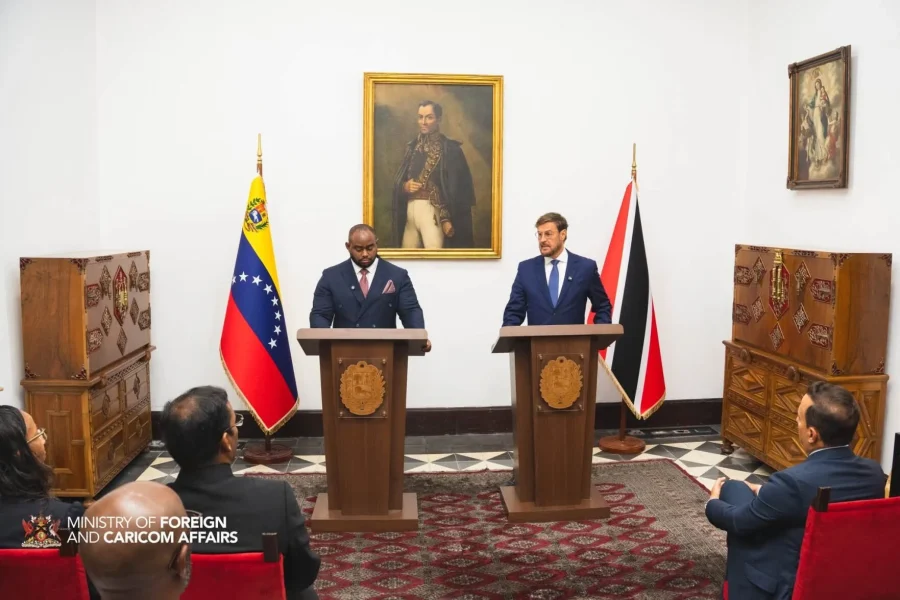
FORMER government minister Vasant Bharath said the Government must prove that Minister of Caricom and Foreign Affairs Sean Sobers’ visit to Venezuela on September 3 was “more than an embarrassing retreat” from the Government’s previous actions.
In a Facebook post yesterday, Bharath said there was “considerable irony” in the latest developments between Trinidad and Tobago and Venezuela.
“Not long ago, Persad-Bissessar adopted an openly confrontational position towards our closest South American neighbour. Her language and strong alignment with Donald Trump’s policy towards Venezuela contributed to Caracas declaring her persona non grata,” Bharath said.
Bharath said the country was now being told that Trinidad and Tobago and Venezuela were entering a “new era” of cooperation.
“Better relations are certainly welcomed. But the political cost of this dramatic reversal cannot simply be brushed aside. A prime minister is entitled to change policy when circumstances change. But when decisions prove to have been poorly made, there must be consequences beyond simply changing direction and moving on,” he said.
Bharath said there must be accountability for the Government’s earlier decisions.
“Poor foreign policy decisions can carry real costs of damaged diplomatic relationships, lost commercial opportunities, reduced negotiating leverage, uncertainty for investors and businesses and reputational damage,” he said.
“Ultimately, the country suffers for an intemperate tongue.”
Bharath said T&T should ask whether opportunities for cooperation with Venezuela in gas, energy, trade and agriculture “were delayed or compromised while relations deteriorated”.
He also questioned whether T&T’s standing within Caricom and the wider region was affected by a foreign policy that appeared closely aligned with Washington.
Bharath called on the Government to provide the country with a clear account of what advice informed its earlier Venezuela policy, “what risks were identified, what consequences followed, and whether any economic or diplomatic opportunities were lost”.
He said if the Government now believes engagement with Venezuela is essential to T&T’s national interest, it should have the courage to acknowledge that the earlier approach was wrong, excessive and poorly calculated.
Bharath said the “Trump factor” made the issue even more important.
“If the US midterm elections weaken his political position and Washington’s influence over Venezuela changes, T&T could find itself having to rebuild a relationship that it damaged partly because it followed the geopolitical direction of another country,” he said.
The former minister also pointed out that Prime Minister Kamla Persad-Bissessar had been declared persona non grata by the Venezuelan government.
“The Venezuelan government that declared the Prime Minister persona non grata could now become an important partner in addressing T&T’s energy and economic challenges. That is a remarkable reversal,” he said.
Bharath said the Government must demonstrate that the policy reversal was made because the national interest demanded it and that T&T would now negotiate with Venezuela from a position of confidence rather than political necessity.
“As the old saying goes, ‘If you’re not at the table, you’re on the menu’,” he said.
Bharath also invoked the words of 18th-century English writer and lexicographer Samuel Johnson, quoting him as saying, “Never trust your tongue, when your heart is bitter.”
He described the quote as a lesson for political leaders.
Trinidad Express