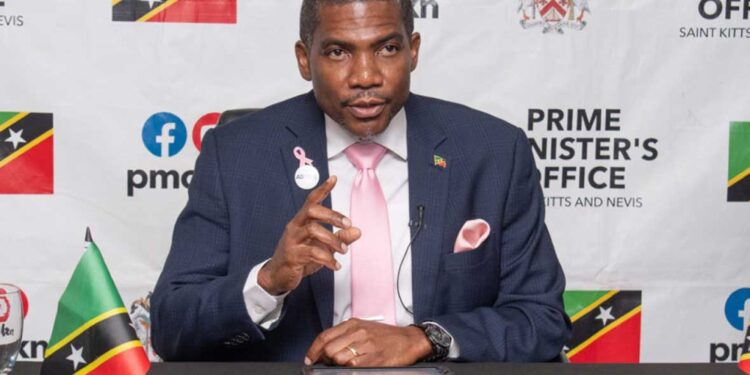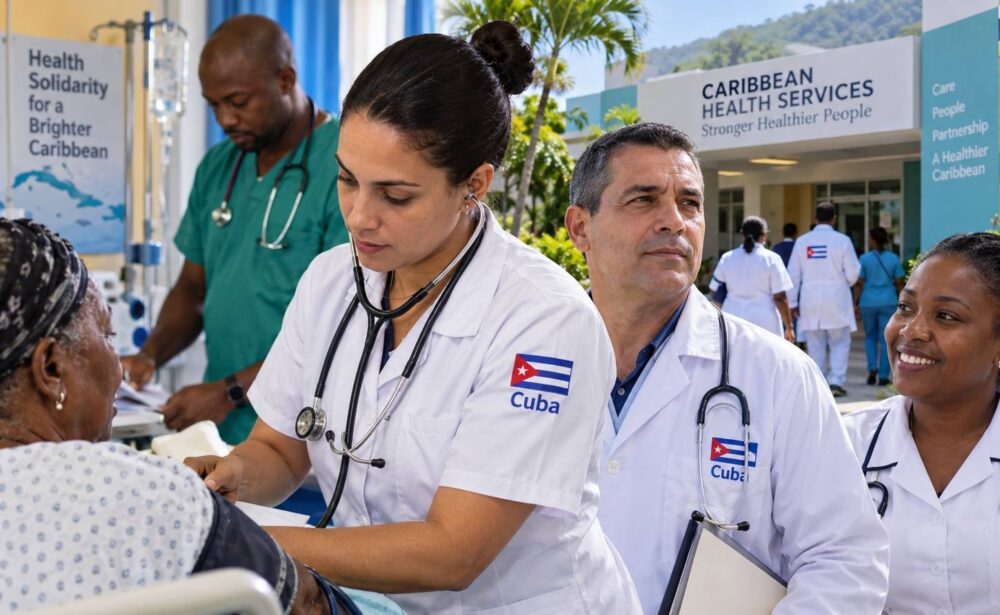
(WiredJA) In February 2026, chairing CARICOM’s 50th Heads of Government Conference in his own capital, Dr Terrance Drew defended Cuban medical cooperation against Washington’s charge of forced labour. St Kitts and Nevis, he said, pays Cuban doctors directly, and they keep their own passports. Drew is himself a Cuban-trained physician. Seven months later he was stabilised in a French intensive care unit in Martinique and flown to Florida for evaluation. Every axis of the region’s medical dependency ran through one man in a single week — and not one of those axes was Caribbean-owned.
What the Cuban solution actually was
For half a century, Cuban doctors, nurses, biomedical engineers and technicians were the load-bearing wall of Caribbean public health. Nearly 280 of them were working in Jamaica when the agreement ended. They served in Barbados, Dominica, Grenada, St Kitts and Nevis, St Lucia, St Vincent, Antigua and Guyana. They came after hurricanes and stayed through COVID. They also trained our own — Drew signed a cooperation memorandum with Havana in May 2025, calling the relationship “vital to our healthcare systems,” with twenty-two Kittitian and Nevisian students then studying medicine in Cuba.
That debt is real and should be stated without hedging. In much of this region, Cuban personnel were the difference between a clinic that opened and one that did not.
What it was never designed to do
But note precisely what was supplied. Cuba sent hands, not hardware.
It staffed our health centres, restructured primary care and drove down infant and maternal mortality. It never built a catheterisation laboratory in Basseterre, an oncology centre in Kingstown, or a stroke unit anywhere in the OECS. After fifty years of the most celebrated medical partnership in the developing world, the region still airlifts its heads of government to Florida.
We mistook staffing for capacity. A borrowed workforce keeps the doors open; it does not build a health system, and it was never Havana’s job to.
The unravelling, told straight
On 25 February 2025, the US State Department expanded visa restrictions targeting officials connected to Cuba’s labour-export programme, which Secretary of State Marco Rubio characterises as “forced labor.”
Within a year the structure came apart. Jamaica terminated its five-decade agreement in early March 2026; Havana withdrew 277 professionals. Days later, Cuba pulled a brigade of more than 200 from Guyana. Honduras cancelled, and over 150 personnel departed. Antigua and Barbuda turned to Ghana for 120 nurses.
Both governments’ accounts belong on the record. Kingston says it had been proposing a restructured deal since July 2025 — direct salaries, passports retained — and that “no substantive response was ever received.” Havana says Jamaica acted unilaterally under American pressure, and regrets the loss of a long collaboration.
There is a fact in the middle that neither side emphasises. In Guyana, the government moved to pay Cuban personnel their full salaries directly rather than routing most of it through the Cuban state — and Havana responded by withdrawing the brigade. Cuba walked away from direct payment. Any honest account of this rupture has to carry that sentence.
The part nobody in the region says out loud
Professional services are among Cuba’s largest sources of foreign exchange, with medical personnel the bulk of that export and estimates running into billions annually. Meanwhile Cuban doctors at home have been reported surviving on state salaries worth a small handful of US dollars a month.
Solidarity was also an export industry, and the workers saw the least of it. That does not make the missions slavery, and Washington’s language flattens something more complicated than its slogan allows. But it does mean the Caribbean spent fifty years praising an arrangement it never examined.
And the system that trained us is now failing
Cuba’s own health service is in open crisis. UN and WHO officials who visited in May 2026 reported suspended surgeries, disrupted blood banks and laboratories, and emergency care degraded by blackouts and fuel scarcity; the UN system in Cuba launched a $94.1 million emergency appeal in March. The CT scanner at Hermanos Ameijeiras, the island’s flagship hospital, has been out of service for months. Specialists are emigrating in numbers.
Part of that is the long decay of a command economy. A substantial part is a US fuel blockade imposed in January 2026. Both are true, and the region gains nothing by conceding only one.
So — what is Washington providing?
The fair answer is that it provided a great deal, and has been withdrawing it for nearly a decade.
PEPFAR has been foundational here. In Jamaica, roughly 70 per cent of HIV resources come from external sources, with PEPFAR covering about half of services. That is not charity at the margins; that is the response itself.
But the American retreat did not begin in 2025. The Bahamas lost its PEPFAR allocation in 2017, Barbados in 2018, and Guyana, Suriname and Trinidad and Tobago by 2019, as Washington concluded it could not justify funding upper-middle-income Caribbean states. Then came the harder phase: USAID was effectively shut on 1 July 2025, with about 86 per cent of its awards terminated, including 77 per cent of health awards. Congress has continued appropriating — $4.8 billion for PEPFAR in FY 2026 — but the machinery that delivered it was dismantled.
Washington is providing conditions. It has told Caribbean governments what workforce arrangement they may not have, while reducing the health financing it once supplied, while blockading the fuel that keeps the alternative system running. It has removed options without adding one.
That is not an anti-American observation. It is an accounting.
The bill, and who is going to pay it
Jamaica now recruits from India, Ghana and Nigeria. Antigua from Ghana. St Kitts and Nevis from Ghana and the Philippines. We have replaced one dependency with four, and called it diversification.
At no point in fifty years has the region been asked to build the thing itself: shared tertiary centres of excellence, a CARICOM specialist roster with genuine mobility, sovereign health financing, and reciprocal-care agreements with the French departments that sit inside our own archipelago and outside our habits.
Cuban doctors bought the Caribbean fifty years of time. Washington’s money bought us two decades more. Both were loans against a debt we never serviced, and both have now been called in.
The question is no longer what Cuba provided, or what Washington is providing. It is what we intend to provide for ourselves.