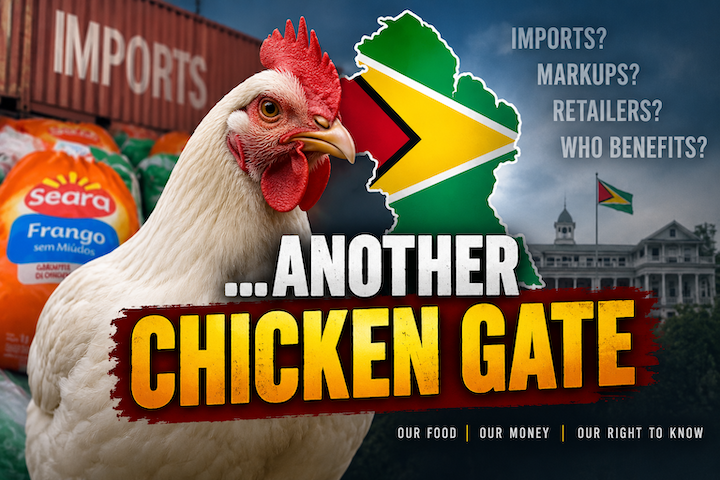
Questions surround the cost of Brazilian chicken bought by the container, GMC’s markup, participating retailers and who is benefiting from the multimillion-dollar import programme
By Village Voice News
The Government of Guyana says its decision to facilitate the importation of approximately 330,000 pounds of chicken every week is intended to increase supply and protect consumers from escalating prices. Yet imported Brazilian chicken is now being sold for approximately G$360 per pound, raising an obvious question: how does chicken purchased by the container from one of the world’s largest poultry-exporting countries reach Guyanese consumers at that price?
Agriculture Minister Zulfikar Mustapha said the temporary importation was necessary because domestic production was failing to meet demand. He was explicit about the objective of the intervention, saying, “I don’t want the price to escalate.” Approximately 330,000 pounds are expected to be imported weekly, with the New Guyana Marketing Corporation (GMC) facilitating the importation and distribution arrangements.
There are also whispers within the sector that government officials, politically connected individuals or associated businesses may be benefiting financially from the importation and distribution arrangements. Village Voice News has obtained no documentary evidence establishing those allegations and is not presenting them as fact. However, where a government intervention involving an essential food commodity creates a commercial operation worth hundreds of millions of dollars, such concerns make transparency even more important. The government can quickly put speculation to rest by publishing the purchase price, landed cost, distribution arrangements and the names of the businesses participating in the programme.
What Does the Chicken Actually Cost?
The imported product observed by Village Voice News is Seara frozen whole chicken without giblets, produced in Brazil. Current Brazilian wholesale market data provide a useful benchmark. CEPEA/ESALQ at the University of São Paulo reported frozen chicken at approximately R$7.52 per kilogram on September 3, 2026.
Guyanese consumers generally buy and understand chicken by the pound, so the conversion is important. One kilogram equals approximately 2.205 pounds. At approximately R$5.1 to US$1, the Brazilian benchmark works out to around US$1.47 per kilogram, or US$0.67 per pound. Using approximately G$209 to US$1, that translates to roughly G$139 per pound.
That G$139 figure is a Brazilian wholesale benchmark and should not be confused with proof of what the Guyana government, GMC or the importer actually paid. Indeed, Guyana is reportedly purchasing approximately 330,000 pounds, or almost 150,000 kilograms, every week. Purchases at that scale could attract prices substantially lower than that $139 figure, a number more appropriate for ordinary domestic wholesale transactions. This is precisely why the actual invoice matters. Guyanese should not have to estimate the government’s acquisition cost using Brazilian market data when the government itself possesses the invoices.
Even using the G$139-per-pound Brazilian wholesale benchmark, however, an illustrative calculation raises questions. If GMC were allowed a substantial 40 percent markup, G$139 would become approximately G$195 per pound. If a retailer then received another 40 percent markup on the GMC price, the retail price would rise to approximately G$273 per pound. Yet the imported chicken is being offered at approximately G$360 per pound, another G$87 per pound above that figure.
| Stage | Calculation | Price per lb |
|---|---|---|
| Brazilian wholesale benchmark | G$139 | |
| 40% markup for GMC | $139 × 1.40 | G$195 |
| Additional 40% markup for retailer | $195 × 1.40 | G$273 |
| Observed Guyana selling price | G$360 | |
| Difference | G$87 |
The calculations do not establish anybody’s profit. Refrigerated freight, insurance, port handling, customs processing, cold storage, transportation and other legitimate costs must be considered for ordinary private importers but not for a central government agency like GMC. Neither is Village Voice News suggesting that GMC and retailers are actually receiving 40 percent margins (they may actually be receiving less). The two hypothetical 40 percent markups are used to demonstrate how much room exists between the Brazilian wholesale benchmark and the price being charged in Guyana. But even after allowing a generous $139 price and 40 percent markup for GMC and another 40 percent for the retailer, the resulting G$273 price remains substantially below G$360.
Put another way, G$360 is approximately 159 percent above the G$139 Brazilian wholesale benchmark. The relevant question is therefore what legitimate costs and margins account for that difference.
Insider Alleges Government Margin Exceeds 100 Percent
An insider familiar with the arrangements, who spoke with Village Voice News on condition of anonymity, alleges that the government is making more than 100 percent on the imported chicken.
Village Voice News has not independently verified that assertion. Without disclosure of the actual acquisition price, freight charges, landed cost and GMC selling price, independent verification is impossible. That allegation nevertheless makes publication of the government’s numbers even more important. If it is wrong, the invoices and cost breakdown will demonstrate that. If it is correct, the public deserves an explanation as to why an intervention introduced specifically to reduce the price of an essential food item is producing such a substantial margin.
Almost $119 Million in Chicken Every Week
The scale of the programme makes these questions significant. At 330,000 pounds per week multiplied by G$360 per pound, the chicken represents approximately G$118.8 million in weekly sales value. Over four weeks, that amounts to approximately G$475.2 million.
This is therefore not a small emergency shipment. It is potentially a major commercial operation involving hundreds of millions of dollars every month. That raises questions the Ministry of Agriculture and GMC should answer. Who negotiated the purchase from Brazil? Who is the importer of record–clarify whether it is really GMC? How are retailers selected? Who selected the supplier? Was there competitive procurement? What price per kilogram was negotiated and, more importantly for Guyanese consumers, what did government actually pay per pound? What was the freight cost? What is the actual landed cost per pound after shipping, insurance and handling? Who provides the cold storage and transportation, and how much are those companies being paid?
And given the whispers now circulating about possible beneficiaries of the programme, government should disclose whether any elected official, government official, relative, associate or politically connected individual has a direct or indirect financial interest in any business participating in the importation, transportation, storage, distribution or retailing of this chicken.
These questions should not be mistaken for accusations. They are questions that naturally arise when government intervenes directly in the market for an essential food commodity and hundreds of millions of dollars flow through the resulting supply chain.
Who Are the Retailers?
There is another important question that remains unanswered: Who exactly is selling the government-facilitated chicken?
Government reporting has indicated that GMC is facilitating the importation while the chicken is distributed through local distributors and suppliers. If GMC receives imported chicken and passes it to selected businesses, Guyanese should know which businesses were selected, how they were selected, what quantities they received and what they paid.
Consumers also need to know precisely where the G$360-per-pound price occurs in the supply chain. Is $360 GMC’s selling price? Is it the price charged by a distributor? Is it the retailer’s final selling price? Or is it a government-recommended consumer price?
Those distinctions are critical. If GMC is supplying the chicken considerably below $360 and retailers are taking the price to $360, then scrutiny should properly fall on those retailers and their margins. If GMC itself is supplying the chicken at or close to $360, an entirely different question arises about the government’s own pricing.
The names of the distributors and retailers participating in the programme should therefore be published, along with the prices at which the chicken changes hands.
Publish the Invoice
There may be a perfectly legitimate explanation for the G$360 price. But that explanation should be provided with numbers rather than assurances.
The Ministry of Agriculture and GMC should publish the Brazilian supplier, total quantity contracted, purchase price per kilogram and equivalent price per pound, freight and insurance costs, total landed cost per pound, duties and taxes paid or waived, GMC’s selling price, names of distributors and retailers receiving the chicken, quantities allocated to each and any recommended or agreed retail price.
Government should also disclose whether any elected official, public official, relative, associate or politically connected company has a direct or indirect financial interest in any business involved in importing, transporting, storing, distributing or retailing the chicken.
An unnamed insider’s allegation that government is making more than 100 percent on the chicken remains an allegation until supported by documentary evidence. Likewise, whispers that government officials or politically connected persons are benefiting financially remain unsubstantiated. Transparency is how the government answers those concerns.
The administration intervened in the market because local chicken had become extraordinarily expensive and Guyanese consumers needed relief. If chicken purchased by the container in one of the world’s largest poultry-producing countries is nevertheless reaching those consumers at G$360 per pound, citizens have a legitimate interest in knowing every significant cost and margin between the Brazilian supplier and their dinner table.
The government has those numbers. Publish the invoice. Publish the landed cost. Publish GMC’s selling price. Publish the distributors and retailers. Publish the margins. Then Guyanese consumers can determine for themselves whether the programme is delivering the relief they were promised, or whether someone is making an extraordinary amount of money from a national shortage.