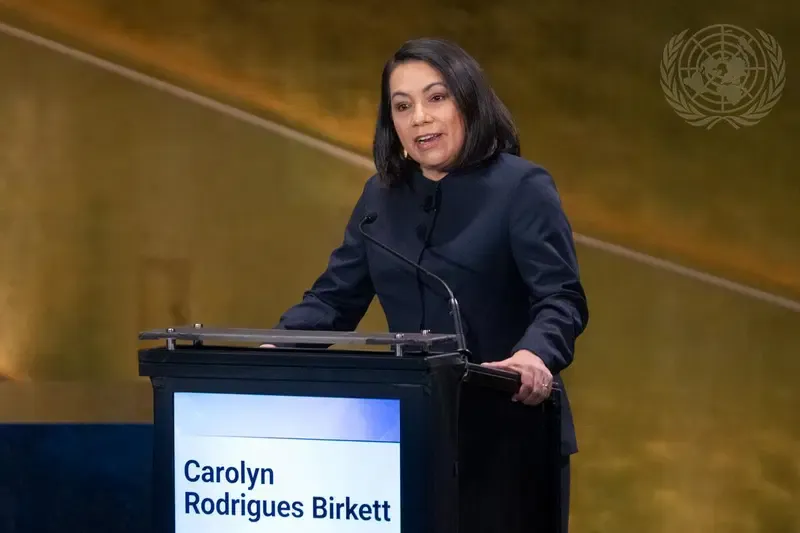
Guyana’s candidate for United Nations Secretary-General, Ambassador Carolyn Rodrigues-Birkett, has come under scathing criticism from Wall Street Journal editorial board member Elliot Kaufman, who accuses her of “raging ignorantly” against Israel while praising former Cuban leader Fidel Castro.
Kaufman made the comments in an opinion article published in the Wall Street Journal on August 31, 2026, titled “They Forget Who Started the War.” His column comes as the race to succeed UN Secretary-General António Guterres intensifies, with Rodrigues-Birkett emerging as the leading candidate in the latest Security Council straw poll.
In the August 21 poll, Rodrigues-Birkett received eight “encourage” votes, placing her ahead of Costa Rican economist and UN trade official Rebeca Grynspan and Argentine diplomat Rafael Grossi, who each received seven. The poll is non-binding, however, and the eventual nominee must secure the support of the Security Council, including avoiding a veto from any of its five permanent members.
Kaufman argues that Rodrigues-Birkett’s record deserves scrutiny, particularly her statements on Cuba, Israel and the Israeli-Palestinian conflict.
He points to remarks Rodrigues-Birkett made in 2013, when she was Guyana’s Foreign Minister, during celebrations marking 40 years of diplomatic relations between Guyana and Cuba.
She said:
“To speak about Cuba, its achievements, its resilience, its focus on human development,” Ms. Rodrigues-Birkett said, “cannot be done without paying tribute to the visionary, determined, revolutionary behind it all, Comandante Fidel Castro. . . . Let us also pay tribute to Comandante Fidel not only for what he has done for Guyana, but also for humanity at large.”
Kaufman contrasts that praise with what he describes as Rodrigues-Birkett’s “full of invective” approach to Israel.
According to the columnist, Rodrigues-Birkett has repeatedly accused Israel before the UN Security Council of “genocide” and alleged that Israel has “colonialist aspirations, fueled by a racist and religious ideology of superiority.”
He also highlights her May 2024 criticism of Israel’s evacuation orders in Gaza.
“Quite cynically,” she said in May 2024, “it has urged civilians to evacuate to safe zones.”
Kaufman argues that the comment ignored Israel’s efforts to evacuate civilians from areas of combat, particularly Rafah, while Hamas continued operating from within Gaza.
But it is Rodrigues-Birkett’s interpretation of the origins of the Israeli-Palestinian conflict that appears to draw Kaufman’s strongest criticism.
In September 2024, Rodrigues-Birkett told the Security Council:
“The situation in Palestine today did not begin on 7 October 2023. We must cast our minds back to 1948 because it was in that year that Israel first violently rejected the two-state solution.”
Kaufman directly challenges that account, arguing that the Jewish community in Palestine accepted the 1947 UN partition proposal, while Arab leaders rejected it and war followed in 1948.
He similarly rejects what he describes as the tendency to portray the current Gaza war primarily as a story of Israeli aggression, arguing that Hamas initiated the war with its October 7, 2023 attack on Israel.
“Hamas started the war by massacring Jews on Oct. 7, 2023,”
Kaufman writes.
He argues that Hamas’ attack and subsequent refusal to release hostages must remain central to any assessment of the conflict, even as Israel’s military response has produced widespread destruction and civilian suffering in Gaza.
Rodrigues-Birkett has nevertheless continued to position Guyana strongly on the Palestinian issue at the Security Council, while condemning Hamas and calling for an end to the violence and the release of hostages.
Her emergence as the frontrunner in the UN Secretary-General race now places those positions under a much brighter international spotlight.
For Guyana, the stakes are significant. Rodrigues-Birkett’s candidacy represents an opportunity for the country to produce its second UN Secretary-General candidate and potentially elevate a Guyanese diplomat to the highest administrative position in the international organization.
But Kaufman’s intervention puts a sharp question at the center of that campaign: whether Rodrigues-Birkett’s record on Israel and the Middle East conflict reflects the impartiality and diplomatic judgment expected of the UN’s chief international official.