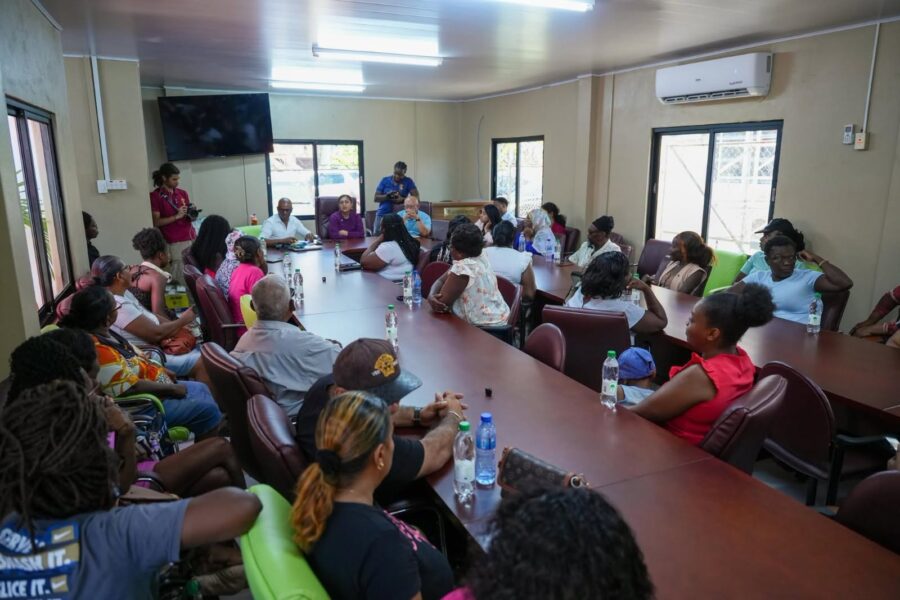
By Mark DaCosta- In an effort to engage with vendors impacted by infrastructure improvements along Woolford Avenue, the Ministry of Local Government and Regional Development is reportedly seeking solutions that support both economic activities and development. The recent dialogue with vendors on Monday August 31, led by Minister Priya Manickchand and Permanent Secretary Miguel Choo-Kang, underscores the government’s concerns.
The upgrading of Woolford Avenue has sparked discussions about the balance between development and community needs. The initial phase of these upgrades has seen expansions in road space and drainage. The ministry’s engagement with these vendors aims to forge a path that acknowledges their challenges while promoting the broader objectives of urban development.
Minister Manickchand articulated a key understanding during the discussions, stating, “The removal of vendors was not the objective of the works.” This sentiment reflects the ministry’s intention to restructure vending operations in a manner that aligns with the improvements taking place, thus ensuring that those who rely on street vending for their income are included in the planning process. The aim is to find a middle ground where the needs of vendors are met alongside the aspirations for a more developed landscape.
The dialogue with vendors was reportedly not merely a one-sided affair; it was characterised by active listening. Minister Manickchand took the time to hear out the concerns and suggestions put forth by the vendors, who voiced their desire for a more organised vending environment that would complement the ongoing renovations. The ministry is exploring the possibility of establishing formalised vending structures, which could potentially mitigate conflicts with nearby canteens and other food service providers, all while keeping public safety and order in mind.
An additional layer of complexity exists in the relationship between vendors and schools located nearby. Discussions highlighted existing struggles faced by vendors in acquiring the necessary approvals to operate, which often hinders their ability to engage with the community adequately. As a result, the ministry has pledged to conduct further discussions involving vendors, local canteen operators, and school administrators to establish an arrangement that takes into account the interests of all stakeholders.
In reaffirming the ministry’s resolve, Minister Manickchand stated, “Progress should improve communities while fostering opportunities for the people who live and earn within them.”
The government, through the Ministry of Local Government and Regional Development, emphasised that its commitment extends beyond mere infrastructural upgrades. The focus is on fostering a collaborative environment with communities and their stakeholders.
As the discussions progress, it is clear that the path forward must not only consider the physical enhancements of our urban landscapes but also the human aspects those transformations impact.