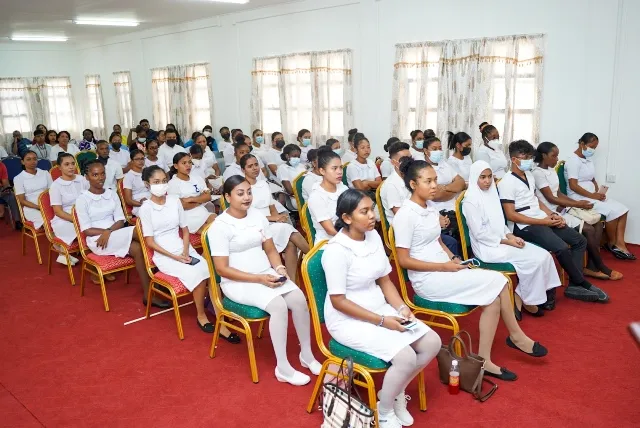
The People’s Progressive Party (PPP) Government’s aggressive push to expand nursing training nationally is raising questions about its decision five years ago to suspend nursing programmes at the Charles Rosa School of Nursing in Linden, a move that sparked public condemnation and left students questioning their future.
On April 29, 2021, first-year students at Charles Rosa were informed that their nursing programme had been suspended with immediate effect, barely weeks after classes began. The affected students had started classes on March 8, 2021, after some had waited almost two years for an opportunity to enter the programme.
The decision triggered anger among students, parents and political representatives in Region 10, with critics arguing that the Government was taking away one of the few accessible pathways to professional training available to young people in Linden.
One student described the impact bluntly:
“This is very devastating and I am sure my batch mates feel the same way because it left a lot of us without a job because individuals like myself had to leave their jobs to attend nursing school and we were already replaced and it is hard to stay home and do nothing.”
The Government defended the decision at the time as a matter of national workforce planning, not the abandonment of Linden.
The Ministry of Health said a review had found that Region 10 had an excess of 233 registered nurses and 106 registered nursing assistants, while other regions were experiencing shortages. It therefore temporarily suspended Batch #66 of the professional nursing programme and Class #17 of the registered nursing assistant programme.
But the explanation did little to quiet criticism because nursing training was not simply an employment statistic for Linden. It was an avenue through which young people—particularly those without the financial means to study outside the region—could acquire professional qualifications and enter a stable career.
The controversy becomes more striking in 2026, as the same PPP administration promotes a dramatic expansion of nursing education and recruitment.
The 2026 Budget says Government trained 2,862 nursing and allied health professionals in 2025 and has set a target of 5,440 in 2026. Over five years, it says, Guyana intends to recruit and train at least 6,000 nurses.
Health Minister Dr Frank Anthony has said the traditional nursing schools in Georgetown, New Amsterdam and Linden historically produced only about 200 nurses a year. Under the new hybrid model, however, the Government expected 800 people to graduate in July 2026, with successful graduates to be employed by the Ministry of Health.
The Government has also touted the first major results of the hybrid programme, reporting 669 graduates, with training combining online instruction, simulation laboratories and supervised clinical rotations.
That expansion exposes an uncomfortable question for the PPP: if Guyana now needs thousands more nurses, why was nursing training in Linden suspended in the first place?
The Government has since insisted that Charles Rosa was never permanently closed. In 2023, Anthony said the school remained operational and argued that the hybrid model actually allowed it to accommodate far more students than the traditional classroom system. By 2025, Government reported that 379 students were enrolled at the institution.
That distinction is important, but it does not erase the consequences of the 2021 suspension for the students whose training was interrupted or whose opportunities were delayed.
Nor does the Government’s explanation fully answer the broader policy question. A nursing school can simultaneously be operational and still have its intake or programmes curtailed in a way that affects a community.
The Government’s current policy suggests that the national shortage of trained healthcare workers is now sufficiently serious to justify a massive expansion of training. It is also investing in regional simulation centres and specialised programmes in areas such as critical care, neonatal care and surgical nursing.
In other words, the policy priority has shifted dramatically—from controlling regional intake because of alleged staffing imbalances to urgently producing thousands more nurses.
That reversal deserves scrutiny.
The PPP Government can legitimately argue that circumstances have changed, Guyana’s population and healthcare infrastructure are expanding, and the distribution of nurses needed to be addressed nationally. But it must also account for the young people in Linden who bore the immediate cost of the 2021 decision.
For Region 10, the issue is therefore bigger than whether Charles Rosa was technically “closed.”
It is about whether a government that now says Guyana desperately needs nurses made the right decision when it suspended nursing training in Linden—and whether the opportunities lost by young Guyanese five years ago could have been preserved while the national workforce imbalance was being addressed.