The Government is seeking to guarantee former presidents a lifetime of extensive publicly funded benefits, including unlimited household utilities, medical care, security, staff and transportation, even as thousands of Guyanese struggle with low wages, rising living costs and gaps in essential public services.
That is the stark contrast confronting the country as the National Assembly prepares to debate the Former Presidents (Benefits and Other Facilities) Bill 2026 on Wednesday, November 11.
The proposed legislation would restore a benefits framework that removes several restrictions imposed under the 2015 law. It has provoked strong objections from trade union representatives, opposition politicians and members of the public, including former Minister and Parliamentarian Annette Ferguson, who has taken her opposition directly to the gates of the Office of the President.
Ferguson has been leading a public protest campaign demanding that the Government withdraw the legislation, arguing that taxpayers should not be burdened with virtually unlimited privileges for former presidents while ordinary citizens struggle to meet basic needs.
The controversy also raises a broader question about the Government’s priorities: why is legislation guaranteeing extensive privileges for former holders of the highest political office advancing while demands for improved wages, better healthcare and greater economic relief remain pressing concerns?
What the Bill would provide
The proposed legislation provides for former presidents to receive benefits throughout their lifetimes, including payment of household utility bills, medical treatment for themselves and dependent family members, household staff, administrative support, personal security and state-owned and maintained vehicles.
It also provides for toll-free road transportation, annual vacation travel and tax concessions.
The Bill would remove restrictions introduced under the 2015 legislation, including limits on utility payments, medical reimbursements, staffing, security and vehicles. It would also remove provisions affecting eligibility when a former president engages in paid employment or business.
The Government’s position is that the legislation restores the framework established under the 2009 law. Attorney General Anil Nandlall has argued that the 2015 legislation was flawed and that the proposed changes do not materially expand the benefits previously available.
However, the restoration of benefits without the earlier limits has become the central point of contention.
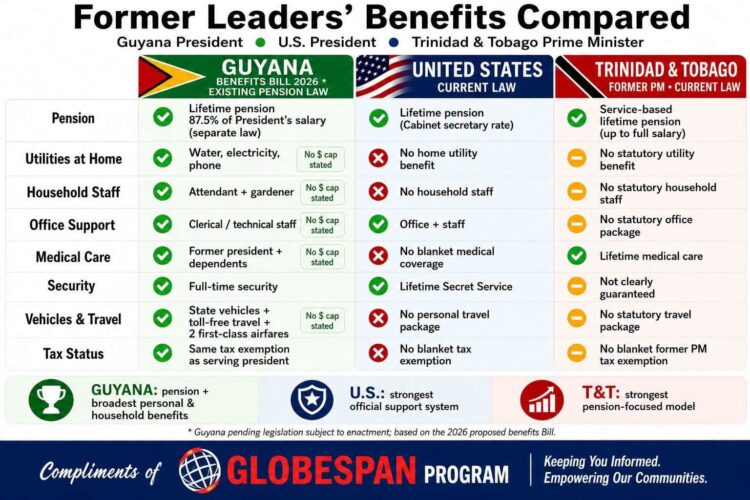
The issue is not whether individuals who have served as president should receive reasonable support after leaving office. It is whether taxpayers should be required to finance an open-ended package of privileges without clearly defined limits, particularly when public resources are also needed to address the challenges confronting the wider population.
Workers cannot ignore the disparity
The proposed benefits are being advanced against a difficult economic backdrop for many working families.
The Bank of Guyana’s 2025 Annual Report placed the monthly minimum wage for public servants at G$102,346. The Guyana Public Service Union’s estimated living wage, is approximately G$215,000 per month.
The difference illustrates the financial strain facing public employees who must meet the costs of food, housing, transportation, utilities and other necessities.
Guyana’s poverty situation also remains a serious concern, although the country lacks sufficiently recent comparable data to establish a reliable current national poverty rate. The World Bank’s widely cited estimate placed 48 per cent of the population below the US$5.50-a-day poverty threshold using 2019 data. That historical figure should not be mistaken for a current measurement, but it underscores the importance of obtaining updated information on household welfare.
Against this background, the proposal to restore extensive benefits for former presidents has struck a nerve.
Lincoln Lewis, General Secretary of the Guyana Trades Union Congress, described the move to restore unlimited benefits as “vulgar and unconscionable”.
In his criticism, published by Village Voice News, Lewis questioned the morality of guaranteeing former presidents extensive publicly funded provisions while workers continue to struggle for decent wages and many citizens face inadequate access to essential services.
The Working People’s Alliance has also opposed the Bill, while citizens and opposition representatives have participated in protests against the proposed arrangements. Kaieteur News reported on demonstrations in which the legislation was denounced as an excessive use of national resources.
The objections are not simply about the cost of providing former presidents with benefits. They concern the apparent imbalance between what the State is prepared to guarantee former political leaders and what ordinary citizens can reasonably expect from the public services they depend upon.
Medical privileges amid healthcare challenges
The proposed medical provisions have added another dimension to the controversy.
Former presidents and their dependent family members would be entitled to medical treatment or reimbursement under the proposed framework. Meanwhile, ordinary Guyanese continue to raise concerns about access to public healthcare, shortages of medical personnel and the quality and consistency of services.
The Pan American Health Organisation has identified shortages of healthcare workers, uneven quality of care and barriers to accessing services, particularly in rural and hinterland communities, as continuing challenges for Guyana.
The World Bank has also highlighted healthcare workforce shortages in hinterland regions.
These concerns exist alongside the Government’s substantial investments in new hospitals and health facilities. Those investments are important, but infrastructure alone cannot guarantee effective healthcare without adequate staffing, equipment, supplies and consistent service delivery.
In February 2026, opposition parliamentarians raised concerns in the National Assembly about patients allegedly being redirected from public facilities to private clinics. Health Minister Frank Anthony responded that no patient should be denied care and encouraged members of the public to report such incidents.
The contrast is difficult to dismiss: the proposed law would provide extensive medical arrangements for former presidents and their dependants, while the wider population continues to depend on a public healthcare system facing significant operational challenges.
Parliament must account to the people
The timing of the Bill has also brought renewed attention to the limited number of parliamentary sittings.
The 13th Parliament held only four plenary sittings during its first 12 months following the September 2025 general elections. The report noted that the comparable first-year figures were 31 sittings after the 2011 elections, 36 after the 2015 elections and 24 after the 2020 elections.
The National Assembly first met on November 3, 2025, followed by sittings on January 26, February 2 and June 5, 2026. The November 11 meeting is the sixth sitting listed for the current session.
The Order Paper includes the former presidents’ benefits legislation alongside public accounts, audit reports, the 2026 mid-year report and other matters requiring scrutiny.
The frequency of parliamentary sittings matters because the National Assembly is one of the principal institutions through which government spending, policy decisions and the conduct of public officials are examined. A Parliament that meets infrequently risks limiting opportunities for meaningful public debate and sustained oversight.
The Government says the proposed benefits framework restores an established arrangement and ensures equal treatment for former presidents. That explanation, however, does not remove the need to justify the scale of the entitlements, their long-term cost to taxpayers and the absence of the restrictions contained in the 2015 law.
Guyana’s oil revenues have created significant opportunities for national development. The test of responsible governance is whether that wealth translates into better living conditions, stronger public services and greater economic security for the population.
Former presidents may be entitled to dignity and reasonable support after leaving office. But public resources must also serve the people who finance the State and depend on it for healthcare, education, infrastructure and economic opportunity.
As the Bill reaches the National Assembly, the public deserves clear answers about the cost of these lifetime provisions, the safeguards governing their use and why the Government considers their restoration a priority at this time.
The ultimate measure of national development cannot be the privileges guaranteed to those who once occupied the highest office. It must be the quality of life enjoyed by the people who entrusted them with power.