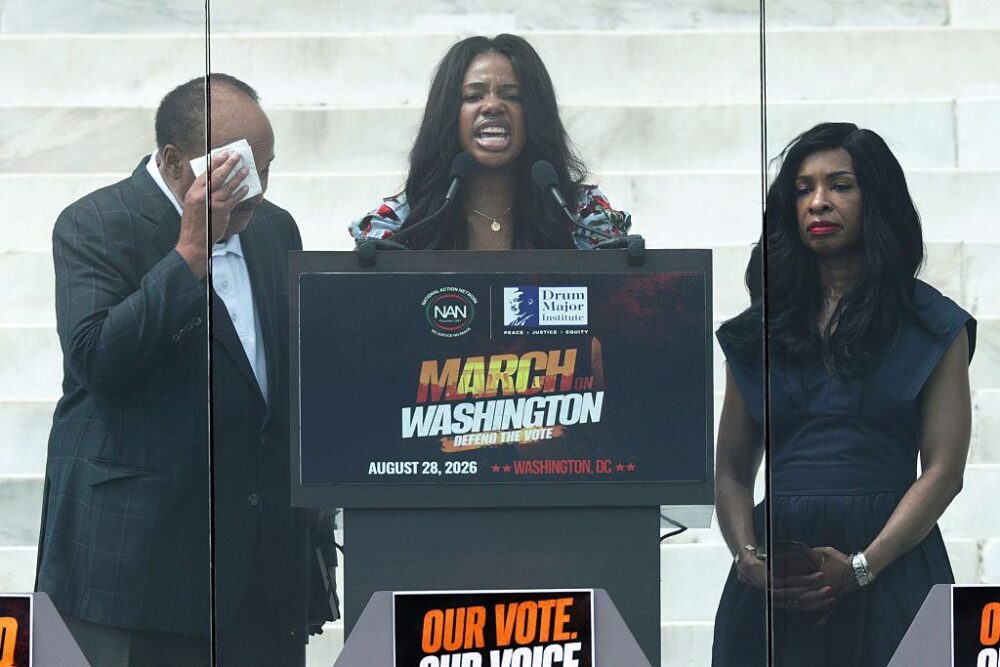
Sixty-three years after more than 250,000 Americans converged on the nation’s capital demanding jobs, freedom and racial equality, a new generation returned to the Lincoln Memorial, Washington DC, USA on Friday, August 28, to confront what civil rights leaders described as renewed threats to voting rights and democratic freedoms.
The anniversary marked the 63rd anniversary of the historic March on Washington for Jobs and Freedom, held on August 28, 1963, when civil rights, labour, religious and community organisations joined forces in one of the largest demonstrations for civil rights in American history.
The original march was about far more than the speech that made Martin Luther King Jr.’s name synonymous with the American civil rights struggle.
Organisers demanded comprehensive civil rights legislation, an end to segregation, decent housing, integrated education, voting rights and an end to employment discrimination. They also called for a federal jobs programme, a higher minimum wage and stronger protections for workers.
The march therefore brought together racial justice and economic justice—a combination that remains central to its legacy.
It was against that historic backdrop that 18-year-old Yolanda Renee King, Dr. King’s granddaughter, addressed Friday’s gathering at the Lincoln Memorial.King, who never met her grandfather or grandmother, Coretta Scott King, told the crowd that the responsibility for carrying the movement forward now rests with her generation.
“I know something they both understood: a dream without work is just a wish.”

AFP via Getty Images
She urged young Americans to “pick up the baton” and “restore the dream,” declaring that her generation would be the one to protect the right to vote.
Her words echoed the central lesson of the original march: that progress does not happen simply because a powerful speech is delivered or a historic demonstration is held. It requires sustained organizing, political pressure and ordinary people willing to challenge injustice.
A march for jobs and freedom
The 1963 demonstration was conceived largely by labour leader A. Philip Randolph and organised with the crucial assistance of Bayard Rustin. It brought together a broad coalition of civil rights and labour organisations, including the NAACP, National Urban League, Congress of Racial Equality, Student Nonviolent Coordinating Committee and King’s Southern Christian Leadership Conference.
Their demands reflected the realities confronting Black Americans at the time: racial segregation, disenfranchisement, discrimination in employment, inadequate housing and education, and widespread economic inequality.
King’s famous “I Have a Dream” speech became the defining moment of the day, but the march itself was rooted in a much broader political program.
Its impact was substantial. Within two years, Congress enacted the Civil Rights Act of 1964 and Voting Rights Act of 1965, landmark laws addressing several of the injustices that marchers had taken to Washington to confront.

The unfinished work
Friday’s gathering, called “March on Washington 2026: Defend the Vote,” deliberately connected the struggles of 1963 with contemporary concerns about voting rights, economic opportunity and civil rights. Organizers described it as a Black-led, multiracial, interfaith and intergenerational mobilisation.
The King Center, founded in memory of Dr. King, has similarly emphasised that the meaning of the original march extends beyond commemoration. Dr. Bernice A. King has described its enduring themes as economic and racial justice, hope, unified power and nonviolent direct action.
That connection between past and present was perhaps most clearly expressed by Yolanda King. Her message was not simply that Americans should remember what her grandfather accomplished. It was that remembering is insufficient.
The generation that inherited the gains of the civil rights movement must decide whether it will defend them—and whether it will continue the work of expanding freedom and equality.
More than six decades after her grandfather stood before the Lincoln Memorial and spoke of a dream, his granddaughter stood on the same ground with a message of her own: the dream survives only when each generation is willing to work for it.