Residents of Chinese Landing, an Indigenous community in Guyana’s Region One, have blocked heavy mining equipment from entering their titled lands, reviving a yearslong dispute over mining rights and the government’s responsibility to protect the community.
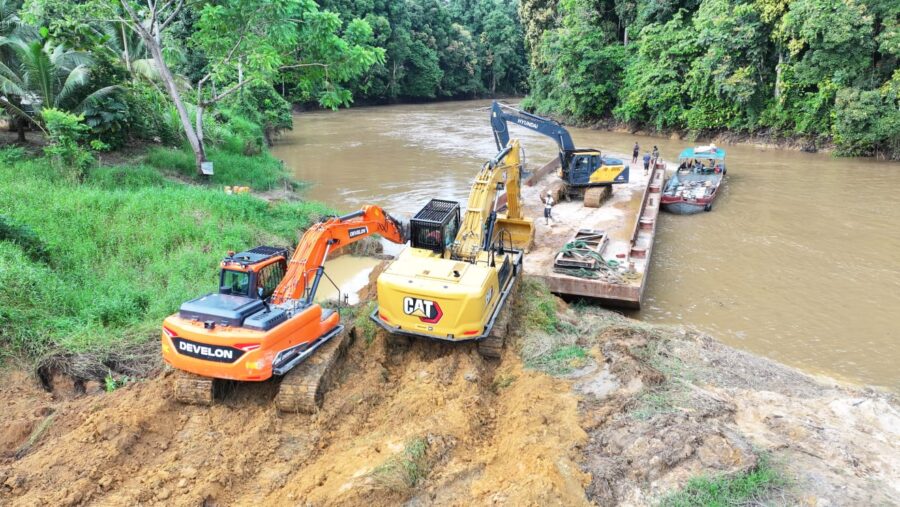
The standoff at Tassawini has continued as residents maintain a round-the-clock presence at the entrance to the backdam. The Chinese Landing-Tassawini Village Council said at least nine excavators, two bulldozers and several dredge engines had recently been transported into the community without its knowledge or consent.
Residents subsequently prevented four additional excavators and a bulldozer from proceeding into Tassawini.
Toshao Nikita Miller has said the community will not allow the machinery to enter while the dispute remains unresolved.
The confrontation involves mining operations associated with businessman Wayne Vieira, whose mining permits cover areas within Chinese Landing’s titled lands.
Natural Resources Minister Vickram Bharrat said the government is facilitating talks between the parties and that a meeting would be held to find a way forward. He did not announce a date for the meeting or say what measures would be taken while the standoff continues.
A dispute dating back decades
Chinese Landing received legal title to its lands in 1976. The dispute over mining in Tassawini has continued for decades, including legal battles between the Village Council, Vieira and the Guyana Geology and Mines Commission.
Government records show that Vieira’s medium-scale mining concession in Tassawini dates to 1995. The government has acknowledged that the concession predates the Amerindian Act of 2006, which established requirements concerning village consent for mining activities on Indigenous lands.
The GGMC issued a cease-work order against Vieira in 2010 after the Village Council complained that there was no formal agreement allowing him to mine. Vieira challenged the order, and the dispute eventually reached the Caribbean Court of Justice.
In 2017, the CCJ ruled in Vieira’s favour, finding that the GGMC officer who issued the cease-work order did not have the statutory authority to enforce the Amerindian Act through the Mining Act in the circumstances of that case. The government subsequently renewed Vieira’s mining permits.
The community later brought another legal challenge. That case was dismissed by the High Court and has been appealed, according to community representatives.
International human-rights concerns
The dispute has also drawn the attention of the Inter-American Commission on Human Rights.
In 2023, the commission issued precautionary measures for members of the Chinese Landing community after receiving allegations of threats, harassment, violence and environmental harm linked to mining activities.
The Guyanese government subsequently announced a temporary halt to mining in Chinese Landing and said it would take steps to comply with the commission’s measures. Those measures included government fact-finding, consultation with the Village Council and miners, and steps to address social and environmental concerns.
The renewed confrontation has raised questions about whether those commitments have been fully implemented.
The Guyana Human Rights Association on Tuesday called for international intervention, urging the United Nations and Inter-American human-rights systems to press Guyana to implement the precautionary measures and prevent further escalation.
The Village Council has also said the equipment was brought in while it was engaged in discussions with Vieira over a temporary arrangement pending the outcome of the court proceedings.
For residents, however, the immediate concern is the presence of machinery on or near their titled lands without the council’s approval.
For the government, the dispute presents a difficult legal and political balancing act: Vieira holds mining permits recognized through the courts, while Chinese Landing holds title to the land and maintains that its rights must be respected.
As the machinery remains at Tassawini and residents continue their blockade, the government’s proposed talks face an urgent test: whether they can prevent another confrontation while addressing a dispute that has remained unresolved for decades.