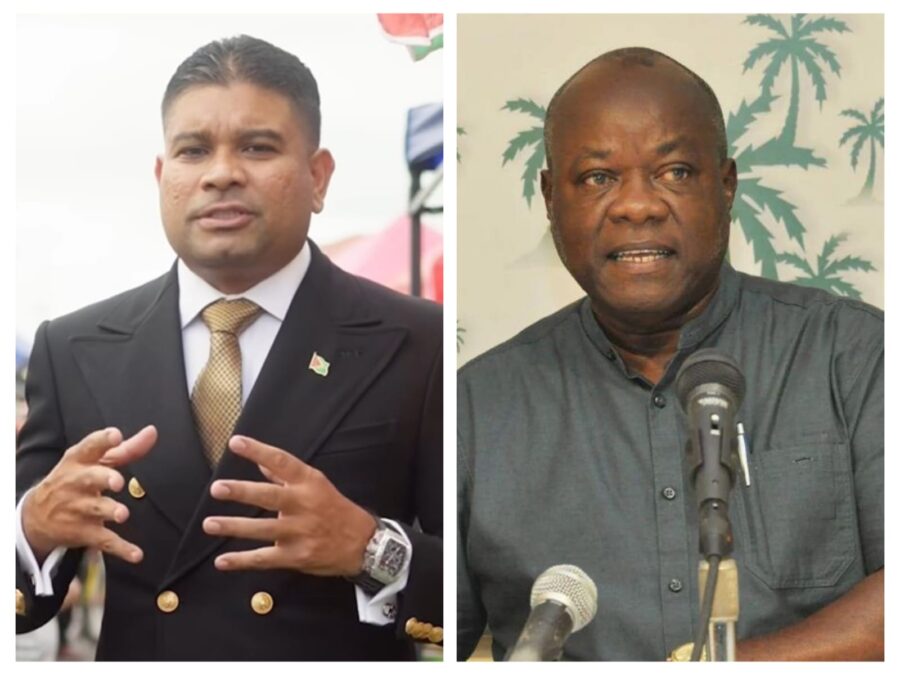
Opposition Leader Azruddin Mohamed and A Partnership for National Unity (APNU) Chairman Aubrey Norton are scheduled to meet at 11:00 a.m. today as pressure mounts on Guyana’s fractured opposition to put aside political differences and forge a more effective united front against the governing People’s Progressive Party/Civic (PPP/C).
The meeting follows a growing dispute over opposition representation on the Local Government Commission (LGC), but the discussions are expected to extend to several other contentious issues affecting Guyana’s democratic institutions.
Mohamed, leader of the 16-seat We Invest in Nationhood (WIN), invited Norton and an APNU delegation to discussions after Norton objected to APNU being excluded from the three opposition nominations submitted for the LGC. APNU holds 12 seats in the 65-member National Assembly, while the Forward Guyana Movement (FGM) holds one.
Norton had proposed Joan Ramaschindo and Ronald Daniels as APNU nominees, but the names submitted for consideration were Leona Narine and Leslyn Lowe of WIN and Nicholas Chesney of FGM. Norton subsequently demanded that APNU be given at least one seat on the commission.
The disagreement has exposed the continuing difficulty of coordinating the opposition despite the parties collectively holding 29 parliamentary seats against the PPP/C’s 36.
Mohamed’s invitation also places GECOM representation, opposition scrutineers and the leadership of the Region 10 Regional Democratic Council on the agenda.
The meeting itself became a subject of negotiation after Norton agreed to engage but objected to meeting at the WIN headquarters, insisting on a mutually agreed neutral venue. By Sunday, arrangements were being worked out, including the possibility of using a meeting room at Parliament Buildings or an agreed private establishment.
The talks come amid repeated calls from civil society and political observers for the opposition to overcome internal rivalries and operate as a coherent force capable of scrutinising the PPP/C Government and holding it accountable.
Veteran trade unionist and Guyana Trades Union Congress (GTUC) General Secretary Lincoln Lewis has been outspoken about the opposition’s failure to work together. In his Eye on Guyana column, Lewis argued that opposition politics must move beyond personalities and factional interests and be grounded in constitutional principles.
In urging Mohamed and Norton to put Guyana first, Lewis wrote:
“We must move beyond personality politics to politics grounded in principles. Those principles are enshrined in the Constitution of Guyana.”
Lewis said political leaders cannot condemn exclusion by the Government while themselves preventing others from participating in decision-making where the Constitution requires inclusion.
“You cannot claim alienation by the Government while, at the same time, using—or rather, misusing—the Constitution to deny others the right to be involved in decision-making as mandated by the Constitution.”
His appeal comes amid deepening disputes over representation on state institutions, including GECOM and the LGC, and failure of the parliamentary opposition to develop and pursue a common agenda. The Opposition Leader has argued that Guyana’s post-2025 political reality requires opposition representation on key institutions to reflect the current parliamentary configuration, while APNU has challenged aspects of WIN’s approach.
Lewis warned that the present moment offers the opposition an opportunity to break from what he described as Guyana’s entrenched “garrison politics.”
“[Today], you have the opportunity to chart a new course for this society, one that has grown tired of garrison politics. Or you can continue to lead this society down a path of no return.”
He made a direct appeal to the two opposition leaders:
“I call on you, gentlemen, to let good sense prevail. Put the Constitution and the nation first, for they should never be seen as separate entities but as intertwined.”
Today’s meeting therefore carries significance beyond the immediate LGC dispute. Whether Mohamed and Norton can establish a mechanism for cooperation could determine how effectively the opposition confronts the Government on issues ranging from electoral reform and local government to accountability, governance and the management of Guyana’s oil wealth.
The challenge is no longer simply whether WIN and APNU can agree on institutional appointments. It is whether two major opposition forces can overcome their rivalry sufficiently to convince a divided electorate that they are capable of acting in the national interest.