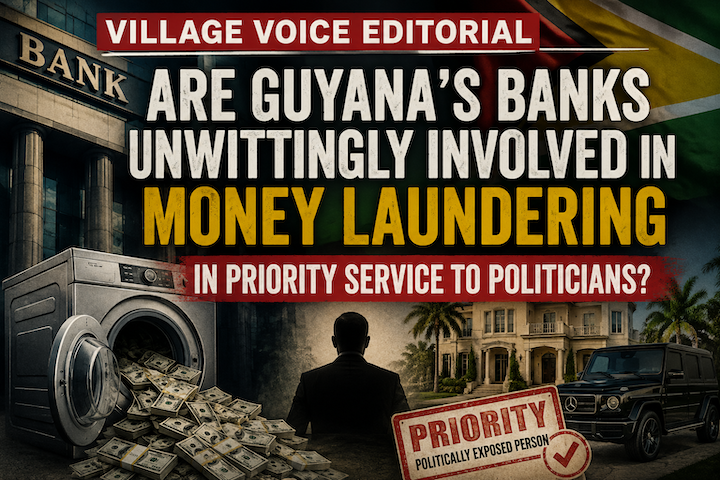
There is a question Guyana needs to begin asking about the extraordinary wealth increasingly associated with some of our political leaders. It is not simply where the money came from. It is this: Are Guyana’s financial institutions applying the country’s anti-money laundering rules to politically exposed persons with the seriousness those rules require?
That question becomes particularly important when politicians confronted about expensive homes, farms, vehicles and other investments respond that the money came from a bank loan.
A loan may explain where the money used to purchase an asset came from. It does not necessarily explain how the borrower accumulated the wealth to qualify for the loan, where the deposit or collateral came from, or how the debt will ultimately be repaid. And for politicians, those questions matter.
The Financial Action Task Force, FATF, which establishes international standards for combating money laundering, classifies senior politicians and other prominent public officials as Politically Exposed Persons, or PEPs. This does not mean that PEPs are presumed to be corrupt. FATF specifically says these are preventive measures, not an accusation of criminal conduct. But their positions create particular risks of bribery, corruption and laundering of illicit proceeds, which is why financial institutions are required to exercise additional scrutiny. ([FATF][1])
Guyana has incorporated these principles into its own AML/CFT system. The Financial Intelligence Unit publishes specific guidance dealing with politically exposed persons and high-risk customers, while the Governor of the Bank of Guyana is the AML/CFT supervisory authority for commercial-bank activities including deposits, lending and mortgage credit. ([Finance Intelligent Unit (Guyana)][2])
The issue, therefore, is not whether politicians are allowed to borrow money. Of course they are. The issue is whether the rules are being rigorously applied.
FATF makes an important distinction between source of funds and source of wealth.
Suppose a politician purchases a $300 million property and says that a commercial bank provided the mortgage. That establishes the immediate source of the purchase money. But it does not necessarily establish the politician’s source of wealth.
FATF defines source of wealth as the origin of a PEP’s overall wealth and assets. Financial institutions are expected, where the applicable PEP rules require it, to take reasonable measures to establish both source of wealth and source of funds and to consider whether transactions are consistent with what could reasonably be expected from the person’s known circumstances, including current income, previous employment, business activities and family wealth. ([FATF][3]) That distinction should matter greatly in Guyana today.
There have been repeated public questions and allegations concerning the rapidly changing lifestyles, properties and investments of politicians and persons associated with them. An allegation is not proof of corruption. Neither an expensive house nor a successful investment establishes wrongdoing. But neither should the words “I got a bank loan” automatically end the inquiry.
If a politician receives an exceptionally large loan and uses illicit funds to repay it within an unusually short period of time, that is essentially money laundering. Are questions therefore being asked? What income demonstrated the ability to repay it?
If collateral was provided, what was the collateral and how was it acquired? If the loan is supposedly supported by business income, what business generates that income?
If rental income is expected to service the debt, does the expected rental income reasonably support the borrowing? Where did the down payment come from?
And if a politician’s wealth appears substantially different from what could reasonably be expected from declared income and known legitimate business activities, did the financial institution investigate that discrepancy?
These are precisely the kinds of issues FATF expects financial institutions to consider. Its PEP guidance identifies property and land registers, asset declarations, company registers, beneficial ownership information, previous transactions and even publicly available information concerning a PEP’s lifestyle and official income as potentially useful information. FATF warns that discrepancies between a PEP’s declarations and information obtained elsewhere can be indicators of money-laundering suspicion and should not simply be disregarded. ([FATF][4])
There is another question ordinary Guyanese are entitled to ask. Would a teacher, nurse, police officer or ordinary public servant with the same documented income, assets and collateral receive the same loan?
Banks make loans based on more than salaries. Businesses generate income. Investments produce returns. Assets provide collateral. There can therefore be entirely legitimate explanations for borrowing that greatly exceeds someone’s annual salary. But the explanation must make financial sense.
The latest CFATF assessment of Guyana actually reported that Guyanese banks demonstrated a good understanding of their money-laundering risks and recognised PEPs among their higher-risk customers. It also reported that banks were applying AML/CFT controls and submitting suspicious transaction reports. That is encouraging. ([FATF][5]) But it makes the question even more important.
Are those systems working equally when the customer is one of the most powerful people in Guyana? Village Voice is not accusing any bank or politician of money laundering. We are asking whether the safeguards Guyana has painstakingly constructed are being applied where they matter most.
The Bank of Guyana should also be interested in that question. It supervises commercial banks for AML/CFT compliance, including their lending activities. ([Finance Intelligent Unit (Guyana)][6])
Guyana cannot have one standard that demands ordinary citizens explain relatively modest deposits and another standard that accepts extraordinary political wealth without serious scrutiny. Political office does not prohibit wealth. Politicians can invest, build businesses, purchase property and borrow money. But political power is precisely why international AML rules demand heightened vigilance.
So the next time a politician confronted about extraordinary wealth says, “The bank gave me a loan,” perhaps that should not end the conversation. Perhaps it should begin another one:
– Did the bank establish the politician’s source of wealth?
– Did the income, assets and collateral reasonably support the borrowing?
And are Guyana’s financial institutions applying the country’s AML rules to politically exposed persons with the seriousness those rules require? Those are questions Guyana’s banks, regulators and financial watchdogs should be prepared to answer.