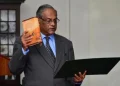
(Caribbean News Weekly) -Prime Minister Gaston Browne has dismissed a call from the Antigua and Barbuda Bar Association (ABBA) for him to withdraw what the association described as a threat against a sitting judge of the Eastern Caribbean Supreme Court.
The ABBA on Wednesday called on Browne to “withdraw the threat” and publicly affirm that no immigration or other executive power would be used to influence, intimidate, punish or remove a judicial officer because of decisions made in the lawful exercise of judicial office.
Browne, however, responded sharply to the association in a post on his Facebook page, referring to the ABBA as “defunct” and writing: “Here is my response to your request for an apology: Piss off.”
The dispute stems from remarks Browne made Monday during a National Security meeting about what he described as short sentences being imposed by judges despite Parliament passing legislation allowing for harsher penalties in response to rising gun crime and violence.
Addressing a judge whom he did not identify by name, Browne said: “Brother man, if you cannot follow the lead of parliament to give longer sentences, leave our country voluntarily otherwise we are going to deport you and make you persona non grata. You know who you are. This is the Prime Minister of the country saying this.”
The ABBA said it had “noted with deep concern” the statement, arguing that the threat of deportation could not be reconciled with Browne’s assertion that he did not intend to interfere with the judiciary.
In a three-page statement, the association described Browne’s remarks as “a grave threat to the independence of the judiciary” and said they were incompatible with the constitutional separation of powers and the rule of law.
The ABBA said the Constitution allows Parliament to make laws for the “peace, order and good government of Antigua and Barbuda,” but argued that neither Parliament nor the executive can act in a manner inconsistent with the constitutional order.
The association also emphasized that the separation of powers is a fundamental principle underpinning constitutions based on the Westminster system, including Antigua and Barbuda’s Constitution.
“It has been judicially affirmed that Parliament cannot, consistent with that principle, transfer from the judiciary to an executive body which is not qualified to exercise judicial powers a discretion to determine the severity of the punishment to be inflicted upon an offender,” the association said.
According to the ABBA, Browne’s direction that a judge “follow the lead of parliament” on sentencing amounted to the kind of executive interference that the separation of powers is intended to prevent.
The association said determining the severity and duration of sentences imposed on convicted offenders is a function of the judiciary.
“It has been held that the determination of the duration of a sentence must remain in the hands of the court and not those of the executive,” it said. “Any arrangement by which the executive or legislature dictates or coerces the outcome of sentencing decisions violates the common law constitutional principle that underpins the separation of powers.”
The ABBA added that a judge who imposes a sentence in accordance with the law, including sentencing guidelines and the evidence before the court, is carrying out the constitutional role of the judiciary.
It said Browne’s comments instead treated judicial independence “as a form of insubordination.”
The association also took particular issue with the threat to deport the judge and declare the individual persona non grata.
“Such a threat strikes at the very foundation of judicial independence,” the ABBA said. “A judge who faces the prospect of expulsion from the jurisdiction for delivering judgments within its discretion that displeases the executive cannot be said to be independent.”
It argued that judges must be able to decide cases according to the law without fear of personal consequences imposed by the executive.
“The Prime Minister’s statement is a direct and public threat against an identifiable judge, made for the express purpose of influencing the exercise of judicial power. The violation of constitutional principle is manifest,” the association said.
The ABBA warned that publicly threatening a member of the judiciary with expulsion could have implications beyond the individual judge, saying it could signal to the judiciary as a whole that compliance with executive preferences is a condition of continued tenure and residence.
The association acknowledged that Parliament can legislate to establish maximum or minimum sentences within constitutional limits. However, it said Parliament and the executive cannot direct individual judges to impose sentences of a particular severity in specific cases or threaten judges with expulsion for declining to do so.
“This is unacceptable in a fair and democratic society,” the ABBA said.