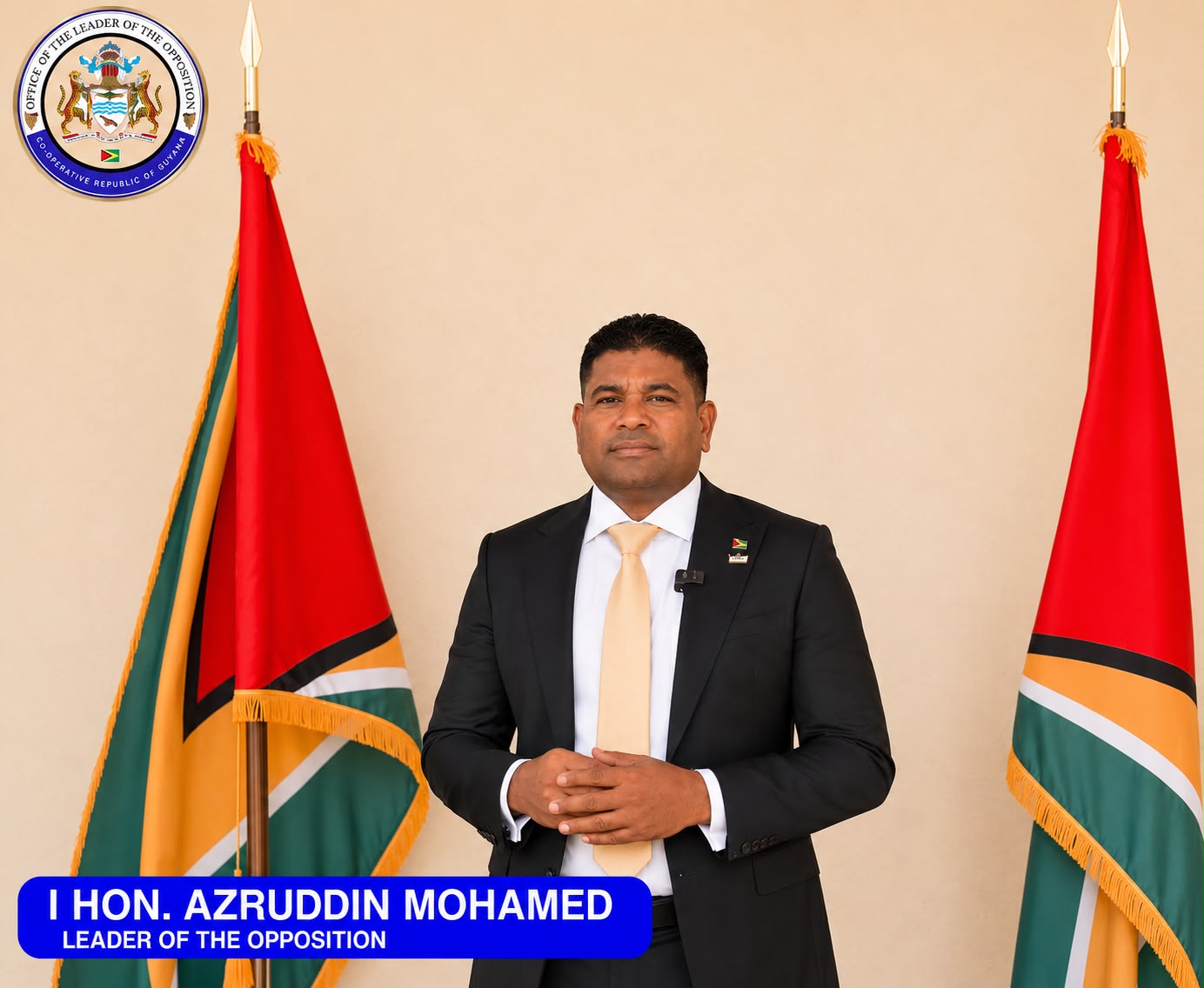
GEORGETOWN, Guyana — Opposition Leader and WIN Member of Parliament Azruddin Mohamed is demanding that Vice President Bharrat Jagdeo and the government disclose the financial implications for Guyana following what Mohamed says is ExxonMobil’s confirmation that approximately US$55 billion invested in the Stabroek Block has been recovered.
In a video statement, Mohamed described the development as a potentially significant turning point for Guyana’s petroleum revenues, arguing that the recovery of such a large portion of investment costs should translate into a substantially greater share of oil production and revenue flowing to Guyana.
“ExxonMobil has confirmed that US$55 billion invested in the Stabroek Block has been recovered,” Mohamed said. “This is a significant turning point for Guyana. Guyana should now receive a larger share of revenues from its oil production.”
Mohamed accused the government of failing to adequately explain the development to the Guyanese public, questioning why information with potentially major consequences for national revenues was coming from ExxonMobil rather than the administration responsible for managing the country’s petroleum resources.
“Once again, Guyanese are learning this information about their own oil from ExxonMobil instead of the PPP government,” he charged.
Mohamed directed several questions at Jagdeo, who has taken a leading role in the government’s management and public discussion of the petroleum sector.
He called on the government to disclose what percentage of current production would now be allocated to cost recovery, what costs remain recoverable, how much additional profit oil Guyana could receive, and what revenue the government projects for the remainder of 2026, 2027 and subsequent years.
He also questioned how costs associated with new petroleum projects would affect Guyana’s future share.
Mohamed made the potentially significant claim that information received from sources within the Ministry of Natural Resources suggests that Guyana could, in some instances, receive substantially more than the 12.5 percent profit-oil share plus the 2 percent royalty that he said Guyana currently receives.
“Our sources in the Ministry of Natural Resources confirm that instead of the 12.5 percent profit oil and 2 percent royalty, in some instances we are going to be getting sometimes three times more,” Mohamed said.
Using hypothetical production of approximately 920,000 barrels per day and an oil price of US$80 per barrel, Mohamed calculated that Guyana’s monthly receipts could potentially rise dramatically if his assertion of a threefold increase were realised.
The Opposition Leader stressed, however, that the government must release the underlying figures so that Guyanese can independently understand how much money the country should receive.
“We are calling on VP Jagdeo to reveal the true numbers,” Mohamed declared.
Mohamed also turned his attention to the Natural Resource Fund, arguing that the rapid accumulation of petroleum revenues has not translated sufficiently into improved living standards for ordinary Guyanese.
He cited approximately US$3.64 billion in the NRF at the end of March 2026 and approximately US$4.1 billion by the end of April, while claiming another approximately US$1.235 billion in oil revenues and royalties would flow into the fund during the second quarter.
But Mohamed argued that the more important question is what those billions mean for Guyanese households.
“What does US$4 billion sitting in the NRF mean to a single mother who cannot afford groceries?” he asked. “What does record oil production mean to a public servant whose salary cannot keep pace with the cost of living?”
Mohamed said Guyana should not measure the success of the petroleum industry solely through GDP growth, production levels, government revenues or the size of the Natural Resource Fund.
Instead, he argued, oil wealth should be visible in wages, roads, reliable electricity, potable water, affordable housing, healthcare, education, emergency services and opportunities for young Guyanese.
“A country can become extraordinarily wealthy while its citizens remain poor,” Mohamed warned. “GDP can rise, oil production can rise, government revenues can rise, the NRF fund can rise. But if household incomes, living standards, and access to basic services do not rise with them, then we cannot call that development.”
He warned that Guyana must guard against the resource curse and ensure that petroleum wealth does not simply produce larger government budgets, massive contracts and greater wealth for politically connected interests.
“The oil is the people’s resource, and the government is merely its custodian,” Mohamed said.
He argued that Guyanese must be able to trace a clear line between the billions of dollars generated from the petroleum sector and tangible improvements in household wealth and quality of life.
“Guyana’s success must not be measured by how rich the country looks on paper,” Mohamed concluded. “It must be measured by how well the Guyanese people are living.”