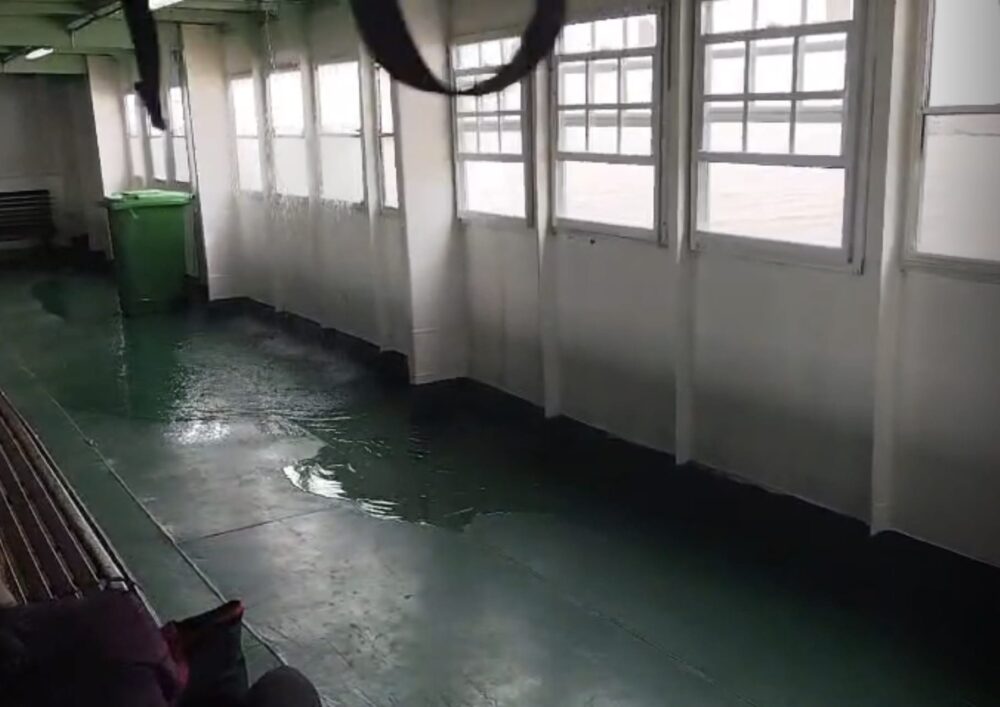
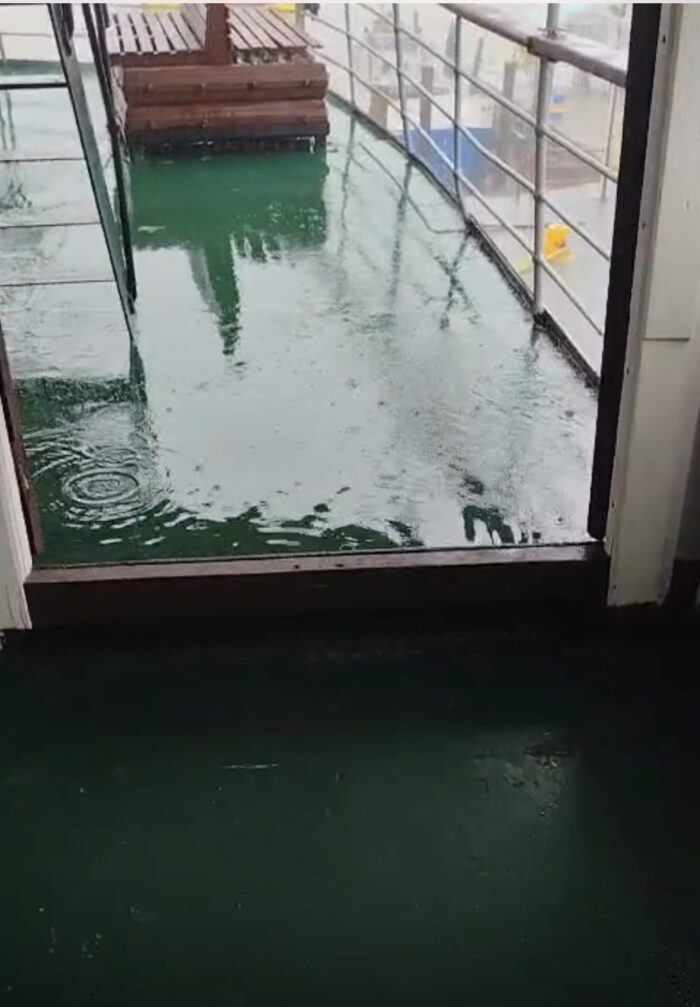
The MV Makouria, a 67-year-old state ferry stationed at Bartica, is showing clear signs of deterioration, raising serious concerns about passenger safety and the reliability of a critical trade route. Reports of water flowing across the vessel’s passenger deck and visible corrosion point to a vessel in urgent need of repair—conditions that place lives at risk.
A report by Theon Alleyne of La Caribeña News lays bare the situation at the heart of Guyana’s interior transport system. On August 7, 2026, images and information provided to the newsroom showed water pooling along seating areas inside the passenger section during heavy rainfall, while deck machinery displayed significant corrosion. Despite these conditions, the vessel remained alongside and did not depart.
The concerns are heightened in the aftermath of the MV Barima disaster, where another aging state ferry sank with significant loss of life, exposing systemic weaknesses in maintenance and oversight. The parallels are difficult to ignore.
But the issue extends far beyond the condition of a single vessel. Bartica, located at the confluence of the Essequibo, Mazaruni, and Cuyuni rivers, has no direct road connection to Georgetown. River transport is therefore essential, making the Makouria a key artery for the movement of fuel, machinery, food supplies, gold, and timber between the coast and the interior. When the ferry fails to operate, trade is effectively disrupted.
Despite its importance, the MV Makouria was excluded from the government’s $440 million ferry rehabilitation programme announced in March 2026. Its last recorded docking was in 2022—nearly four years ago—raising further questions about its operational condition and maintenance history.
The report underscores a deeper contradiction in Guyana’s development trajectory. While the country pursues international trade opportunities, including entry into a 12.5% U.S. tariff band, and advances local content legislation, the infrastructure needed to move goods domestically remains fragile. Trade policy assumes goods can reach ports, but in Bartica, that journey depends on an aging and increasingly unreliable vessel.
The economic consequences are immediate. Missed sailings disrupt supply chains, spoil perishable goods, and break delivery commitments. Larger operators may absorb these losses, but small traders—without storage capacity, alternative transport, or financial buffers—bear the greatest burden.
Although a government-appointed Safety and Compliance Audit Team is reviewing vessel conditions, its focus is limited to seaworthiness and regulatory compliance. Critical issues such as service reliability, scheduling consistency, and trade continuity remain outside its scope, leaving a gap between maritime oversight and economic reality.
The situation at Bartica highlights a fundamental problem: Guyana’s trade ambitions may be expanding on paper, but at the first mile of that journey, movement itself remains uncertain.
For full details and further reading, see the original report by Theon Alleyne at La Caribeña News.