Dr. (H. C.) Gerald Richard Gouveia, Sr. Honorary Doctorate; 36th. IRAQ invasion of KUWAIT August 1990; 5 Top CASHLESS COUNTRIES, Sweden, Norway, Finland, China & Denmark; SWOT Analysis; and NY DIAMOND JUBILEE 60th. Independence Gala AWARDS, Hon. Justice Yonette Cummings-Edwards, Dr. Shamir Ally and Dr. Keith Cummings, MD.
Congratulations to Dr. (H. C.) Gerald Richard Gouveia, Sr. for Honourary Doctorate.
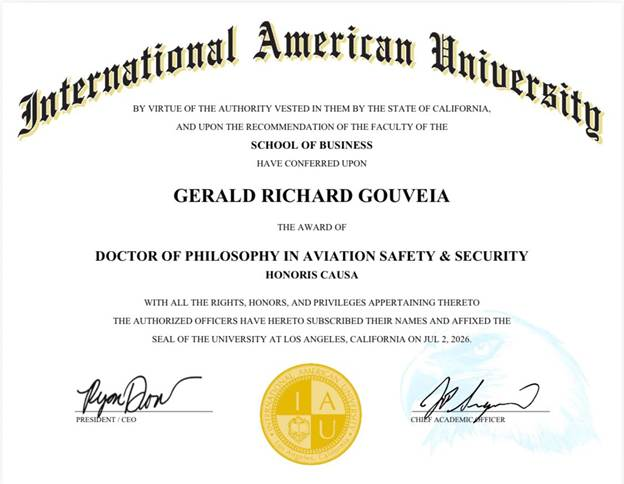
Our Congratulations TO Dr. (H.C.) Gerald Richard Gouveia Sr. – Doctor of Philosophy in Aviation Safety & Security (Honoris Causa), from International American University (IAU) Los Angeles, California, USA – July 2, 2026.
His Current Roles in Guyana:
National Security Advisor to His Excellency the President of Guyana
Founder, Chairman & CEO – Roraima Airways & Roraima Group Holdings (Guyana’s leading aviation & hospitality group)
Pioneer Aviator & Entrepreneur – Over 40 years aviation, tourism development
Shareholder – Ogle Airport Inc. (Eugene F. Correia International Airport)
Former Chairman – Private Sector Commission of Guyana, Georgetown Chamber, Aircraft Owners Association
A FITTING RECOGNITION FOR his LIFETIME WORK in Aviation Safety, National Security, and Private Sector Development for Guyana is now Academically Recognized.
Blessings, Congratulations and Best Wishes Captain Dr. (H.C.) Richard Gouveia Sr.
36TH IRAQ invasion of KUWAIT Aug 2, 1990
Statement of Compassionate Remembrance — 36 th. ANNIVERSARY of the IRAQI INVASION.
On this SOLEMN 36th. ANNIVERSARY, WE, GLOBALLY, TOGETHER, BOW OUR HEADS, in Compassionate REMEMBRANCE, SOLIDARITY, and RENEWAL.
TO His Highness the Amir Sheikh Meshal Al-Ahmad Al-Jaber Al-Sabah, TO His Highness the Crown Prince Sheikh Sabah Al-Khaled Al-Hamad Al-Sabah, TO the Esteemed Al-Sabah Ruling Family, TO the Government and to the Noble People of Kuwait — BOTH Kuwaitis and our Expatriate Brothers and Sisters who call Kuwait HOME — WE OFFER Our Deepest RESPECT, SYMPATHY, and Unwavering SUPPORT.
We remember the DARK DAWN of August 2, 1990, when IRAQI forces crossed into KUWAIT, leading to a 7-month OCCUPATION from August 2, 1990, to February 26, 1991. For two days, August 2-4,1990 the HEROIC Kuwaiti Armed Forces, Amiri Guard, and Volunteers stood against overwhelming odds. We remember the MARTYRS who FELL DEFENDING their HOMELAND, the PRISIONERS and MISSING, the FAMILIES who endured, and the HUNDREDS of THOUSANDS who were DISPLACED. We REMEMBER the BURNING of the OIL FIELDS and the WOUND to the HEART OF THE GULF.
This PAINFUL HIDSTORY must be REMEMBERED IN FULL, and it MUST be placed beside another TRUTH : Kuwait has never held HATRED in its HEART. Even after such grievous INJURY, Kuwait extended the hand of FRIENDSHIP, Brotherhood and Sisterhood, to the people of IRAQ. KUWAIT has consistently DISTINGUISHED between a FORMER regime’s aggression and the Iraqi PEOPLE, themselves. Through DEBT Forgiveness, HUMANITARIAN AID, support for RECONSTRUCTION, HOSTING and MEDIATING, and Welcoming IRAQI
Patients, Students and Workers, KUWAIT has LIVED its ISLAMIC and ARAB VALUES — that of FORGIVENESS, with DIGNITY.
WE recognise with profound gratitude Kuwait’s continuing efforts for PEACE. From MEDIATION in GCC and Regional crises, to its GLOBAL HUMANITARIAN LEADERSHIP through the UNITED NATIONS, to its steadfast SUPPORT for the UN Charter, International LAW, and the PRINCIPLE that NO Country’s SOVEREIGNTY may be ERASED — KUWAIT has TRANSFORMED its own SUFFERING into a FOREIGN POLICY OF PEACE. KUWAIT, The SMALL STATE, that was once INVADED, is now ONE of the WORLD’S GREATEST PEACEMAKERS.
May ALLAH have MERCY on the MARTYRS of Kuwait, may ALLAH preserve Kuwait’s SECURITY, STABILITY and WELLBEING under the WISE LEADERSHIP of His Highness the Amir and the Al-Sabah family, and may ALLAH keep KUWAIT FOREVER a BEACON of SAFETY, GENEROSITY, and PEACE — for KUWAITIS and EXPATS — and for the ENTIRE REGION.
WE WILL NEVER FORGET. WE WILL ALWAYS STAND WITH KUWAIT. WE STAND STRONG.

5 top CASHLESS COUNTRIES, Sweden, Norway, Finland, China, and Denmark
SWEDEN: With only 10% of transactions using cash, Sweden is one of the LEADERS in cashless adoption. Over 98% of Swedes own a debit or credit card, and mobile payments are widely accepted.
NORWAY: Norway has a cashless transaction share of 97.76%, with 98% of citizens using debit or credit cards. Mobile payment apps are also immensely popular.
FINLAND: Finland is predicted to become fully cashless by 2030, with 80% of Finns preferring debit card payments.
CHINA: China is making rapid progress towards a cashless society, with 91% of urban transactions conducted digitally.
DENMARK: Denmark has a cashless score of 81.5 and is considered one of the most cashless countries in the world.
https://coinlaw.io/cashless-economy-statistics/
https://zimpler.com/blog/which-countries-are-leading-the-cashless-society-race/
https://coinlaw.io/cashless-society-adoption-statistics/
https://www.wavetec.com/blog/pros-cons-of-cashless-society/
https://www.readycreditcorp.com/resources/blog/cashless-society-pros-cons/
What are the POTENTIAL IMPACTS of a CASHLESS SOCIETY on LOW-ONCOME COMMUNITIES ?
A cashless society could have significant impacts on low-income communities, including:
Exclusion: 4.2% of U.S. households are unbanked, and 14.2% are underbanked, making it difficult for them to participate in a cashless economy.
Limited access: Low-income communities may not have access to digital payment methods, such as smartphones or internet connectivity.
Increased costs: Alternative financial services, like check cashing, may become more expensive.
How can GOVERNMENTS ensure FINANCIAL INCLUSION in a cashless economy?
Governments can ensure financial inclusion by:
Implementing policies that promote access to digital payment methods.
Providing education and training on digital financial literacy
Encouraging the development of inclusive digital payment systems
Offering subsidies or incentives for low-income individuals to access digital financial services.
What role will BANKS play in the future of payments?
Banks could:
Increase financial inclusion by providing access to digital payments for the unbanked
Improve payment efficiency and security.
Reduce transaction costs.
Banks also raise concerns about PRIVACY, SECURITY, and the potential for GOVERNMENT surveillance.
The FINANCIAL INDUSTRY is entering a new era, with AI and new regulations on accessing data transforming how finance works. These changes are giving people more options to manage their money in new ways—making us CLOSER TO TOTALLY CASHLESS TRANSACTIONS.
Over the last century, banks implemented innovative technologies like ATMs, internet banking, and smartphone apps to fundamentally change our relationship with money. Now, new regulations and initiatives around the world are forcing banks to allow fintech firms (companies that use technology to provide financial services) to access customers’ banking data.
Accessing customer data allows for greater openness in the financial industry. It enables a shift from a closed banking model, where banks kept a tight hold of their customers’ data, to an open banking ecosystem where people are free to share their financial data with third-party apps or websites.
FIVE WAYS that AI could be RESHAPING OUR RELATIONSHIP with MONEY.
- Intelligent credit-scoring
AI-driven credit scoring uses open banking data instead of a customer’s traditional bank credit history. It considers customers’ context and behavior—things like mobile phone and rent payments—to make fairer assessments. This can encourage responsible access to credit for people on low incomes and promote financial inclusion.
- Debt rehabilitation services
These services can be used to manage financial behavior. People who are struggling financially can use these debt services to track their spending patterns in real time. Trusted individuals, maybe a friend or relative, can be alerted when their spending is irregular.
- Automated savings trackers
Saving trackers use AI to advise customers on when and how much to save. They can also transfer funds into savings accounts automatically. This can help people to manage money shocks and build financial resilience.
- Account aggregation services
Customers can connect accounts from different banks to get an aggregate view of their financial health. This can help them to make better decisions around their money, enhancing their sense of being in control and making them more resilient against financial shocks.
- Predictive finance
Personalized services can assess financial behavior by learning customers’ habits and anticipating their future needs. Predictive finance can translate these assessments into practical, money-saving recommendations. People can use AI agents to plan and time a family trip. The AI agent can then autonomously make a booking that best fits and alerts the customer.
RISKS are INEVITABLE . In this new landscape, the traditional trust between bank and customer might be challenged, as the open nature of transactions can increase security risks. Automated profiling, data vulnerabilities, and fraud can also erode trust, invade customers’ privacy, and violate their dignity. That is why transparent regulations are needed to protect customers and preserve their digital rights.
When traditional banks and fintech’s work together, they must keep the customer’s best interests in focus. After all, there is no doubt that the double-edged consequences of AI and data will continue to shape the evolving financial landscape.
The United States is moving towards a cashless society, with cash accounting for only 18% of all US payments in 2022. Mobile wallet apps and contactless cards are becoming increasingly popular.
Some benefits of a CASHLESS society include:
Faster transactions: Cashless payments are generally quicker than cash transactions.
Reduced crime: Less cash means less risk of theft and robbery.
Improved financial tracking: Digital payments create records, making it easier to track spending and income.
There are also CONCERNS :
Exclusion: Unbanked and underbanked populations may struggle with cashless systems.
Privacy: Digital payments can compromise anonymity.
Security: Cashless systems are vulnerable to cyber-attacks and technical issues.
The USA Federal Reserve and other institutions are exploring Central Bank Digital Currencies (CBDCs) to promote financial inclusion and improve payment systems.
SWOT Analysis for CASHLESS COUNTRIES
STRENGTHS:
Convenience: Cashless transactions are often faster and more convenient than cash.
Security: Digital payments reduce the risk of theft and counterfeiting.
Efficiency: Cashless systems can reduce transaction costs and increase productivity.
WEAKNESSESS:
Exclusion: Cashless systems can exclude those without access to digital payment methods.
Dependence on technology: Cashless systems rely on functioning technology and internet connectivity.
Security risks: Digital payments can be vulnerable to cyber-attacks and data breaches.
OPPORTUNITIES :
Financial inclusion: Cashless systems can increase access to financial services for underserved populations.
Innovation: Cashless systems can drive innovation in payment technologies and services.
Sustainability: Digital payments can reduce the environmental impact of cash production and transportation.
THREATS:
Inequality: Cashless systems can exacerbate existing inequalities if not implemented carefully.
Cybersecurity risks: Cashless systems are vulnerable to cyber-attacks and data breaches.
Regulatory challenges: Cashless systems often require new regulations and oversight frameworks.
EMBRACING A CASHLESS SOCIETY is a step towards a more efficient, convenient, and connected future.
By going DIGITAL , we can reduce waste, increase financial inclusion, and unlock new opportunities for economic growth.
Let us ditch THE CASH and TAP into a WORLD of SEAMLESS TRANSACTIONS, INNOVATIVE services, and a BRIGHTER FINANCIAL FUTURE for ALL.
Guyana DIAMOND JUBILEE 60th. Independence GALA AWARDS CEREMONY on JULY 4, 2026, BROOKLYN, NEW YORK