On May 23, 2023, a fire in a school dormitory in Mahdia claimed the lives of 20 children. The dormitory was locked from the outside, with barred windows and no adequate fire suppression system. It was a trap. The nation wept, promised inquiries, and then, in a silence that has become our most practiced national reflex, we moved on.
We always move on. This is by design.
More than 100 people perished on a vessel too old to have been in service, too decrepit to be carrying the load it was asked to carry and too compromised to risk the lives of nearly 200 of our nation’s citizens. Insult has been added to injury now that the government of Guyana, after first refusing to raise the vessel, is now dragging its feet on the process of selecting a company to complete the work and under duress from the citizens of Guyana.
It remains to be seen how long it will take us to move on from this horrendous tragedy.
Although Guyana’s crisis is one of corruption and politics, it is also about a pervasive, suffocating cloud of mediocrity that has seeped into every artery of our republic. It’s in the crumbling public infrastructure, the lethargic civil service, the reactive governance, and the deep, functional incompetence that allows tragedies like Mahdia and MV Barima to be met with shrugs by our government politicians, once the cameras leave.
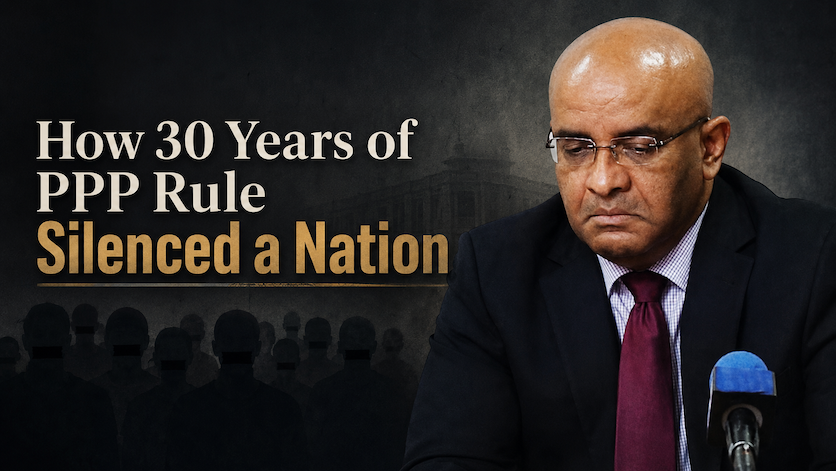
To understand this systemic failure, we must diagnose its architect: a 30-year political project by the People’s Progressive Party (PPP) to govern not through excellence, but through the strategic cultivation of under-education and the reward of blind loyalty.
The history is deliberate. Following the death of Dr. Cheddi Jagan, the party’s founding father, in 1997, the PPP’s strategy evolved from ideological struggle to raw power preservation. The mechanism was not violence alone, but a slower, more insidious tool: the education system. For decades, the government systematically under-resourced and politicized education in its traditional strongholds and, crucially, in opposition-leaning communities, creating a dependent class of loyalists. As Guyanese historian Dr. David Hinds observes in Ethno-Politics and Power Sharing in Guyana, the post-1992 political landscape saw the consolidation of an “ethno-political state” where access to public goods, including quality education, was filtered through party loyalty.
The product of this system is a bureaucracy filled not with the competent, but with the obedient. These are the undereducated loyalists inserted into every single service. The consequences can be measured not in abstract dysfunction, but in lost lives. Consider the MV Barima. Over 100 people imprisoned aboard that floating deathtrap—a vessel so flagrantly unseaworthy, so manifestly unfit for human transport, that its continued operation could only be explained by a system where oversight is optional and human life is cheap. When the tragedy came, it was not an act of God. It was an act of mediocrity, signed off by officials whose qualifications were political, not professional.
This same incompetence haunts the very places meant to uphold justice. The Georgetown Prison fire was not a random catastrophe. It was the predictable, blazing endpoint of a correctional system rotted by neglect, where the safety of inmates is an afterthought. When a prison burns with souls trapped inside, it is because mediocrity, long before the first spark, had already sentenced them. And just last year, 20 students were killed in Mahdia, not in a war zone, but in what should have been a sanctuary of slumber. They were behind locked doors and barred windows, and the systems meant to protect them failed in every conceivable way. We mourned, we lit candles, and then the machinery of mediocrity quietly began the work of making us forget.
This silence is not voluntary. It is enforced by a specter of violence that history forces us to remember. On July 18, 2012, three unarmed protestors—Ronnell Somerset, Shemroy Bouyea, and Allan Lewis—were shot and killed by police during a peaceful demonstration in Linden against proposed electricity tariff hikes. The “Linden Martyrs” were pleading for economic relief. The state’s response was bullets. The subsequent Commission of Inquiry concluded that the police had used “unnecessary and unwarranted force” and that the protestors were killed on a day filled with “police lawlessness.” Recommendations were made. Accountability was a ghost.
Three years later, on March 10, 2015, political activist Courtney Crum-Ewing was gunned down in Diamond, East Bank Demerara, while using a megaphone to urge residents to vote. His weapon was his voice. For the crime of political dissent, he was silenced with an assassin’s bullet. His murder remains a chilling semicolon in our national story—a sentence that was brutally punctuated but never allowed to end with a full stop and a conviction. The message was crystalline: to vocally dissent against the governance of mediocrity is to invite a fatal consequence.
And when consequence comes for the governed, the response is grotesque. In the aftermath of the tragedies that have scarred our hinterland communities, including those in Region 1, the government’s approach has been emblematic of its contempt. Instead of dispatching top-tier grief counselors, mental health professionals, or competent administrators to region 1, they sent political degenerates—party apparatchiks whose primary skill was partisan messaging, not humanitarian care. Ruel Johnson and Juan Edghill were there to lecture, not to listen; to manage a political narrative, not to heal shattered communities. Even in the deepest tragedy, the party sees the people not as citizens, but as problems to be managed, votes to be secured, and narratives to be controlled.
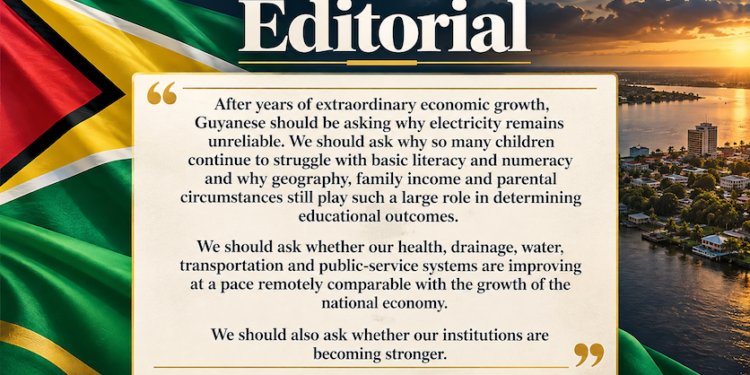
We are now an oil-rich nation, floating on a sea of unprecedented wealth. But no amount of petroleum revenue can lubricate a state apparatus rusted solid by three decades of deliberate incompetence. We can erect new buildings, but if the people operating them are products of a system designed to crush critical thought, those structures will remain hollow monuments to a hollowed-out nation.
The 20 children of Mahdia, the souls lost on the MV Barima, the Linden martyrs, Courtney Crum-Ewing, and the men who burned in the Georgetown Prison are not isolated incidents. They are data points in a single, unbroken graph of a nation held hostage by mediocrity. The question facing the next generation is the same one Crum-Ewing shouted through his megaphone on that fatal night: how long will we remain silent? The answer, if we dare to utter it, will determine if we finally move on from tragedy, or finally move towards justice.