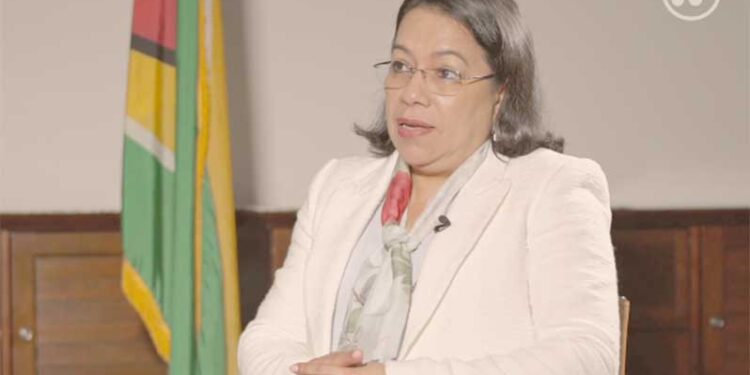
Forward Guyana Movement (FGM) executive Nigel London said the Government’s handling of the MV Barima tragedy was marked by “arrogance, callousness and disrespect,” arguing that grieving families—particularly those from Indigenous communities—have been offered promises instead of the accountability and justice they deserve.
The MV Barima, operated by the Transport and Harbours Department (T&HD), was a vital passenger and cargo ferry linking Georgetown with Port Kaituma in Region One (Barima-Waini). The vessel served riverine and hinterland communities, transporting passengers, food, fuel, building materials, vehicles and other essential supplies to the region, which is home to Guyana’s largest predominantly Indigenous population and relies heavily on river transport for commerce, healthcare, education and travel.
Speaking at a recent public forum, London said the Government’s response to one of Guyana’s worst maritime disasters reflected a mindset that devalues Indigenous lives.
“It would be better to be dead than to live in a country where a tragedy of this magnitude can occur, yet those in authority respond with such arrogance, callousness, and disrespect as [Prime Minister] Mark Phillips and [Minister] Juan Edghill have displayed.”
When the MV Barima departed Georgetown on July 18, 2026, it was officially recorded as carrying 116 manifested passengers and 17 crew members, for a total of 133 people on board. Survivors and relatives, however, consistently maintained that additional passengers boarded the vessel without being recorded—a claim later reflected in the Government’s own estimate that approximately 180 people were aboard when the ferry sank.
Following the tragedy, the Government announced relief measures for affected families and communities, including commitments to provide infrastructure and other forms of assistance. London argued that while those initiatives may offer temporary relief, they fail to address the central issues of responsibility and accountability.
“To them, it is just another ordinary day. They behave as though Guyanese—particularly our Indigenous communities—can still be treated as they were in the days of Christopher Columbus, pacified with beads and buttons.”
He said the Government appeared to be attempting to placate grieving communities with material offerings rather than confronting the questions surrounding the disaster.
“Today, the ‘beads and buttons’ are a black water tank, a promise of a boat and engine, a contract, or some other token gesture, as though these can erase unimaginable loss.”
London said such actions conveyed a deeply troubling message about how Indigenous communities are regarded.
“The message this sends is deeply offensive: that the lives of Indigenous people are worth so little that, after so many deaths—especially the deaths of children—their grief can be silenced with promises and handouts.”
He added that the response suggested the Government believed affected communities would simply accept the assistance and move on.
“It reflects a mindset that assumes these communities can be bought off, that they will simply accept whatever is offered and move on.”
London maintained that the fundamental questions surrounding the disaster remain unanswered, including who bears responsibility for ensuring the vessel was seaworthy before it departed.
“No promise, no contract, no water tank, and no boat can replace the lives that were lost. The families deserve accountability, respect and justice—not token gestures that diminish the value of those they have buried.”
The MV Barima disaster has become one of Guyana’s deadliest maritime tragedies in recent history. In the weeks since the sinking, opposition parties, trade union leaders, civil society organisations and relatives of the victims have continued to demand a full and transparent investigation into the circumstances surrounding the tragedy, including the vessel’s maintenance history, safety inspections and regulatory oversight.
While the Government has maintained that it is supporting affected families and that investigations are ongoing, its response has remained under intense public scrutiny. Questions have been raised over its decision to establish what opponents describe as a partisan Commission of Inquiry instead of immediately convening an independent maritime casualty investigation in keeping with international practice.
The administration has also faced criticism for initially refusing calls to recover the MV Barima from the seabed before reversing course and issuing an Expression of Interest (EOI) to salvage the vessel—a decision that came only after sustained public pressure from victims’ families, maritime stakeholders and the wider public.
Public demonstrations have continued across the country, with families of the victims, trade unionists, civil society organisations and opposition supporters maintaining that only a full, independent investigation and genuine accountability will bring justice to those who lost their lives.