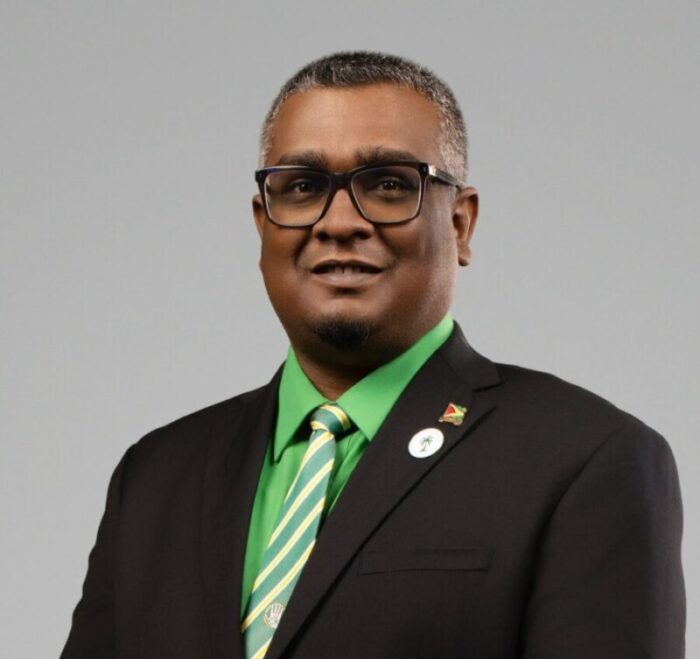
A Partnership for National Unity (APNU) Member of Parliament Ganesh Mahipaul has sharply criticised the Government’s decision to use a public procurement process to recover the sunken MV Barima, arguing that the approach will unnecessarily delay the salvage operation, jeopardise crucial forensic evidence and prolong the anguish of families still grieving Guyana’s worst maritime disaster.
In a statement on Sunday, Mahipaul described the Maritime Administration Department’s (MARAD) decision to invite Expressions of Interest (EOI) from marine salvage contractors as “cruel, insensitive and entirely unacceptable,” contending that the Government is placing bureaucracy ahead of justice.
MARAD has set August 14, 2026 as the deadline for submissions from interested contractors. However, Mahipaul noted that the procurement process will then require the evaluation of bids, shortlisting of contractors, contract negotiations, mobilisation of specialised equipment and personnel, and the issuance of a commencement order before salvage work can begin.
“This means that the actual salvage operation is unlikely to begin until late August or even early September. That timeline is simply unacceptable,” he said.
The MV Barima sank on July 18, 2026, while travelling from Georgetown to Port Kaituma. The ferry carried 116 manifested passengers, 17 crew members and approximately 268 tonnes of cargo. Prosecutors have since alleged that 66 named victims and other persons unknown died in the tragedy, amid persistent claims that additional passengers boarded the vessel but were never recorded on the official manifest.
The disaster sparked nationwide outrage after the Government initially announced that the wreck would remain on the seabed. That position was met with sustained protests, vigils and calls from grieving families, political parties and civil society for the vessel to be raised, with many arguing that it constitutes a submerged crime scene containing vital evidence. The Government later reversed its position and announced plans to recover the vessel before publishing the EOI.
Mahipaul argued that, despite the policy reversal, the latest procurement process demonstrates “a shocking lack of urgency and compassion.”
“More than one hundred Guyanese lost their lives in one of the greatest maritime tragedies in our nation’s history. Families continue to grieve. Survivors continue to relive the trauma. Yet the Government appears content to allow the vessel to remain submerged beneath salt water for several more weeks while it proceeds through a lengthy procurement process,” he said.
He warned that every additional day underwater increases the likelihood that evidence critical to determining the cause of the tragedy will deteriorate.
“Salt water is unforgiving. Mechanical systems corrode, electronic equipment deteriorates, structural evidence changes over time, and materials that may assist investigators can be permanently damaged. The Commission of Inquiry, law enforcement authorities, marine investigators and forensic experts deserve access to the vessel in the earliest possible time, not after unnecessary administrative delays,” Mahipaul stated.
The APNU parliamentarian argued that the Government already possesses the legal authority to act immediately through emergency procurement provisions.
“Guyana’s procurement framework provides for emergency procurement under exceptional circumstances. These provisions exist precisely because there are occasions where the public interest demands immediate action instead of competitive procurement. If there was ever a case that justified emergency procurement, surely the worst maritime disaster in modern Guyanese history is one,” he said.
Mahipaul also questioned what he described as the Government’s inconsistent use of procurement laws, pointing to previous instances where emergency procurement or sole sourcing was used for projects that many Guyanese considered far less urgent, including the acquisition of the MV Hercules and several major infrastructure contracts.
“Why then is the greatest maritime tragedy in Guyana’s history not considered sufficiently urgent? This inconsistency raises legitimate and unavoidable questions,” he said.
He further noted that the Leader of the Opposition had publicly offered to facilitate the immediate salvage of the vessel through a reputable international marine salvage company at no cost to taxpayers, but said the Government instead opted for “a procurement route that virtually guarantees additional weeks of delay.”
Questioning the administration’s reluctance to expedite the operation, Mahipaul asked: “Why? What is the Government afraid of? Why is there such reluctance to recover the vessel as quickly as possible?”
He maintained that the issue extends beyond procurement, arguing that every day of delay not only threatens valuable forensic evidence but also postpones truth and closure for families who lost loved ones.
“This is not simply another government contract. This is about justice. This is about accountability. This is about respect for the dead and compassion for the living,” Mahipaul said.
He urged the Government to immediately abandon what he described as an unnecessarily prolonged procurement process and invoke emergency procurement provisions to expedite the salvage operation.
“The people of Guyana deserve answers. The grieving families deserve closure. The victims deserve dignity,” Mahipaul declared, adding that history would judge not only the tragedy itself, but also how the Government responded in its aftermath.