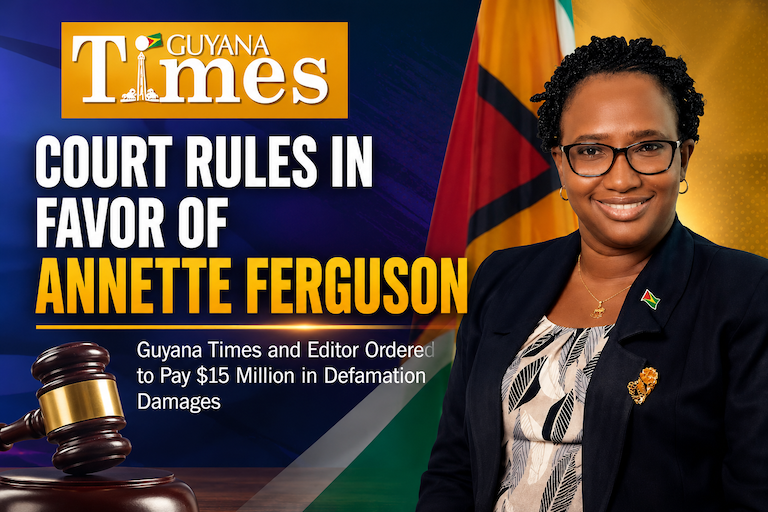
Former Minister Annette Ferguson has won a defamation lawsuit against Guyana Times and its editor after the High Court found that a 2019 newspaper article falsely portrayed her as dishonest, accused her of lying about house lot allocations, and implied that she had accumulated unexplained wealth through improper means.
In a 41-page judgment delivered on July 21, 2026, Justice Fidela Corbin-Lincoln ruled that Guyana Times and its editor, Tusika Martin, failed to establish any of the legal defences they relied upon, including qualified privilege, fair comment and statutory privilege under the Defamation Act. Ferguson was represented by Attorney-at-law Lyndon Amsterdam.
The Court ordered Guyana Times and Martin to pay Ferguson $15 million in damages, together with $1 million in discretionary costs. The claim against the newspaper’s third defendant, Dwijendra Rooplall, was dismissed, and Ferguson was ordered to pay him $200,000 in costs.
Court: Article Conveyed Ferguson Was Dishonest
The case arose from a December 11, 2019 article titled “Opposition calls out Minister for lying about house lots allocation” with the subheading “as multimillion-dollar home goes up on large plot of land.”
Justice Corbin-Lincoln found that an ordinary reader would understand the publication to mean that Ferguson:
* lied about the number of house lots she owned,
* lacked honesty and integrity,
* had acquired unexplained wealth while serving as a government minister, and
* may have abused public office to accumulate that wealth.
The judge concluded these meanings were plainly defamatory because they were capable of lowering Ferguson in the estimation of right-thinking members of society.
Court Rejects Newspaper’s Defences
The newspaper argued that it was protected because it was reporting on statements made by the People’s Progressive Party (PPP) and on Ferguson’s own press conference concerning allegations about her property holdings.
However, the Court held that the defendants failed to satisfy the requirements of responsible journalism.
Among the judge’s principal findings were:
* Guyana Times relied almost entirely on allegations published by the PPP on Facebook without independently verifying whether Ferguson actually owned three house lots.
* The newspaper made no attempt to obtain official records from agencies such as the Deeds Registry or Ministry of Housing, despite acknowledging such information was publicly available.
* There was no evidence that the newspaper sought Ferguson’s response before publication, notwithstanding its claim that attempts had been made.
* The article adopted editorial language and conclusions rather than maintaining a neutral tone expected of privileged reporting.
The Court found these deficiencies defeated the defence of qualified privilege.
Fair Comment Defence Also Failed
Justice Corbin-Lincoln also rejected the newspaper’s defence of fair comment.
Although she accepted that allocation of public lands to ministers is unquestionably a matter of legitimate public interest, the Court emphasized that opinions must be based upon proven or privileged facts.
The defendants never pleaded justification, meaning they did not seek to prove that the allegations against Ferguson were true.
Accordingly, the Court found there was no factual foundation supporting comments implying dishonesty or unexplained wealth, rendering the fair comment defence unavailable.
Statutory Privilege Under Defamation Act Rejected
The defendants also relied on Section 14 of the Defamation Act, arguing they had merely published a fair and accurate report of a public meeting.
While the Court accepted that Ferguson’s press conference qualified as a public meeting under the legislation, it ruled the article itself was not a fair and accurate report.
Justice Corbin-Lincoln found the publication:
* framed Ferguson as having lied before presenting her explanation,
* introduced editorial descriptions such as “sprawling mansion,” “palatial property” and “meteoric rise in wealth,”
* inserted the newspaper’s own evaluation of photographic evidence, and
* relied heavily on the PPP Facebook post rather than confining itself to reporting the press conference.
For those reasons, statutory privilege under Section 14 was unavailable.
Damages
In assessing damages, the Court noted that the allegations were serious because they accused Ferguson of dishonesty and corruption in public office.
Justice Corbin-Lincoln also observed that the publication appeared both in a newspaper with nationwide circulation and on the internet, giving it worldwide reach.
The Court found that no apology or retraction had been published and concluded that an award of $15 million was appropriate to vindicate Ferguson’s reputation and compensate her for the injury caused by the defamatory publication.