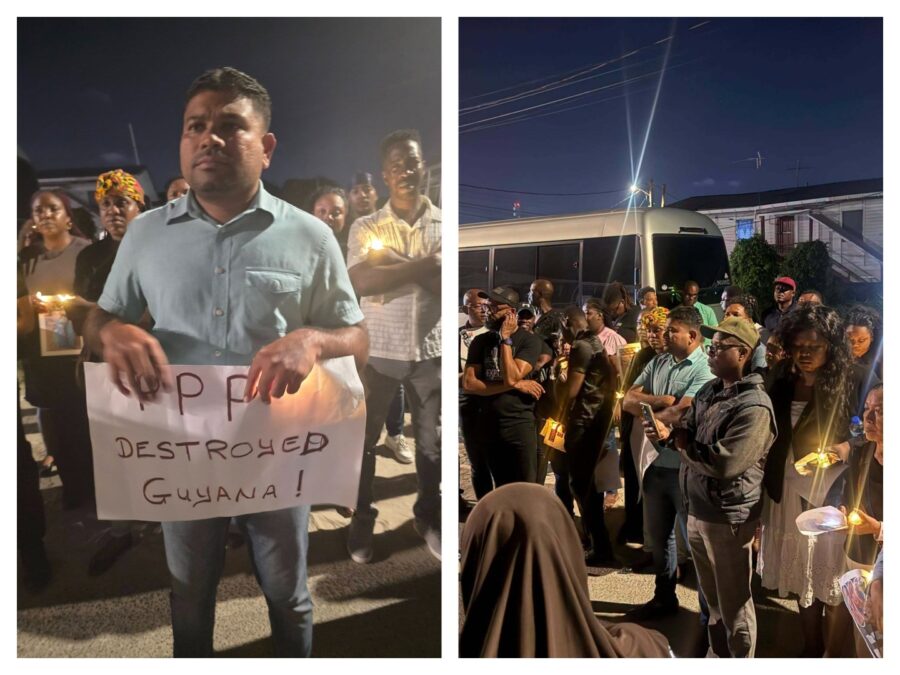
The political fallout from the July 18 MV Barima disaster intensified on Thursday night as opposition parties and civil society groups mounted a prolonged candlelight vigil outside the South Ruimveldt residence of Public Works Minister Juan Edghill, declaring that the campaign to force his removal—and that of Minister within the Ministry of Public Works Deodat Indar—has only just begun.
For hours, the normally quiet neighbourhood echoed with hymns, prayers and chants of “Edghill must go!” and “Indar must go!” as demonstrators, many carrying lit candles, blasted the Government of failing to accept political responsibility for one of Guyana’s worst maritime disasters.
The vigil- more than 100 strong- united an unusually broad coalition of political and civic organisations, including leaders and supporters of We Invest in Nationhood (WIN), A Partnership for National Unity (APNU), the Alliance For Change (AFC), the Vigilant Political Action Committee (VPAC), the Institute for Action Against Discrimination (IFAAD) and other civil society groups, alongside dozens of ordinary Guyanese demanding accountability.
The protest is part of an escalating national campaign following the sinking of the MV Barima, which capsized on July 18 while sailing from Georgetown to Port Kaituma, claiming dozens of lives. The tragedy has raised serious questions about the vessel’s seaworthiness, inspection regime, regulatory oversight and the Government’s management of the country’s maritime transport system.
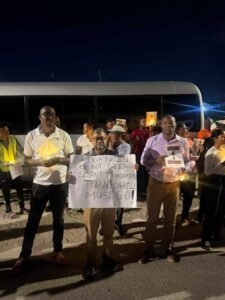
Despite mounting public outrage, the Government has resisted calls to remove Edghill and Indar, instead relying on a partisan-established international Commission of Inquiry to determine what led to the disaster. Those demanding accountability contend that a Commission of Inquiry cannot replace ministerial responsibility, arguing that political leaders must answer for failures within the ministries they oversee.
Addressing the crowd during the vigil, Opposition Leader Azruddin Mohamed vowed that the demonstrations would continue until justice is secured for the victims and their families.
Turning his attention to the Public Works Minister, Mohamed warned that Edghill would have “sleepless nights,” signalling that the protests will remain a constant presence until meaningful action is taken.
The peaceful vigil was briefly disrupted after Edghill reportedly summoned supporters to his residence. Moments later, tensions erupted when one of the minister’s supporters allegedly confronted opposition demonstrators.
Mohamed later identified the individual as Stacey, alleging that she “boxed the hands of a staff” member in the presence of police officers, including Deputy Commissioner Simon McBean and Commander of Regional Division 4A.
The Opposition Leader questioned the police’s response and publicly called on Commissioner of Police Clifton Hicken to uphold the impartiality of the Guyana Police Force.
“Remember your mandate—to serve and protect—and don’t be clouded by loyalty to a political party,” Mohamed said.
Although police remained at the scene, no immediate action was reported against the alleged aggressor, drawing criticism from protesters who questioned whether the law was being applied equally regardless of political affiliation.
Thursday night’s vigil marked the latest in a series of increasingly visible protests outside Parliament, government offices and now the private residence of the minister at the centre of public anger. The expanding coalition of political parties, civil society organisations and ordinary citizens underscores that demands for accountability have broadened beyond partisan politics into a wider national movement.
As candles flickered outside Edghill’s home late into the night, protesters made it clear they were mourning more than the lives lost aboard the MV Barima. They said they were protesting what they view as a Government unwilling to accept responsibility for a preventable national tragedy.
More than two weeks after the disaster, no minister has resigned, no senior public official has been relieved of duty, and the administration continues to insist that the Commission of Inquiry should run its course. For many of those gathered outside the minister’s residence, that response has become the very reason the protests are growing—not fading—with each passing day.