The sinking of the MV Barima did not simply expose the failures of one vessel. It exposed a governing philosophy.
A philosophy that too often accepts mediocrity, tolerates deteriorating public infrastructure, dismisses professional advice, and responds to crises only after lives have been lost.
Guyanese have been told repeatedly that ours is one of the fastest-growing economies in the world. We are reminded almost daily of record oil revenues, historic budgets and transformative development.Yet many citizens are asking an uncomfortable question. Where is it?
Where is the evidence that unprecedented national wealth has translated into world-class public systems? The MV *Barima* tragedy forced the nation to confront what many had quietly accepted for years: critical public services may not be as safe, resilient or professionally managed as we have been led to believe. That realization should concern every Guyanese. It should concern every investor. And it should concern every visitor considering Guyana as a destination.
Tourism Begins Long Before the Rainforest
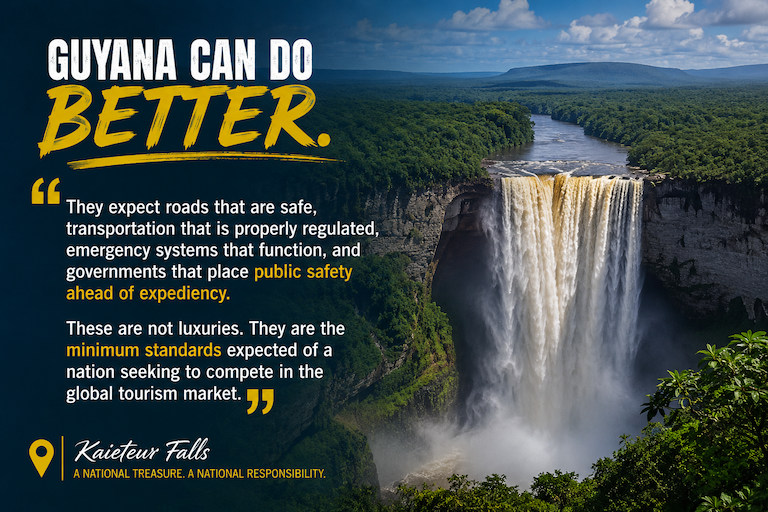
Government advertisements proudly showcase Kaieteur Falls, the Rupununi, the Essequibo River and our pristine rainforest. Those places are extraordinary. Nature has given Guyana a tourism product that few countries can match. But tourists do not judge a destination only by its scenery. They judge it by the entire experience.
It begins when they land at Cheddi Jagan International Airport. They travel roads where poor maintenance, inadequate drainage, wandering livestock and inconsistent traffic management can create unnecessary hazards. They pay premium prices for hotels that often compete with rates in major international cities. They dine at restaurants where the quality and service do not always justify the cost. Then they are asked to place their confidence in the transportation systems that carry them to Guyana’s greatest attractions.
Tourists willingly seek adventure. They do not willingly accept avoidable risk. The country’s eco-tourism brand depends upon confidence that aircraft are properly maintained, vessels are seaworthy, emergency systems function effectively, and regulators enforce standards consistently. Without that confidence, marketing becomes little more than expensive advertising.
The MV Barima disaster has naturally focused attention on maritime safety. But the broader question is unavoidable. If significant weaknesses can exist within one essential public transportation system, are there similar vulnerabilities elsewhere? Citizens have every right to ask whether adequate maintenance, inspections, emergency preparedness and regulatory oversight exist across other sectors, including aviation, road infrastructure, bridges, public buildings and critical utilities.
These are not questions born of cynicism. They are questions born of experience. Public confidence is not restored by asking citizens to stop asking difficult questions. It is restored through transparency, independent investigations and demonstrable improvements.
Professionals Must Be Heard
No nation builds safe infrastructure by sidelining expertise. Engineers identify structural risks. and Marine surveyors evaluate vessel integrity. Pilots understand operational hazards. Inspectors identify safety deficiencies. Emergency planners prepare for the unimaginable before it happens. Professionals exist precisely because optimism is not a substitute for risk management. Too often, however, professional advice appears to become secondary to administrative convenience, political considerations or short-term financial decisions.
Infrastructure does not fail overnight.Failures accumulate one inspection postponed, one maintenance schedule delayed, one procurement shortcut accepted, one warning dismissed at a time. Eventually, systems fail exactly as professionals predicted they would.
Oil wealth has enabled Guyana to spend billions of dollars on roads, bridges, buildings, airports and public facilities. But national development is measured not by contracts awarded. It is measured by assets that perform safely and reliably for decades. Citizens should expect procurement systems that prioritize quality, durability, transparency and value for money. They should expect projects completed to specification. They should expect maintenance to be routine rather than crisis-driven.
When projects require repeated repairs, remain unfinished for years, or fail to meet reasonable public expectations, legitimate questions about planning, execution and oversight naturally follow. Every dollar lost to poor planning or avoidable defects is a dollar unavailable for schools, hospitals, transportation and public safety.
Oil Must Build Institutions, Not Just Infrastructure
History offers a warning. Many resource-rich countries have accumulated wealth without building strong institutions. Roads can be resurfaced. Buildings can be reconstructed. Vehicles can be replaced. Weak institutions are far more difficult to repair. The true measure of Guyana’s oil era will not be the number of construction projects announced. It will be whether oil revenues strengthen the institutions responsible for protecting the public: regulators, inspectors, engineers, emergency responders, procurement authorities and independent oversight bodies. Those institutions determine whether development is sustainable.
The Greatest Risk Is Losing Trust
Confidence, once lost, is difficult to recover. Investors require predictable institutions. Businesses require reliable infrastructure. Tourists require confidence in safety. Citizens require confidence that government places competence above expediency. The MV Barima tragedy has shaken that confidence. Restoring it will require more than condolences. It will require a national commitment to excellence.
Guyana stands at a remarkable moment in its history. We possess extraordinary natural beauty, unprecedented financial resources and enormous economic potential. There is no reason our roads should not reflect international standards. There is no reason our public transportation systems should not inspire confidence. There is no reason professional expertise should ever be treated as an inconvenience.
Oil has given Guyana the resources to build a first-class nation. Whether we become one depends not on the size of our petroleum revenues, but on whether we finally decide that accountability, professionalism and public safety are non-negotiable. The victims of the MV Barima deserve justice. The living deserve something equally important. A country where tragedies expose isolated failures, not systemic ones.