GEORGETOWN, Guyana Former Minister of Public Works David Patterson has called for an independent investigation into the sinking of the MV Barima, arguing that the tragedy raises serious questions about the vessel’s maintenance history, operational oversight, passenger management, and the government’s handling of the country’s aging ferry fleet.
Speaking at a press conference on Wednesday, Patterson extended condolences to the families of those who lost loved ones, expressed support for survivors, and commended those currently engaged in recovery operations.
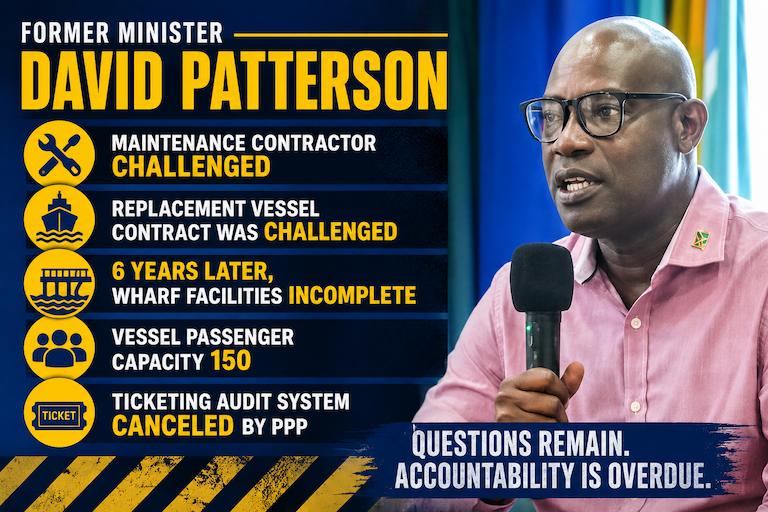
“I wish to address the serious concerns surrounding the MV Barima, its maintenance history, its operation, and the urgent need to protect the travelling public,” Patterson said. Patterson noted that the MV Barima, commissioned in 1939, had served Guyana for decades, particularly on the Northwest route, carrying an estimated 150 passengers and approximately 290 metric tonnes of cargo by design. Given the vessel’s advanced age, he argued that maintenance should never have been viewed as routine administrative work. “For a vessel this age, maintenance is not a routine administrative matter. It is a matter of public safety,” he said.
According to Patterson, previous governments relied on established marine contractors, including GNIC and Courtney Benn Contracting Services, to undertake major repairs. Because replacement structural components often had to be specially fabricated overseas, he said these long-standing relationships ensured access to specialist expertise and technical support required to keep the aging vessel operating safely.
Patterson contended that after the change of government in 2020, those maintenance arrangements were disrupted.
He said contracts previously awarded to Courtney Benn were withdrawn, the company subsequently entered liquidation, and GNIC ceased operations after its dockyard was repossessed by NICIL. According to Patterson, responsibility for maintaining the MV Barima was then transferred to another company whose primary business was fishing. “This is not a personal attack on any contractor,” he stated. “The real issue is whether the critical link to the specialist fabrication, replacement parts, and proven maintenance systems for a vessel of this age was broken.” He argued that this question should be examined by independent maritime experts.
The former minister said records show the MV Barima underwent extensive rehabilitation beginning in November 2015, including the installation of new engines, shafts, hull repairs, and upgrades to passenger and cargo areas before returning to service in March 2017. He further maintained that between 2017 and 2020, the vessel completed its required maintenance cycles and was considered seaworthy during that period. However, Patterson acknowledged that despite those investments, his administration recognized the vessel had a limited remaining service life. He said this prompted the government at the time to pursue financing through the Government of India for a replacement ferry for the Northwest route.
Patterson claimed an independent tender process had selected what his administration considered the most technically suitable replacement vessel. Although the award was challenged by an unsuccessful bidder, he said a subsequent technical review reaffirmed that the original evaluation was correct. According to Patterson, the current administration later reversed that decision and instead awarded the contract to the previously unsuccessful bidder. He argued that the resulting vessel, the MV Malisha, is not properly suited to the Northwest route because of its size and design.
Patterson also criticized the government’s explanation that cost savings from the revised procurement would finance new ferry terminals. “Six years later, those promised facilities remain incomplete,” he said. The former minister also questioned the execution of the Port Kaituma Wharf project, alleging that poor design resulted in costly corrective works. He suggested the project remains unfinished and has since been used as justification for keeping the aging MV Barima in operation.
Patterson questioned whether adequate preliminary engineering studies had been conducted before construction began and whether taxpayers ultimately bore additional costs resulting from design deficiencies. Patterson also raised concerns about passenger accountability and cargo management. He said unauthorized passengers traveling without tickets had long been a challenge but claimed that between 2015 and 2020, the Ministry of Public Infrastructure employed independent inspectors to verify passenger manifests, cargo, fuel, and other operational records.
According to Patterson, that inspection system was later dismantled without an equivalent oversight mechanism being introduced. He argued that maintaining such inspections may have helped prevent unsafe loading practices and other operational failures. Patterson outlined several recommendations, beginning with a full independent review of the MV Barima’s maintenance records, inspection reports, dry docking history, certification documents, and compliance with Guyana’s maritime laws. He also called for every passenger vessel operating in Guyana’s fleet to undergo immediate inspection to verify its seaworthiness and suitability for its assigned route.
Additionally, Patterson urged the government to modernize docking facilities, introduce a secure passenger ticketing system, accelerate the replacement of aging ferries, and upgrade ferry terminals across the country.
“This is not about one vessel,” Patterson concluded. “It is about public safety, accountability, and the rights of citizens in the riverain and hinterland communities to travel with confidence. Our people deserve answers, and they deserve a transportation system that is safe, modern, reliable, and properly managed.”