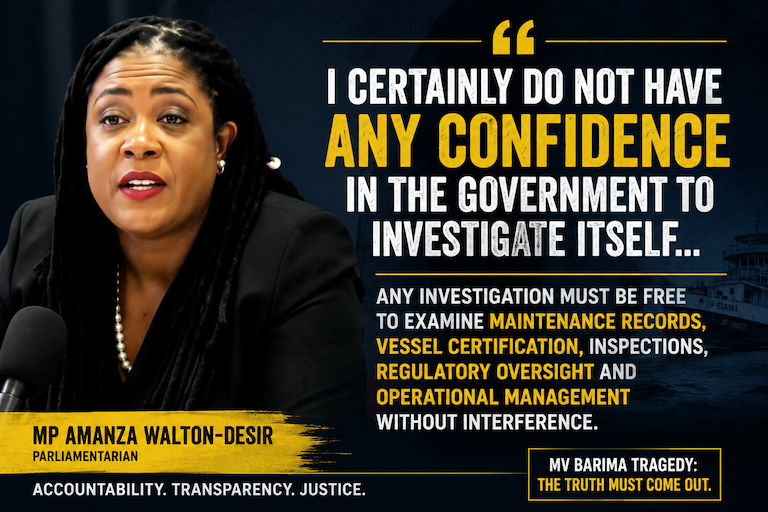
Opposition Parliamentarian Amanza Walton-Desir has called for an immediate, legally mandated, and fully independent investigation into the sinking of the MV Barima, arguing that Guyana’s current institutional framework is inadequate for investigating major transportation disasters and warning that public confidence cannot be restored if the government investigates itself.
Speaking at a press conference, Walton-Desir began by extending sympathy to the families of those who lost loved ones, survivors still coping with trauma, and the many individuals involved in the ongoing recovery effort, including members of the Guyana Coast Guard, the Guyana Defence Force, Transport and Harbours Department staff, fisherfolk, volunteers, and private citizens. She stressed that while the nation continues to mourn, lawmakers have a responsibility to ensure that such a tragedy is never repeated.
“The tragedy demands more than condolences,” Walton-Desir declared. “It demands a fair, independent and capable investigation that can command public confidence.” The parliamentarian argued that Guyana’s rapid economic expansion has significantly outpaced the country’s institutional capacity to regulate and oversee increasingly complex transportation systems. “We are one of the fastest-growing economies in the world,” she said. “Our development has outpaced our institutional capacity, and unless we build institutions equivalent to our growth, more Guyanese will pay with their lives.”
Walton-Desir devoted much of her remarks to explaining what she described as the legal obligations that arise following a serious marine casualty. She said every major maritime accident requires an independent marine safety investigation, emphasizing that such investigations are not primarily intended to assign blame but to establish the facts, determine why the accident occurred, and recommend measures to prevent similar tragedies in the future. According to her, investigators must examine every aspect of the incident, including the vessel’s maintenance history, certification, inspections, operational management, regulatory oversight, and any decisions that contributed to the sinking. She questioned statements made by Prime Minister Brigadier (Ret’d) Mark Phillips during the government’s previous evening press conference, where he repeatedly referred to a Commission of Inquiry.
Walton-Desir argued that it remains unclear what legal mechanism the government intends to invoke. “Is it a Commission of Inquiry under the Commissions of Inquiry Act? Is it the formal investigation provided for under Part 18 of the Guyana Shipping Act? Or is it the marine safety investigation required under the International Maritime Casualty Investigation Code?” she asked. “These are not interchangeable terms. They are separate legal processes with different purposes, different powers and different legal consequences.” She maintained that Guyana, as a signatory to the International Maritime Organization, is legally obligated to conduct a marine safety investigation following a serious maritime casualty and argued that this requirement is mandatory rather than optional. “The government does not have a choice,” Walton-Desir said. “A Commission of Inquiry cannot replace that investigation.” She warned that delays could seriously compromise the integrity of any investigation.
According to Walton-Desir, commissions of inquiry often take considerable time to establish, while critical evidence may disappear, witnesses’ memories fade, and opportunities to determine precisely what occurred may be lost. She said this is why marine safety investigations are required to begin immediately following serious accidents. Expressing frustration with previous official inquiries, Walton-Desir said Guyanese citizens have become weary of repeated promises of comprehensive investigations that ultimately fail to produce satisfactory answers. “We’ve heard enough. We are tired of hearing there will be no stone left unturned. We are tired of hearing there will be full and independent investigations. We’ve watched commissions of inquiry after commissions of inquiry, and we are frankly exhausted.” She called on the government to publicly disclose, before the end of the day, the exact legal framework under which it intends to proceed, identify who will conduct the mandatory marine safety investigation, and explain how investigators will remain functionally independent from the agencies whose actions may themselves come under scrutiny. Marine Accident Investigation Call_otter.ai.txt
Walton-Desir also openly questioned whether the government could objectively investigate an accident involving a state-owned vessel. “I certainly do not have any confidence in the government to investigate itself,” she stated, arguing that any investigation must be free to examine maintenance records, vessel certification, inspections, regulatory oversight and operational management without interference.
Looking beyond the immediate tragedy, Walton-Desir proposed sweeping institutional reforms, urging Parliament to establish an independent Transportation Safety Investigation Board similar to agencies operating in countries such as the United States and Canada. Rather than maintaining separate investigative arrangements for aviation, maritime and future transportation systems, she recommended consolidating these functions under a single statutory authority with permanent investigators, specialized technical expertise and legal powers to secure accident scenes, preserve evidence, obtain operational records, conduct technical examinations and issue independent safety recommendations. Such a body, she argued, would be activated immediately following major transportation accidents instead of relying on temporary, ad hoc investigative arrangements.
Walton-Desir said she had previously recommended the establishment of such an authority while serving in the Ministry of Public Works in the mid-2000s, adding that Guyana’s expanding transportation infrastructure now makes the reform even more urgent. She concluded by warning that the MV Barima tragedy illustrates the consequences of a country whose public investment has outpaced its ability to regulate and protect its citizens.
“Our public expenditure is outpacing the capacity of our institutions to regulate, supervise and protect our public,” she said. “When our institutions fail to keep pace with the development of the country and trillion-dollar budgets, it is the poor and ordinary Guyanese who always bear the cost. And as the MV Barima so very clearly shows us, sometimes we bear that cost with our lives.”