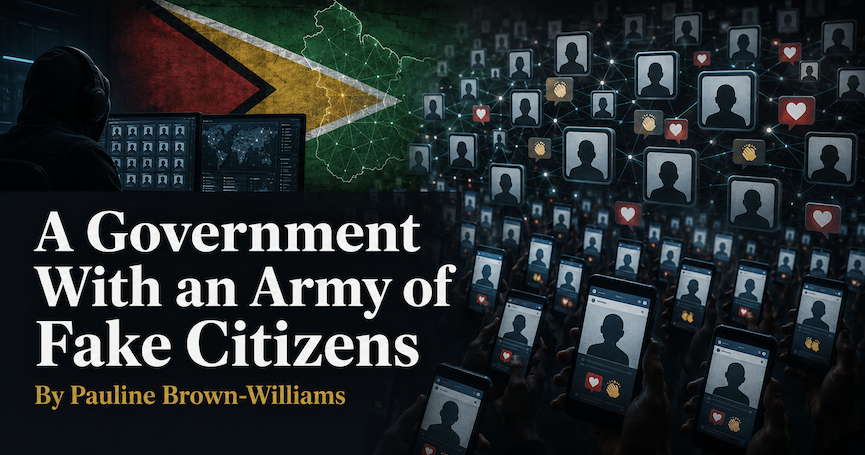
A government confident in its popularity does not need an army of fake citizens. Yet a 90-day monitoring exercise has identified 136 Facebook profiles displaying patterns consistent with coordinated inauthentic behaviour across Guyana’s online political space. These accounts reportedly appear within minutes of posts by President Irfaan Ali, Vice President Bharrat Jagdeo, government ministers, state agencies and media houses. They repeat similar phrases, praise the same officials, attack the same critics and sometimes conduct artificial conversations with one another.
Some carry foreign names while demonstrating an improbable interest in highly specific Guyanese issues. Others use reversed names, unusual spelling or identities resembling those of real Guyanese citizens and public figures.The evidence does not yet establish who created, purchased or manages the accounts. That would require technical information from Meta, including login locations, shared devices, administrators and payment records. But the political beneficiary could hardly be clearer.
The accounts overwhelmingly promote the PPP government. When citizens complain about blackouts, they praise grid modernisation. When families raise concerns about food prices, they celebrate economic growth. When questions emerge about oil, corruption, contracts or unexplained wealth, the accounts redirect the conversation towards highways, house lots and cash grants.
This is not debate. It is displacement. The objective is to bury legitimate complaints beneath an artificial chorus of approval. Since most people read only the first few comments under a post, a small coordinated network can create the impression that the entire country supports the government.
This is the digital equivalent of packing a public meeting with paid supporters and handing them a script. The difference is that one operator may control several online identities and pretend that each represents an independent citizen.
The same network reportedly appears on aggressively partisan pages, including “Live in Guyana,” where criticism gives way to personal attacks and political ridicule. On official pages, the profiles provide praise. On partisan pages, they help to punish critics.
That pattern raises serious questions.Who operates these accounts? Who writes the language they repeat? Are government employees, public-relations contractors or political operatives involved? Are taxpayers indirectly financing a system designed to manufacture support and intimidate dissent?
If the PPP has no connection to this activity, it should be the loudest voice demanding an investigation. The government should ask Meta to examine the accounts and should disclose all contracts involving social-media management, digital communication and online monitoring.
Instead, we hear silence. The PPP already possesses state media, the Department of Public Information, ministerial communication units and enormous public-relations resources. Apparently, even that is insufficient. It wants to publish the announcement, supply the applause, attack the critics and then present the resulting comment section as evidence of national support.
It wants to speak as the government and answer itself as the people. But bots cannot cure political unpopularity. They cannot erase the distance between government propaganda and citizens’ lived experiences. Bots do not stand in grocery lines. They do not experience blackouts, lose crops to floods or wait years for house lots.
Bots do not vote. Real citizens do. But if the government is willing to rig social media communication, how likely are they to rig national elections?