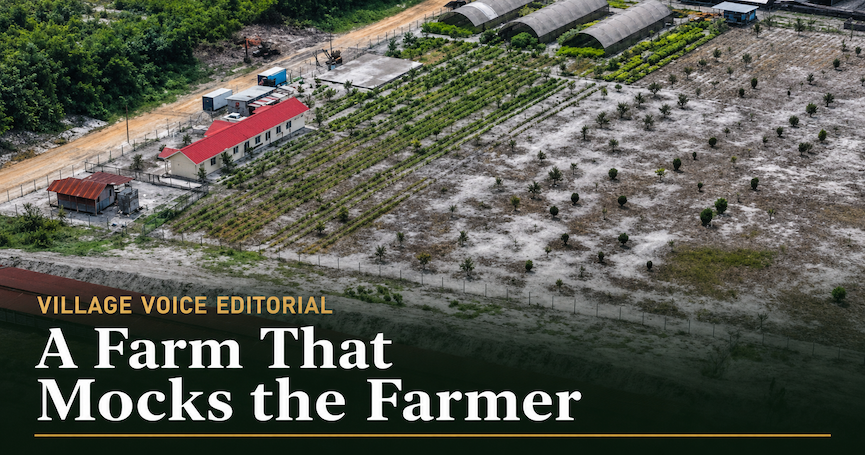
The President has confirmed that he owns the property along the Soesdyke-Linden Highway. He has said that the land was acquired before he entered office, that his involvement in agriculture predates his presidency, and that the purchase and development can be verified through banking and official records. Those explanations should form part of the public record. However, they do not settle the broader questions raised by a sitting President operating an agricultural enterprise on this scale.
Reports and publicly circulated images describe an impressive operation involving cattle, poultry, aquaculture, orchards and cash crops, supported by sophisticated infrastructure and modern agricultural technology. Allegations have also been made about extensive roadworks, drainage, irrigation, machinery and the diversion or modification of waterways. These claims have not all been independently established, which is precisely why disclosure and investigation are necessary.
If everything is legitimate, transparency should be welcomed rather than resisted.
The public deserves to know when the land was acquired, from whom it was acquired, the price paid, the source and terms of financing, the identities of any business partners, and whether any state agencies, contractors, machinery, materials or employees contributed to its development. Guyanese must also be told whether public infrastructure serving the property was constructed principally for the public benefit or to support a private enterprise.
These are reasonable questions. They would be asked of any senior public official presiding over a business with interests closely connected to government policy, public investment and regulatory decisions.
A Farm That Mocks the Farmer
For decades, ordinary Guyanese farmers have struggled with flooded fields, damaged access dams, unreliable drainage, inadequate irrigation, high input costs, limited financing and weak access to markets. They lose crops because trenches are not cleared. They watch livestock die because veterinary assistance is unavailable. They travel on broken dams and muddy trails while begging government agencies for equipment that never arrives.
Many continue farming because it is the only life they know. They borrow money, depend on family labour and gamble each planting season against the weather. One flood, pest outbreak or collapse in market prices can erase years of work. Now, these farmers are being asked to admire the extraordinary agricultural success of the country’s most powerful political officeholder. That is why this farm mocks the farmer.
It presents an image of agricultural possibility without addressing the unequal conditions under which ordinary farmers must operate. It showcases what can be achieved when land, capital, infrastructure, technology and influence are available in abundance. Meanwhile, thousands of farmers remain trapped in a system in which even basic support arrives late, unevenly or according to political connections.
The concern is not that a President farms. Farming is productive work, and Guyana needs more serious agricultural investment. The concern is whether the President’s private enterprise benefits, directly or indirectly, from decisions and resources controlled by the government he leads. That distinction is fundamental.
Who Pays for the Advantage?
If public machinery built or maintained private access roads, the public must know. If government-funded drainage or irrigation works disproportionately benefit the property, the public must know. If livestock, planting materials, technical support, duty concessions, grants or other benefits were obtained through state programmes, the value and eligibility criteria should be disclosed.
The President should also identify the agencies that approved the relevant land use, environmental, water-management, construction, livestock and agricultural arrangements. This is especially important because the President is not an ordinary farmer applying to the state for assistance. He directs the government that establishes agricultural policy, allocates public resources and appoints those responsible for regulating and supporting the sector.
Even if every transaction were lawful, the potential conflict of interest remains obvious. A private farmer must wait for government assistance. A President sits at the centre of the government distributing it. A private farmer must compete for land, financing, concessions and market access. A President exercises immense influence over the policies governing each of those things. That imbalance cannot be dismissed with photographs of crops and livestock or declarations of a lifelong love of farming.
The State Must Not Become the Competitor
There is another danger. A large agricultural enterprise connected to the country’s most powerful political figure can distort the market, particularly if it receives advantages unavailable to ordinary producers. It may have better access to infrastructure, financing, imported inputs, government expertise, transportation and institutional buyers.
Should such an operation begin supplying produce at prices ordinary farmers cannot match, the consequences could be devastating. A private farmer must recover the cost of land preparation, labour, feed, fuel, fertiliser, transportation and loan payments. An enterprise benefiting from publicly supported infrastructure or preferential access would compete from a fundamentally different position. That would not be competition. It would be a rigged game.
No evidence has yet been publicly produced showing that the President’s farm is flooding markets with below-cost produce. But the possibility demonstrates why ownership, financing, public support and commercial relationships must be disclosed before the enterprise grows further. Guyana cannot afford a two-tier agricultural sector, with one tier enjoying political protection and exceptional infrastructure while the other is left to wither in the sun. The farmers cheering today may discover tomorrow that they have been applauding the construction of their most powerful competitor. If they eventually fail, the government may point to the President’s farm as proof that agriculture works, while ignoring the extraordinary advantages that helped to make it work.
Leadership Requires a Higher Standard
President Ali frequently speaks about food security, agricultural modernisation and Guyana’s ambition to become the food basket of the Caribbean. His government has invested heavily in drainage, irrigation, farm roads, livestock development and agricultural technology. That makes full disclosure more important, not less.
The President’s private agricultural interests overlap directly with one of his administration’s major policy areas. Guyanese should therefore be able to examine whether public decisions have created private benefits.
The President should voluntarily publish the acquisition documents, financing arrangements, declared ownership structure, major development costs and a detailed account of any state assistance received. An independent body should determine whether public resources contributed to the farm and whether appropriate conflict-of-interest safeguards were observed.
Transparency would not prevent the President from farming. It would protect public confidence and establish that his private enterprise stands on its own. Until that information is released, the farm will remain more than an agricultural project. It will stand as a symbol of the widening distance between political power and ordinary citizenship.
For the President, agriculture appears to be a modern, well-financed showcase. For thousands of Guyanese farmers, it remains a daily struggle against mud, debt, neglect and uncertainty. That is not an agricultural success story. It is a warning.