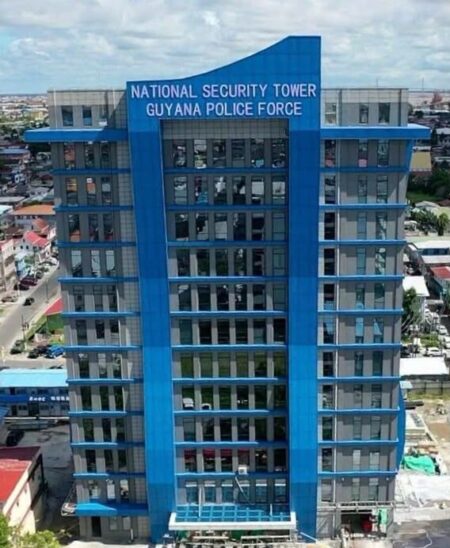
The government’s unveiling of the new National Security Tower at Brickdam as a symbol of a modern Guyana Police Force (GPF) is being met with renewed calls for comprehensive policing reform, with observers arguing that modern law enforcement is defined not by impressive buildings but by well-trained officers, strong institutions, advanced technology and public confidence.
Senior Minister in the Office of the President with Responsibility for Finance, Dr. Ashni Singh, who is performing the functions of Minister of Home Affairs during the absence of Minister Oneidge Walrond, toured the near-completed facility on Tuesday and described it as evidence of President Irfaan Ali’s investment in a technologically equipped, intelligence-driven and citizen-friendly police force.
“Notwithstanding that the genesis of the project lies in the loss of the old Brickdam Police Station by fire, its rebuilding in such an impressive manner was intended to convey an important statement—that our government places the highest importance on ensuring a modern and effective Guyana Police Force (GPF) and one that is committed to and capable of safeguarding the security and safety of the Guyanese people,” Singh said.
The National Security Tower is expected to be commissioned before the end of the year. It replaces the Brickdam Police Station, which was destroyed by fire in October 2021, and will consolidate key operations currently housed at Eve Leary, including Traffic, Finance and Divisional Command offices.
Built of concrete, steel and glass, the high-rise structure features earthquake-resistant engineering, modern fire suppression systems, CCTV surveillance and an expanded communications network.
However, policing specialists, former senior law enforcement officials and governance advocates have consistently maintained that modern policing extends far beyond infrastructure.
They argue that a professional police service is built on properly trained officers, continuous skills development, strict adherence to Standing Orders and internationally accepted policing standards, robust intelligence gathering, advanced forensic capabilities and modern investigative techniques. Equally important, they say, are adequately staffed and equipped research and development units capable of analysing crime trends, evaluating policing strategies and introducing innovation based on evidence rather than reaction.
They further contend that sustained investment in human resources is indispensable. Better salaries, improved conditions of employment, comprehensive life and health insurance, mental health support, modern equipment and opportunities for professional advancement are viewed as essential to attracting and retaining officers capable of responding to increasingly sophisticated criminal networks.
Questions have also been raised about the design philosophy behind the National Security Tower itself. Towering over central Georgetown, the building is among the tallest government structures in the capital. Architects and environmental planners have noted that such a development should also be assessed against Guyana’s commitment to a low-carbon economy, particularly with respect to energy efficiency, natural ventilation, its impact on neighbouring low-rise buildings and whether its design reflects principles of sustainable public infrastructure.
Guyana has positioned itself internationally as a leader in climate action through its Low Carbon Development Strategy, prompting calls for public buildings to embody the same environmental standards the country promotes abroad.
The visit by Dr. Singh coincided with activities marking the 187th anniversary of the Guyana Police Force, with celebrations throughout July including a Fitness Walk, Welfare Day, the Fallen Heroes Wreath-Laying Ceremony, the President’s National Clean-Up Initiative, football and cricket competitions, an awards ceremony, swimming and track and field championships.
While the National Security Tower represents one of the largest investments in police infrastructure in the country’s history, many maintain that the true measure of a modern police force will not be the height of its headquarters, but whether the institution becomes more professional, accountable, better equipped and better trained, with officers who are properly compensated and supported to deliver effective, intelligence-led policing to the people they serve.