Adapted from publication: River of Blood
The Huradaia Massacre , 1964
By Village Voice Staff
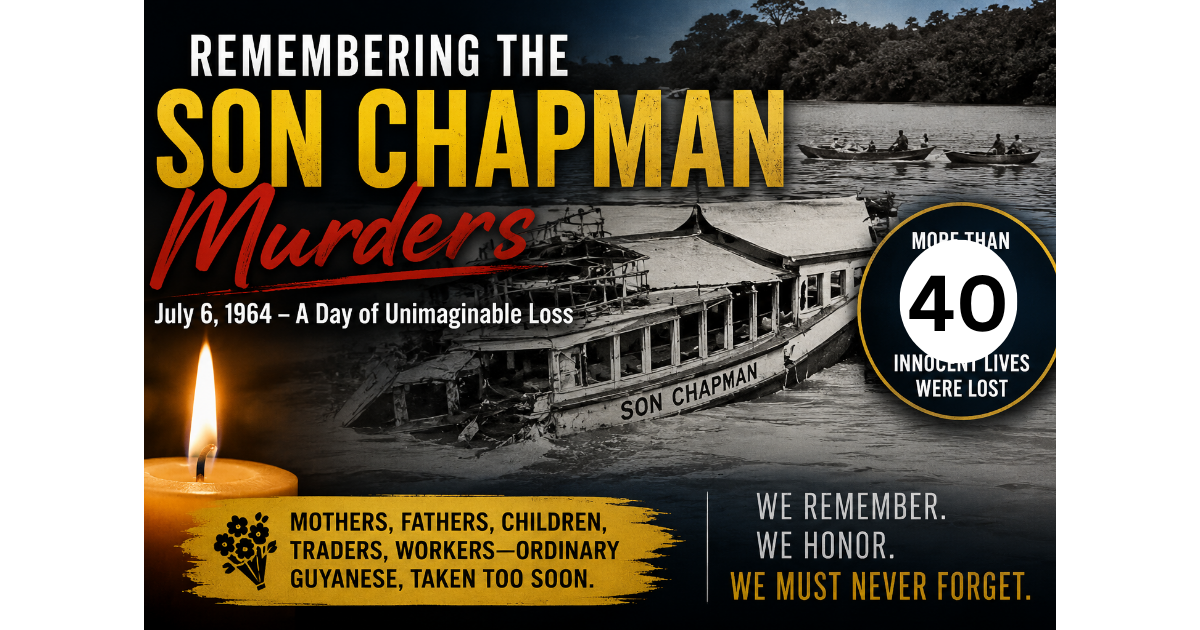
Today, Guyana pauses to remember one of the darkest and most painful days in its modern history. On July 6, 1964, the passenger launch Son Chapman was destroyed by a devastating explosion near Hurudaia on the Demerara River, claiming the lives of dozens of innocent men, women and children.
More than six decades later, the tragedy remains one of the deadliest acts of violence ever committed against civilians in Guyana. It is remembered not only for the horrific loss of life, but also for the lasting scars it left on a nation already gripped by political and ethnic tensions in the years leading to Independence.
The Son Chapman was a vital transportation link between Georgetown and the bauxite town of Mackenzie, now Linden. In an era before the Linden Highway, the launch served as an essential lifeline, carrying passengers, traders and supplies to communities along the Demerara River. On that Monday morning, it departed Georgetown carrying dozens of passengers, many of them hucksters returning home with goods they had purchased in the capital.
At approximately 4:00 p.m., shortly after leaving Hurudaia Landing, a massive explosion ripped through the vessel. Survivors recalled a violent blast that tore open the side of the launch, throwing passengers into the river. Others became trapped as the vessel sank. Rescue efforts began almost immediately, with nearby boats rushing to assist survivors struggling against the powerful currents of the Demerara River.
The human toll was heartbreaking. The victims included mothers, children, traders, workers and crew members. Among them was a heavily pregnant woman whose husband later identified her only by her wedding ring. Many victims were never recovered or could not be positively identified because of the severity of the explosion. Contemporary accounts estimate that more than 50 people were affected, with at least several dozen losing their lives.
The disaster prompted one of the largest recovery operations on the Demerara River. The Demerara Bauxite Company provided equipment, divers and heavy machinery to raise the wreckage from the riverbed. Police launched an extensive investigation, and while several arrests were reportedly made, no one was ultimately held responsible. The coroner’s report did not assign blame.
The tragedy has remained the subject of historical and political debate for decades. Various authors and political figures have interpreted the bombing within the broader context of the violent disturbances that engulfed British Guiana in 1964. The publication River of Blood: The Hurudaia Massacre, 1964 describes the event as a politically motivated act of terrorism and presents one interpretation of the period, while also citing numerous historical works on Guyana’s political conflict.
Whatever one’s view of the political history surrounding those turbulent years, there is little disagreement that the victims aboard the Son Chapman were ordinary Guyanese whose lives ended in unimaginable circumstances. Families lost parents, children, siblings and friends. Entire communities mourned loved ones who never returned home.
As Guyana continues to develop and prosper, anniversaries such as this serve as reminders that national progress must be accompanied by a commitment to peace, respect for human life and the rejection of political violence. The Son Chapman tragedy stands as a solemn chapter in the nation’s history and a reminder of the devastating human cost when conflict overwhelms dialogue.
Today, as wreaths are laid and prayers are offered, Guyanese from every community have an opportunity to honour those who perished, remember the survivors and reaffirm a simple but enduring hope: that such a tragedy should never again be repeated on Guyanese soil.
![Haitians deported from the US land in Cap-Haitien, Haiti, on August 27 [Ketlain Difficile/AP Photo]](https://villagevoicenews.com/wp-content/uploads/2026/09/haiti-750x375.webp)