The opposition A Partnership for National Unity (APNU), which holds 12 of the Opposition’s 29 seats in Guyana’s 13th Parliament, on Friday said the governing People’s Progressive Party/Civic (PPP/C) has systematically weakened one of Parliament’s most important oversight bodies, arguing that changes to the Public Accounts Committee (PAC) have effectively insulated the government from scrutiny of billions of dollars in public spending.
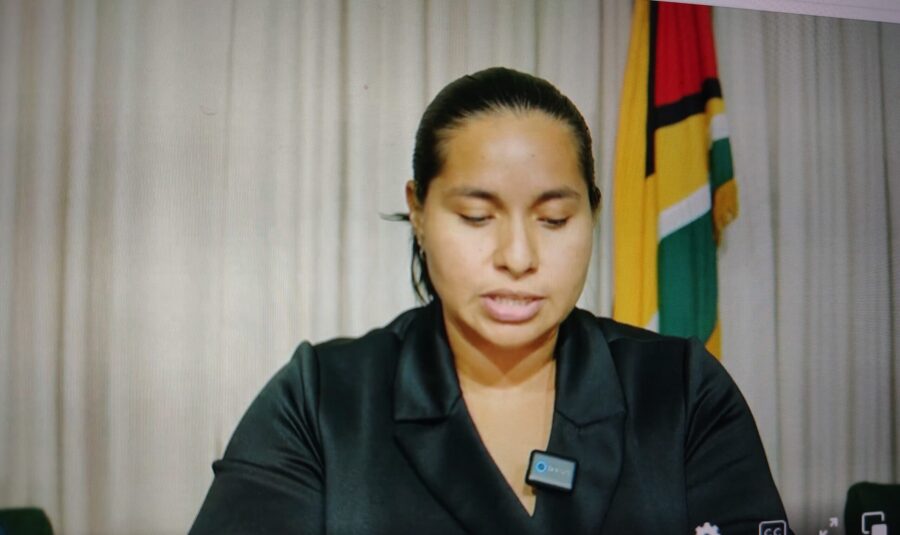
The position was outlined in a statement read by APNU Member of Parliament Juretha Fernandes at a press conference, where she described the government’s handling of the PAC as “an assault on democracy” and urged citizens to defend parliamentary accountability, warning that the committee has been rendered ineffective by rules that allow government members to prevent meetings simply by staying away.
“The A Partnership for National Unity Coalition calls on all right-thinking Guyanese to recognize and resist one of the most serious attacks on parliamentary accountability in our country today: the deliberate weakening and stymying of the Public Accounts Committee of the National Assembly,” Fernandes read from the coalition’s statement.
The PAC is one of Parliament’s principal accountability mechanisms. It examines the Auditor General’s reports, scrutinises government expenditure, reviews the use of taxpayers’ money and exercises oversight over matters involving the Public Procurement Commission. Article 223 of the Constitution guarantees the independence of the Auditor General, whose reports are intended to form the basis of the committee’s work.
Fernandes said the committee’s effectiveness was fundamentally altered in April 2022 when the PPP/C used its parliamentary majority to amend Standing Order No. 82.
Before the amendment, Standing Order 95(6) permitted the PAC to conduct business with a quorum of three members, including the Chairperson. The revised rule now requires five members—two government representatives, two opposition representatives and the Chairperson.
According to Fernandes, the amendment handed the Executive an effective veto over parliamentary oversight by enabling government members to block meetings through their absence.
“The effect is clear. By refusing or not attending PAC meetings, Government members can now prevent the Committee from meeting. This gives the very Government whose spending must be scrutinized an effective veto over when, whether, and how quickly that examination takes place,” she said.
Fernandes maintained that the consequence has been years of unexamined public expenditure.
“As a result, the government spending for 2020 to 2024 has not yet been examined. This is not accountability. This is obstruction and the facilitation of incompetence, the waste of taxpayers’ money, and corruption,” she said.
She recalled that when the quorum amendment was passed on April 13, 2022, the then APNU+AFC Opposition protested inside and outside the National Assembly, warning that the changes would ultimately paralyse the committee.
“Today we are reaping the negative consequences of that silence on the change in the requirements for a quorum of the PAC, the lack of transparency and accountability and the wanton waste of taxpayers’ money through corruption and incompetence,” Fernandes said.
She further contended that repeated attempts by the PAC Chairman to convene meetings to examine outstanding Auditor General’s reports have been frustrated because government members advised they would not attend, thereby denying the committee the quorum needed to conduct business.
Fernandes said the government’s conduct contradicts the principles of democratic governance.
“A government confident in its management of public funds should welcome scrutiny. A government committed to democracy should attend PAC meetings. A government that respects citizens should not hide from the people’s questions. Clearly, the PPP/C Government does not believe in transparency and accountability,” she said.
The coalition is demanding the immediate resumption of regular PAC meetings, full attendance by government members, an accelerated timetable to clear the backlog of Auditor General’s reports, and urgent reform of the quorum rules to prevent either side from using non-attendance to frustrate parliamentary oversight.
Fernandes also appealed to trade unions, civil society organisations, faith leaders, professional bodies, youth groups, the private sector and ordinary citizens to pressure the government to restore the PAC’s effectiveness.
Posing a direct challenge to the administration, she asked: “What is the PPP/C trying to hide?”
Fernandes urged citizens to question PPP/C Members of Parliament about why the Public Accounts Committee is not functioning effectively and why government representatives are not attending meetings to examine the use of public funds.
“The message must be simple and united: Let the PAC work. Let the audited accounts be examined. Let the people know how their money is being spent,” she said.
Maintaining that the issue transcends party politics, Fernandes argued that it strikes at the heart of constitutional governance.
“Guyana cannot be democratic and survive if accountability is optional. The Public Accounts Committee must function, and the Government must answer to the people for its use of taxpayers’ money,” she declared.