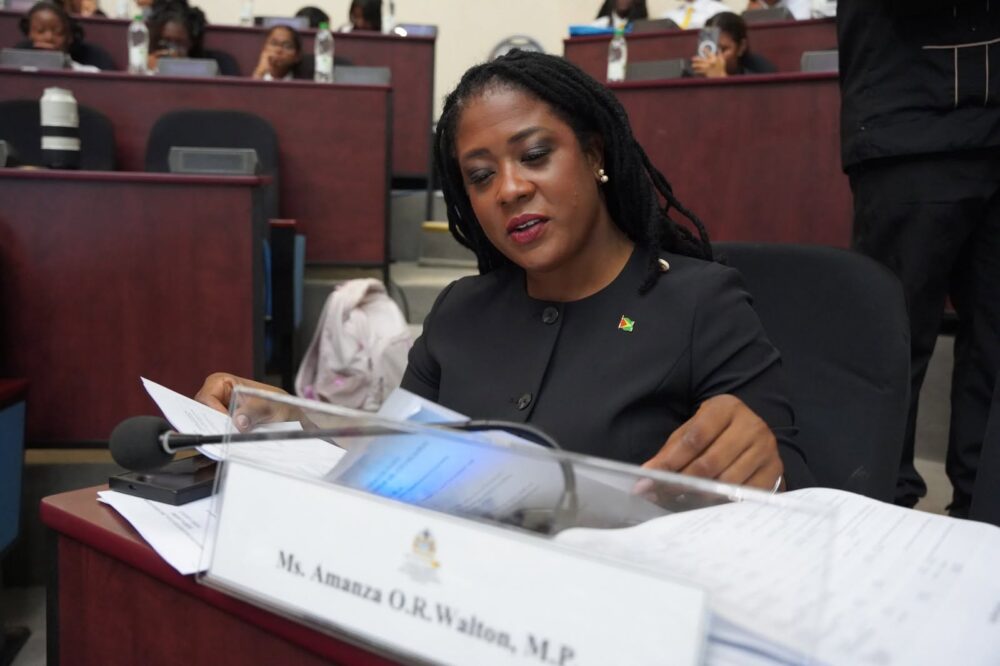
Leader of the Forward Guyana Movement (FGM) and the party’s lone Member of Parliament, Amanza Walton-Desir, is calling for the full functioning of Guyana’s Parliament, saying the government’s commitment to parliamentarism should be measured not by its international rhetoric but by its willingness to uphold accountability at home.
In a statement marking International Day of Parliamentarism, Walton-Desir said this year’s observance, themed by the Inter-Parliamentary Union (IPU) around putting human rights “back on the frontline,” serves as a reminder that Parliament is “the voice of the people and the guardian of justice and accountability.”
“Parliament is not where politicians exercise power. It is where the people exercise power through their elected representatives,” she stated.
Walton-Desir argued that Parliament must be more than a symbolic institution, saying it must sit regularly, debate legislation, ask questions of ministers, establish and operate its committees, scrutinise public expenditure and hold the Executive accountable.
“That is why a Parliament must do more than simply exist. It must sit regularly. It must ask questions. It must debate legislation. It must constitute its committees. It must scrutinise public expenditure. It must hold the Executive to account,” she said.
The FGM leader said delays in the functioning of parliamentary committees, particularly the Public Accounts Committee (PAC), have weakened parliamentary oversight.
“When Parliament does not sit, accountability is delayed. When committees are not established or cannot function, accountability is weakened. When the Public Accounts Committee cannot meet, the people’s representatives cannot examine whether billions of dollars of public money were spent as Parliament authorised,” Walton-Desir said.
She added that “this month four proposed dates for the committee’s inaugural session were offered, and all four were declined by the government benches.”
According to Walton-Desir, these delays are not simply procedural matters but constitutional safeguards intended to ensure transparency in government.
“These are not procedural inconveniences. They are constitutional safeguards. Every sitting of Parliament, every committee meeting, every question answered by a minister, and every Auditor General’s report examined is another opportunity for the people’s business to be conducted in the open,” she stated.
The Public Accounts Committee, traditionally chaired by a member of the parliamentary opposition, is one of the National Assembly’s principal oversight bodies. It examines the Auditor General’s reports and reviews whether billions of dollars in public funds have been spent in accordance with parliamentary approval. When the committee is unable to meet, parliamentary scrutiny of government expenditure is delayed, weakening one of the Constitution’s primary checks on the Executive.
Walton-Desir also questioned what she described as a disconnect between the government’s international advocacy for parliamentary democracy and its domestic record.
“This government is fluent in the language of parliamentarism on the international stage. Its representatives sit at Inter-Parliamentary Union assemblies and Commonwealth Parliamentary Association forums, where they speak comfortably about the rule of law, transparency and institutional strength. That fluency has not made its way home,” she said.
“The same government whose officials are at ease in those rooms abroad is the one whose benches will not show up to seat their own Public Accounts Committee. A government cannot credibly champion parliamentarism overseas while starving it in Georgetown. The contradiction is not a matter of perception. It is a matter of attendance.”
Calling for immediate action, Walton-Desir said the true test of International Day of Parliamentarism is whether governments allow Parliament to perform its constitutional role.
“The test of this day is not what we say about Parliament. It is whether the government is prepared to let it function. That means seating the Public Accounts Committee without further delay, attending the sessions it has already evaded, and allowing every committee of this Parliament to do the work the Constitution assigns it.”
She added that “anything less is a choice to keep accountability out of reach, made by a government that knows exactly what parliamentarism requires because it practises it everywhere except at home.”
The statement comes amid continued concern over the pace of parliamentary business in Guyana’s 13th Parliament. Before the National Assembly convened on June 5, it had not met since February 14, when the government used its parliamentary majority to pass the $1.558 trillion 2026 National Budget, leaving Parliament dormant for more than 100 days.
Opposition parties, civil society organisations and members of the diplomatic community had repeatedly called for the Assembly to reconvene and for key parliamentary oversight committees to become fully operational, arguing that prolonged interruptions weaken parliamentary scrutiny and democratic accountability.
Last month Walton-Desir wrote to the Inter-Parliamentary Union, the Commonwealth Parliamentary Association, CARICOM, the Organisation of American States, and members of the ABCEU diplomatic community, raising concerns about parliamentary oversight and the delayed functioning of key committees.