Dear Editor,
Since James Bond was selected to represent the PPP/C in the National Assembly, one explanation has been repeated to justify his rapid advancement: Bond worked hard during the 2025 campaign and helped the PPP/C “deliver Region Four.”
That explanation should be examined carefully, particularly by the people who have spent decades working for the PPP/C without receiving similar recognition.
In the 2025 general election, the PPP/C obtained 87,536 votes in District Four. APNU received 46,956, WIN received 41,607, the Forward Guyana Movement obtained 2,431, and the Alliance For Change received 1,765.
Collectively, APNU, WIN, FGM and the AFC received 92,759 votes. That is 5,223 more than the PPP/C.
This does not mean all those voters would have supported APNU had the smaller parties not contested. Voters are not owned by political parties, and many may have chosen to abstain or support the PPP/C instead. However, the numbers do establish something important: the PPP/C did not obtain a majority of the votes cast among these parties in Region Four. It finished first because the opposition vote was divided.
The regional council results make the same point even more clearly.
The PPP/C won 17 seats on the Region Four Regional Democratic Council. APNU obtained nine, WIN secured eight and FGM received one. The three parties outside the PPP/C therefore controlled 18 seats collectively, one more than the PPP/C.
Yet the PPP/C secured both the chairmanship and vice-chairmanship because the opposition parties did not unite behind common candidates. During the vote for chairman, the PPP/C candidate received 18 votes, while the APNU candidate received eight. Seven ballots were left blank and two were spoiled.
The PPP/C did not take control of the council because it held an outright majority. It took control because the parties with the collective majority failed to cooperate.
Therefore, when people claim that James Bond “delivered Region Four,” the obvious question is: what exactly did he personally deliver?
Which communities did he convert?
Which polling divisions moved to the PPP/C because of his involvement?
How many voters said that James Bond persuaded them to support the party?
Was any polling or constituency analysis conducted to measure his individual contribution?
Bond may have worked during the campaign. He may also have persuaded some voters. But participating in a successful campaign is not the same as personally producing the result. The publicly available figures show that opposition fragmentation played a decisive role in the PPP/C finishing ahead in Region Four.
The greatest assistance the PPP/C received in Region Four did not come from one recent crossover. It came from a divided opposition.
This raises a larger question for Vice President Bharrat Jagdeo in his capacity as General Secretary of the PPP.
What did James Bond bring to the party that justified his immediate elevation to Parliament ahead of people who had served the PPP/C for decades?
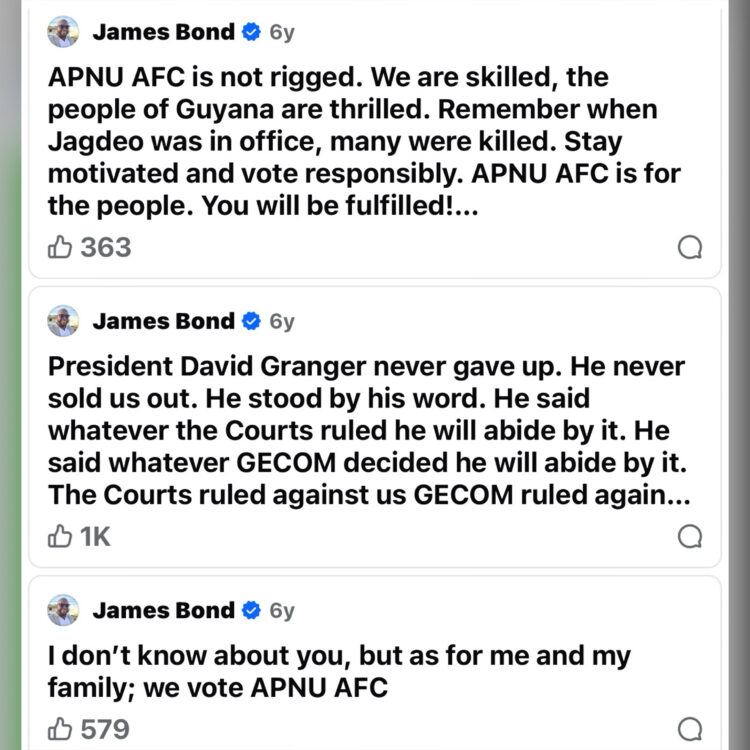
Bond did not spend his political life building the PPP. He spent years campaigning against it and publicly accusing its leadership of corruption, favouritism, money laundering and mismanagement. His criticisms were aimed particularly at Mr. Jagdeo and the record of the PPP/C under his presidency.
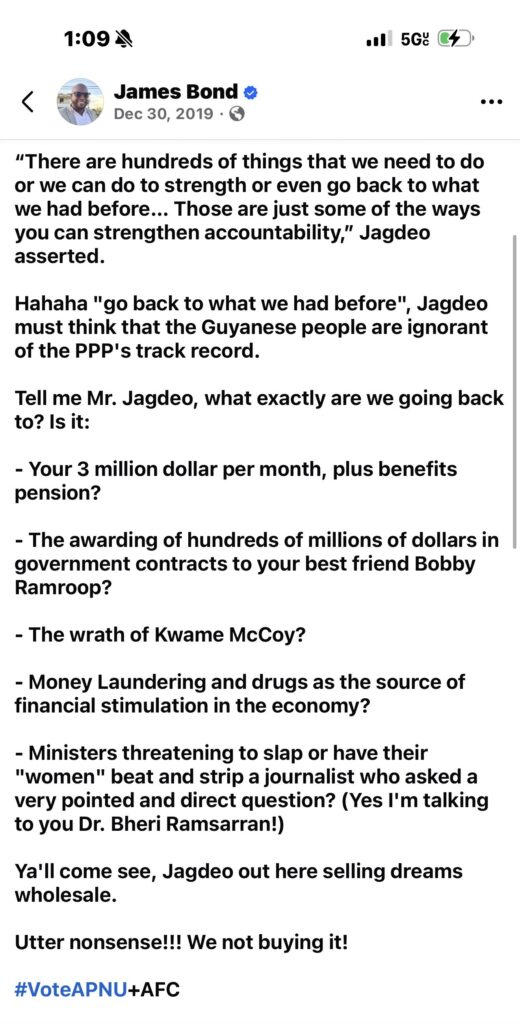
In December 2019, Bond mocked Jagdeo’s proposed anti-corruption measures and asked Guyanese whether returning to what existed before meant questionable government contracts, political misconduct, money laundering and drugs within the economy. He concluded that Jagdeo was “selling dreams wholesale” and urged Guyanese not to support the PPP/C.
By January 2025, Bond had endorsed President Irfaan Ali for a second term.
At the time, Mr. Jagdeo publicly stated that Bond had not been promised money, contracts or any other reward in return for his endorsement. Yet before the end of that same year, President Ali selected Bond as one of the PPP/C’s parliamentarians.
The issue is not that Bond changed his political position. He has a constitutional right to support whichever party he chooses. People can reconsider their political beliefs, leave one party and join another.
The issue is the speed with which he was elevated and what that decision communicates to longstanding PPP members.
Many PPP supporters spent years organising at the community level. They defended the party when it was in opposition, worked during elections, mobilised voters, attended meetings and stood behind its leadership through political controversy. Some have given decades of service without being selected for Parliament.
Bond, by comparison, publicly endorsed President Ali in January and was selected for Parliament later that year.
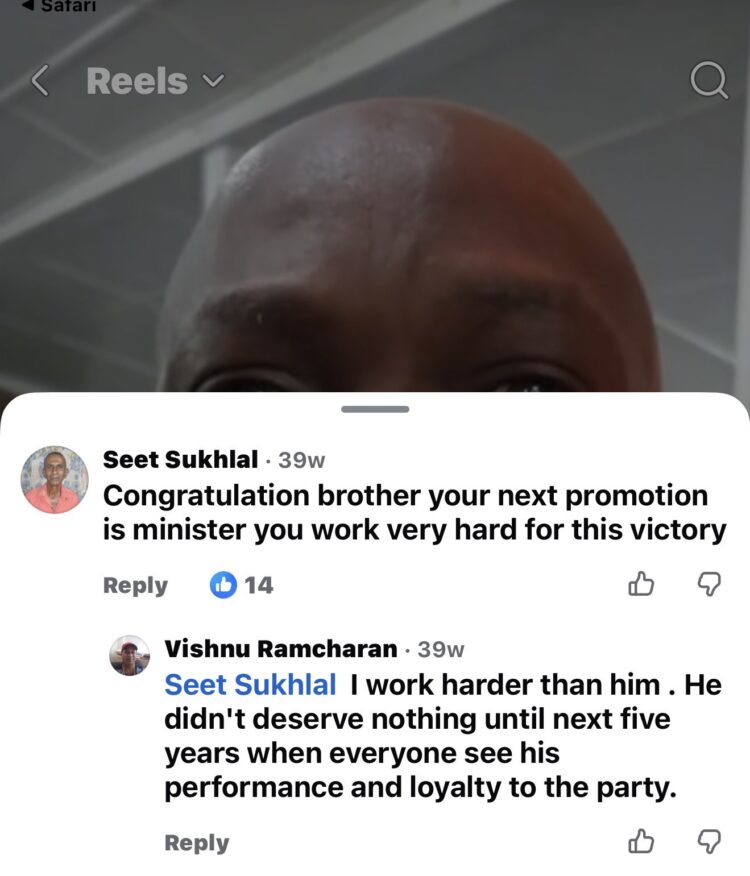
One comment posted when his parliamentary selection was announced captured the concern plainly. The commenter stated that he had worked harder than Bond and believed Bond should have first spent several years proving his performance and loyalty to the party.
That sentiment deserves more than dismissal as jealousy or bitterness. It raises a legitimate internal question about the value the PPP places on loyalty.
Did President Ali consult the party leadership before selecting Bond?
Did Mr. Jagdeo support placing him in Parliament so soon?
What objective criteria were used?
What did Bond achieve that longstanding organisers did not?
Was he rewarded because measurable evidence showed that he converted significant numbers of voters, or because the public spectacle of a prominent former PNC figure joining the PPP/C was politically useful?
The answers matter because political parties cannot continuously demand loyalty while giving their most visible rewards to people who became loyal only when the party was already in government.
If a person can spend years condemning the PPP, join shortly before an election and quickly enter Parliament, what message does that send to members who remained committed when there were fewer contracts, appointments and opportunities available?
It suggests that loyalty may be praised publicly but political usefulness is rewarded more generously.
The PPP/C is entitled to broaden its support and welcome people from other political traditions. Guyana needs fewer rigid political divisions, not more. But inclusion should not require erasing the contributions of the people who built and sustained the party.
Nor should a recent crossover be credited with an electoral achievement that the numbers more convincingly attribute to opposition fragmentation.
James Bond may have contributed to the PPP/C campaign. What has not been demonstrated is that he personally delivered Region Four or accomplished something so exceptional that he deserved immediate elevation over longstanding members.
Vice President Jagdeo and President Ali should explain that decision to their own supporters.
The question is no longer simply what James Bond brought to the PPP/C.
It is what the PPP/C’s decision to reward him says to everyone who was already there.
Yours truly,
Nakisha Sinclair
Writer, Researcher & Social Policy Advocate